1) Take the test. If you're struggling, come back to the directions and formulae. Give it your best shot, but keep moving through the questions.
2) Some questions allow you to show your work. For these, just type what steps you took to get your answer. I may be able to give you partial credit if some of your steps are correct. You do NOT have to show your work.
3) Check your answers. Pay careful attention that you gave what the question was asking for. Check formatting especially.
4) Submit the test. Let me know if GoGuardian blocks you.
5) Close your Chromebook. Read, draw, or work on paper schoolwork quietly.
Desmos - Graphing
Desmos - Scientific Calculator
Mean and Standard Deviation Calculator.
\sigma = standard deviation (SD)
N = size of the data (number of values)
\mu = mean
x_{i} = data value
z = z-score
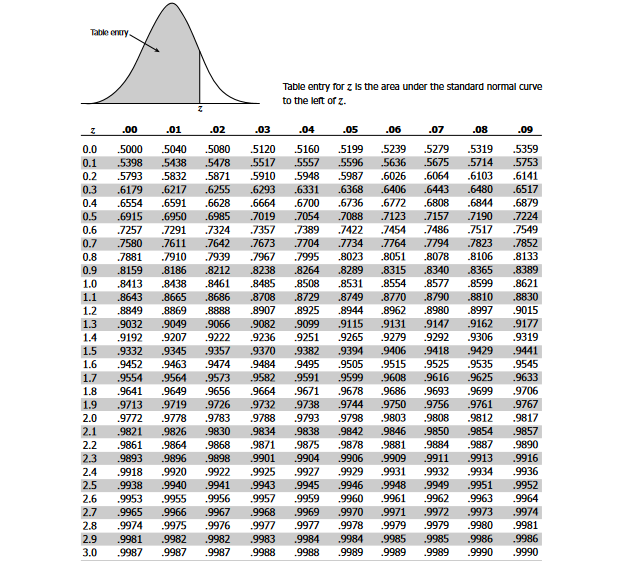
z = \frac{x-\mu}{\sigma}
margin of error (MOE) = \frac{2\sigma}{\sqrt{N}}
Hints:
- draw your bell curves and shade the big side
- for finding %s from the z-table, make sure you keep track of whether the question is comparing the data value to the population, or the population to the data value
- "or" should involve 3 numbers/subgroups; "and" should involve 1
- "given" = "|" = "out of", and this changes your denominator
Directions:
0) Make sure you've turned in your study guide.
On your desk - paper, pencil, calculator
On your browser - this test, Desmos links below.
In your backpack - phones, electronics, notes.
1) Take the test. If you're struggling, come back to the directions and formulae. Give it your best shot, but keep moving through the questions.
2) Some questions allow you to show your work. For these, just type what steps you took to get your answer. I may be able to give you partial credit if some of your steps are correct. You do NOT have to show your work.
3) Check your answers. Pay careful attention that you gave what the question was asking for. Check formatting especially.
4) Submit the test. Let me know if GoGuardian blocks you.
5) Close your Chromebook. Read, draw, or work on paper schoolwork quietly.
Desmos - Graphing
Desmos - Scientific Calculator
Mean and Standard Deviation Calculator.
\sigma = standard deviation (SD)
N = size of the data (number of values)
\mu = mean
x_{i} = data value
z = z-score
z = \frac{x-\mu}{\sigma}
margin of error (MOE) = \frac{2\sigma}{\sqrt{N}}
Hints:
- draw your bell curves and shade the big side
- for finding %s from the z-table, make sure you keep track of whether the question is comparing the data value to the population, or the population to the data value
- "or" should involve 3 numbers/subgroups; "and" should involve 1
- "given" = "|" = "out of", and this changes your denominator
1 point
1
Question 1
1.
A student measures which method of taking notes improves his grades more, using a computer or a pencil and paper. What type of study is described?
1 point
1
Question 2
2.
The Hook TV crew polls randomly-selected students in the school to see their favorite music genre. What type of study is this?
1 point
1
Question 3
3.
The Stats Club wants to know which the school prefers - bringing their lunch or taking the cafeteria lunch. They plan to use a sample survey to gather data. Which of these sampling methods introduce significant bias?
Check four options.
(If you are unsure, you can get partial credit by only answering the 2 or 3 that you are sure about)
1 point
1
Question 4
4.
Categorize each trait according to the type of data collection method.
involve direct interaction between the analyst and the thing being studied
can be tainted with bias unless carefully designed
can have nonhuman samples
gets more accurate results with larger samples
does not generate new data, only collects data that is already there
both surveys and experiments
both surveys and observational studies
both experiments and observational studies
all methods
1 point
1
Question 5
5.
A data set is normally distributed with a mean of 27 and SD of 3.5.
Find the z-score for a value of 25 to the nearest hundredth.
1 point
1
Question 6
6.
A data set is normally distributed with a mean of 27 and SD of 3.5.
What percent of the data is greater than 34?
0 points
0
Question 7
7.
The mean on the statewide geography test was 74, with a standard deviation of 12. West County sampled the scores of some of its students and reported a mean of 79 with a margin of error of \pm 1.9.
To the nearest whole number, how many students were in West County's sample?
1 point
1
Question 8
8.
The mean on the statewide geography test was 74, with a standard deviation of 12. West County sampled the scores of some of its students and reported a mean of 79 with a margin of error of \pm 1.9
What is the maximum reasonable mean for West County's sample? (Hint: think confidence interval)
Enter a number rounded to one decimal place.
1 point
1
Question 9
9.
Match the study description to the type of study
Draggable item
arrow_right_alt
Corresponding Item
A fund manager studies whether the values of her clients' investments increase, decrease, or stay the same based on applying her normal investment strategy or using a more agressive strategy.
arrow_right_alt
experiment
An investment company polls randomly selected business students about which industry they would invest their money in.
arrow_right_alt
sample survey
A firm tests how much attention their website gets using a less formal desgn. An intern determines the number of times each visitor stays on the site.
arrow_right_alt
observational
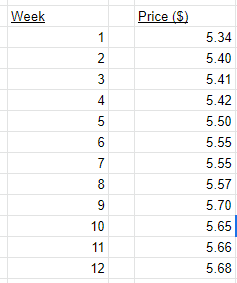
The table below shows the closing price of a certain stock for the first 12 weeks of last year.
1 point
1
Question 10
10.
Find the mean stock price.
Enter your answer as a number rounded to two decimal places.
1 point
1
Question 11
11.
The standard deviation for the data is 0.12. Calculate the z-score for a price of 5.65.
Enter your answer as a number rounded to two decimal places. The number should be between -3 and 3.
1 point
1
Question 12
12.
Based on this z-score, what percent of prices were below 5.65?
Think about whether you expect more or less prices to be below 5.65
Enter your answer as a number rounded to the nearest hundredth.
1 point
1
Question 13
13.
In Lincoln High, 3% of students are in orchestra (including some also in band), 5% are in band (including some also in orchestra), and 1% are in both. If a student is selected at random, what is the probability that the student is in orchestra or band?
1 point
1
Question 14
14.
In a survey of students, 60% were in high school and 40% were in middle school. Of the high school students, 30% had travelled abroad. If a student is selected at random, what is the probability that the student is in high school and has visited a foreign country?
(Hint: Pretend there are 100 people in the school).
1 point
1
Question 15
15.
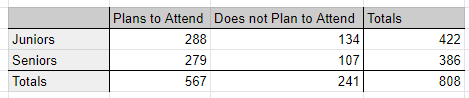
A sample of juniors and seniors were asked if they plan to attend college.
One surveyed student is selected at random. Select all that apply. Percents are rounded to the nearest whole percent.
A company is trying to reduce the cost of producing one of its tools. It comes up with a cheaper, new production method. A sample of old and new tools is tested, and the results are shown in the table below.
1 point
1
Question 16
16.
What is the probability (%) that a tool randomly selected from the sample is defective given that the tool was produced by the new method?
Give your answer as a number rounded to two decimal places.
1 point
1
Question 17
17.
What is P(new | defective) - P(defective | new) in %?
Give your answer as a number rounded to two decimal places.
1 point
1
Question 18
18.
Are the events "defective tool" and "new method tool" independent?
1 point
1
Question 19
19.
Should the company use the new or old method to produce the tools? Justify your answer.
1 point
1
Question 20
20.
If a tool from the sample is selected at random, what is the probability that it was made from the old method and is defective, as a percent?
Enter your answer as a number to 2 places.
1 point
1
Question 21
21.
If a tool from the sample is selected at random, what is the probability that it was made from the old method or is defective, as a percent?
Enter your answer as a number rounded to 1 decimal place.
1 point
1
Question 22
22.
Give an example of a real-world situation that involves conditional probability. Include what two events are involved and how you expect the conditional probability to work (does one event make the other more likely, or less likely?).
Do not use situations found on this test.
Write your answer in standard English sentences. You will receive points for each of the two parts asked for.
1 point
1
Question 23
23.
Give an example of a (different) real-world situation that involves conditional probability. Include what two events are involved and how you expect the conditional probability to work (does one event make the other more likely, or less likely?).
Do not use situations found on this test.
Write your answer in standard English sentences. You will receive points for each of the two parts asked for.