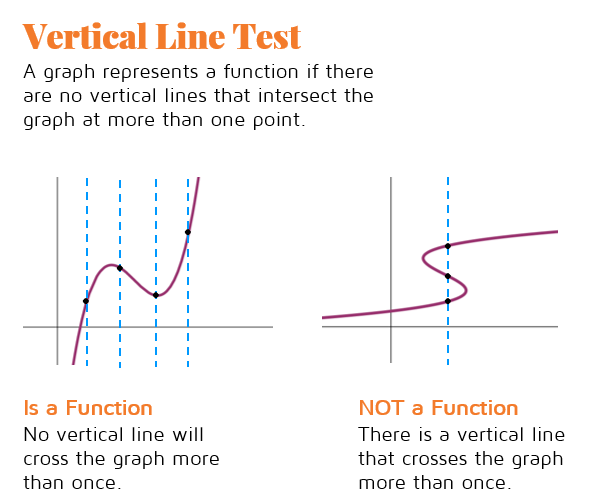
A function is a relationship where an input has exactly one output.
To determine whether or not a graph is a function, we do the vertical line test.
Imagine a vertical line being drawn in the graph. If the vertical line touches the graph at only one point, then it is referred as function. If the vertical line touches more than one point, then it is not a function.
Does the set of ordered pairs represent a function?
(10, 9), (–2, –16), (–6, 7), (5, 8), (8, –16), (–11, 9)
Why or why not?
Does the set of ordered pairs represent a function?
(–7, 4), (–8, 3), (–7, 7), (–20, 8), (5, 9), (3, 1), (2, 6)
Why or why not?
Does the set of ordered pairs represent a function?
(–13, 4), (7, –15), (–13, 9), (6, –12), (–18, 0)
Why or why not?
Does the set of ordered pairs represent a function?
(15, –3), (–6, 9), (–3, 0), (–1, 16)
Why or why not?
Does the set of ordered pairs represent a function?
(–4, 3), (5, –9), (11, 4), (9, 6), (5, –3), (8, –9), (1, 4)
Why or why not?
Does the set of ordered pairs represent a function?
(12, –18), (15, 1), (12, 5), (0, 9), (–5, –17)
Why or why not?
Does the set of ordered pairs represent a function?
(6, 0), (–12, –16), (–6, 10), (20, –7), (6, 0)
Why or why not?
Does the set of ordered pairs represent a function?
(–2, –4), (–8, 3), (–7, –4), (–2, –8), (11, 8), (9, –4)
Why or why not?
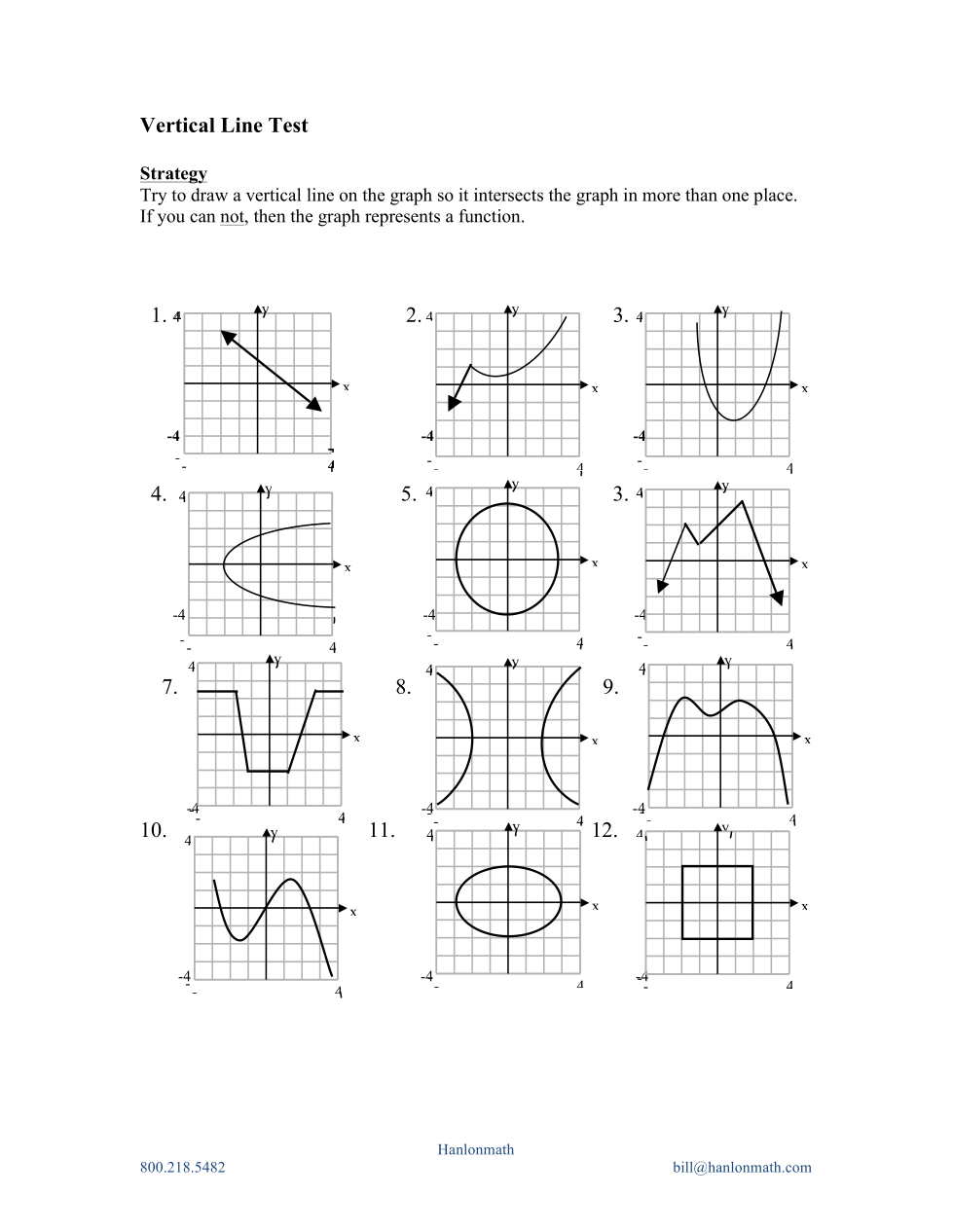
This graph is a function (show your work using the Vertical Line Test).
This graph is a function (show your work using the Vertical Line Test).
This graph is a function (show your work using the Vertical Line Test).
This graph is a function (show your work using the Vertical Line Test).
This graph is a function (show your work using the Vertical Line Test).
This graph is a function (show your work using the Vertical Line Test).
This graph is a function (show your work using the Vertical Line Test).
This graph is a function (show your work using the Vertical Line Test).
This graph is a function (show your work using the Vertical Line Test).
This graph is a function (show your work using the Vertical Line Test).
This graph is a function (show your work using the Vertical Line Test).