LW: Flex 2 (3/10) Version B
star
star
star
star
star
Last updated about 3 years ago
7 Nsɛmmisa

0

0
0
0
0
2
2
Describe each of the light interactions shown below.
A first year biology student wants to use a special artificial light to help their plants grow. Analyze the light interactions below and help them pick the best type of light!
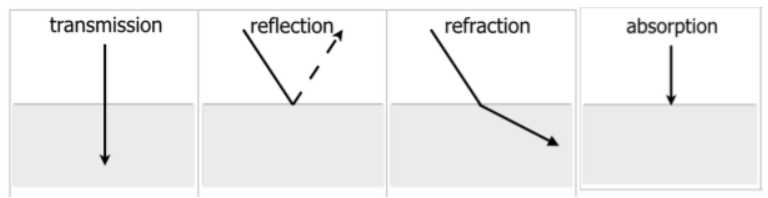
Which light interaction is more likely to cause the plant to help the plant grow taller?
CFS:
Accurately identifies the differences in light sources
Accurately describes the relationship between wave properties and outcomes
"I think that the light interaction (transmission, reflection, refraction, absorption) is most likely to cause the plant to grow. This is because .... "
(Think: Which is the only type of light interaction that can cause any change?)
What evidence do you have transmitted light will not help the plant grow any taller?
CFS:
Accurately identifies the differences in light sources
Accurately describes the relationship between wave properties and outcomes
"I think that the transmitted light is not likely to cause the plant to grow. This is because .... "
(Think: Which is the only type of light interaction that can cause any change?)
You are on a team that is developing a game about people in outer space. You are using a computer program to create the sounds that will be used in the game. To make the sounds on your computer you have to change the characteristics of sound waves.
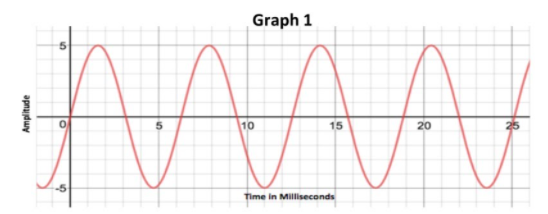
Graph 1 shows a sound (one note) you are working on.
One way you can change the sound is to increase or decrease its frequency.
Which of the graphs below shows how Graph 1 would change if you increased only the frequency/wavelength of the wave? Graph _______.
When the computer program plays the sound wave shown in Graph1, how do you think it will be different from sound made with Graph 2?
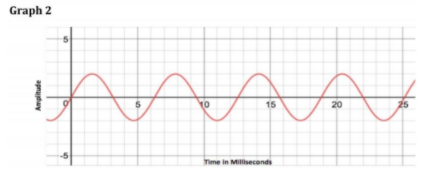
Use evidence from the graphs and what you know about waves (wavelength, frequency, and amplitude) to support your claim.
CFS:
Accurately identifies the differences in sound sources
Accurately describes the relationship between wave properties and outcomes
"I think Graph 2 will sound different than Graph 1 by ...
(Think: Are the wavelenghts the same- what does this mean? Are the amplitudes the same- what does this mean?)
A student went spearfishing during summer vacation the student aimed the spear at the location of the fish they saw in the water. The fish did not move when the spear entered the water, however the student did not catch the fish. THe initial model below shows one of the fish the student observed.
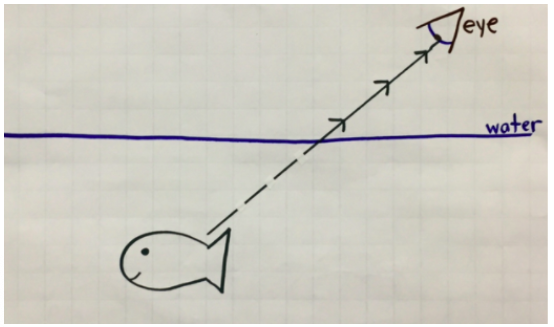
Observe the initial model above. Why was the student unsuccessful in catching the fish? Use your knowledge of light interactions to help you.
CFS:
Accurately identifies the differences in light interactions
Accurately describes the relationship between wave properties and outcomes
On the model below, predict and draw the location of the fish?