LW 3.1 (12/6) Version B
star
star
star
star
star
Last updated about 3 years ago
11 Nsɛmmisa
Safety Note: Laser Pointers Although the laser pointers in the kit are fairly low energy, they should not be shined into eyes.
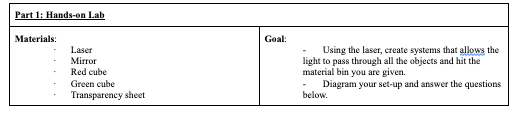
0
0
0
0
Safety Note: Laser Pointers Although the laser pointers in the kit are fairly low energy, they should not be shined into eyes.
Map your setup here:
Claim 1: Can light travel in a curved line? What evidence do you have?
CFS:
Accurately identifies the type of light reactions that cause changes in objects
Accurately describes the relationship between light interaction and outcomes
Claim 2: Can light travel through (be transmitted through) some objects?
Claim 3: Can light travel bounce off/reflect off some objects?
Amplify Science:
Unit 6: Light Waves
Chapter 3: More light interactions
Lesson 3.1: Following the Path of Light
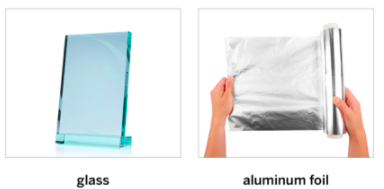
With a partner, discuss which types of light you think will pass through glass and which will pass through aluminum foil. Note your predictions below.
I predict that __________________________ will pass through glass.
Instructions:
Investigate what happens when light hits glass and when light hits aluminum foil. Remember:
If the light is taken in by the material, it is absorbed.
If the light passes through the material, it is transmitted.
If the light bounces off the material, it is reflected.
1. Open the Light Waves Simulation
2. Choose Custom and turn the light source on.
3. Drag GLASS to a platform in the testing area.
4. Move the slider to select different wavelength/types of light and test how they interact with glass.
5. Record the results below.
6. Repeat steps 3 and 4 with ALUMINUM FOIL.
What happened to each type of light when it hit glass? Write absorbed, transmitted, or reflected.
Gamma ray: Transmit
X-ray:
Ultraviolet (UV): Absorb
Visible (all colors):
Infrared (IR):
Microwave: Transmit
Radio:
What happened to each type of light when it hit aluminum foil? Write absorbed, transmitted, or reflected.
Gamma ray: Transmit
X-ray:
Ultraviolet (UV):
Visible (all colors):
Infrared (IR): Reflect
Microwave:
Radio: Reflect
What evidence do you have to support why different materials have different outcomes when they interact with glass?
CFS:
Accurately identifies the type of light reactions that cause changes in objects
Accurately describes the relationship between light interaction and outcomes
"I think different materials have different outcomes when they hit glass because... "
I predict that __________________________ will pass through aluminum foil.
Did the same outcome happen to every type of light when it hit glass?
In glass and aluminum, explain why different types of light react differently to the two types of material? (think: why does visible light react differently to aluminum than glass?)
CFS:
Accurately identifies the type of light reactions that cause changes in objects
"I think visible light reacts differently with aluminum and glass because..."