FM: Lesson 1.3a (9/16) Version B
star
star
star
star
star
Last updated about 3 years ago
14 Nsɛmmisa

0

0
0
0
0
0
0
0
0
0
0
0
0
3
How can the motion of a soccer ball that is moving come to a stop? How much force
must be applied if it is moving with 10 units of force to the right?
A soccer ball that is moving 10 units to the right can stop if…

Amplify Science:
Unit 2: Force and Motion
Chapter 1: Force and Velocity
Lesson 1.3: Investigating Direction of Force
What do the 3 bars on the top left allow you to do?
What are the different masses of the objects you can use in the simulation
If you click on the center of one of the objects what are you able to change?
What is the initial speed/velocity of an object if it is not moving ?
Complete the table below identifying how you made the objects change velocities. Use the key below to help you fill in the chart.
Identify initial velocity and create that in the simulation
Identify the change that needs to happen, identity the force applied
Independent Variable (IV):
The cause of the change/result
Dependent Variable (DV):
The effect based on the change
Constant Variable:
Stays the same
Draw an arrow on the correct line and in the correct direction that will indicate that a force is added to make Object A move faster.
Why does Object A move faster when you applied a specific direction of force rather than another directional force?
CFS:
Accurately identifies applied forces by analyzing the movement of objects
Accurately describes how changing independent variables (force) impact the outcomes in testing
Draw an arrow on the correct line and in the correct direction that will indicate that a force is added to make Object A move slower or stop.
Why does Object A move stop when you applied a specific direction and amount of force rather than slow down or change direction?
CFS:
Accurately identifies applied forces by analyzing the movement of objects
Accurately describes how changing independent variables (force) impact the outcomes in testing
Analyze the data table below and answer the questions below.
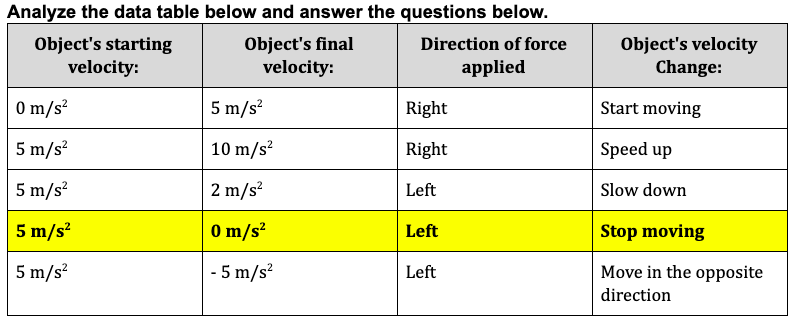
What is required of an impact force in order to cause an object in motion to stop?
CFS:
Accurately identifies applied forces by analyzing the movement of objects
Accurately describes how changing independent variables (force) impact the outcomes in testing