FM: Lesson 1.3b (9/3) Version B
star
star
star
star
star
Last updated about 3 years ago
14 Nsɛmmisa

0
0

0
0
0
0
0
0
0
0
0
0
0
0
Which image (A or B) shows the direction someone would need to kick the ball in order to move it toward the goal?

If the soccer ball is moving with a net force of 8 N towards the goal. How much force must the goalkeeper apply on the ball to stop it? What would happen if more or less force were applied by the goalkeeper?
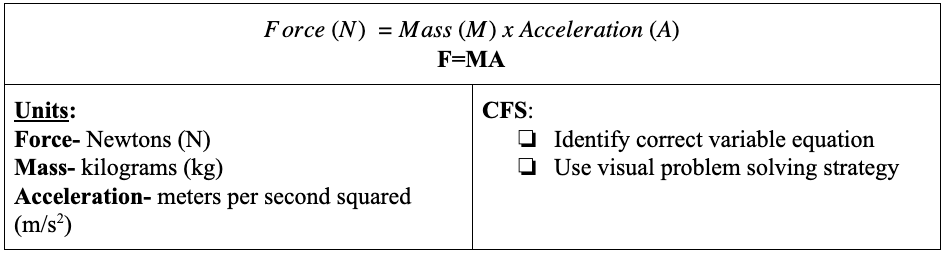
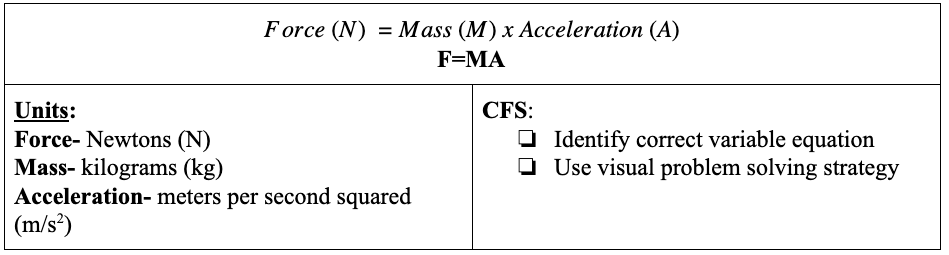
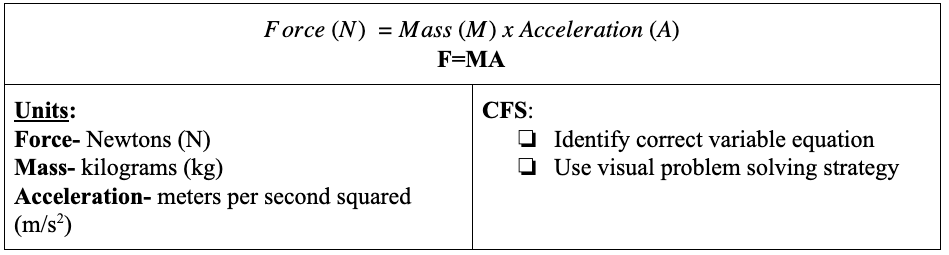
Newtons second law: acceleration of an object is dependent upon the force acting upon the object and the mass of the object.
F=MA
Step 1: write or rewrite the F=MA equation
Step 2: plug in the numbers into the equation
Step 3: solve the equation
Step 4: include the proper units and direction (force and acceleration)
How much force will the moving object have?
mass: 5kg object
acceleration: 2 m/s2
How much acceleration will object experience?
force: 5N of force
mass: 5 kg object
Force:
Mass: 1kg
Acceleration: 30 m/s2
Force:
Mass: 1 kg
Acceleration: 50 m/s2
What is the relationship between force and acceleration when mass remains constant.
CFS:
Accurately identifies energy types (KE/PE) by analyzing the movement of objects
Accurately describes the relationship force and mass have on energy transfer
"when acceleration is greater there is ....
when acceleration is less there is ... "
Force:
Mass: 2kg
Accl.: 10 m/s2
Force:
Mass: 4kg
Accl.: 10 m/s2
What is the relationship between mass and force in a consistently moving object?
CFS:
Accurately identifies changes in the dependent variable (f) in different testing situations
Accurately describes the relationship between force variables (f,m,a) by analyzing moving objects
"when mass is greater there is ....
when mass is less there is ... "
Force: 20N
Mass: 10kg
Accl.:
Force: 20N
Mass: 5kg
Accl.:
What is the relationship between mass and acceleration when an object is equally struck?
CFS:
Accurately identifies changes in the dependent variable (f) in different testing situations
Accurately describes the relationship between force variables (f,m,a) by analyzing moving objects