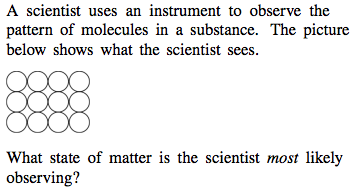
1
Claim: What state of matter is the scientist most likely observing?
Claim: What state of matter is the scientist most likely observing?
DOK.SCI.2
MS-PS1-4
1
Claim: What state of matter is the scientist most likely observing?
Chelsea went ice-skating. The ice, her skates, the Zamboni, and the rink building itself were all examples of solids she encountered. She developed a model of the particles in the ice. Which of these statements about the particles present in her model of a solid are true?
Choose the three statements that apply.
Many technologies use enclosed fluids. For example, a hydraulic press at an auto repair shop uses trapped water to lift heavy cars. Hot-air balloons heat trapped air to lift a basketful of people.
Look at the two diagrams that model fluid particles.
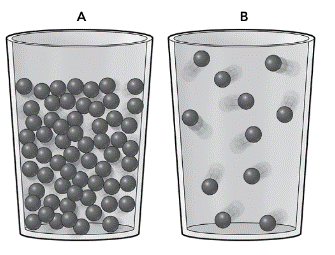
Which statement best identifies which of these models represents a gas?
Match the traits to the states of matter
Has the LEAST energy of all of these states
Fixed shape
Have particles that slide past one another
Fixed volume, but NOT fixed shape
Both shape and volume can change
Has the MOST energy of all of these states
Solid
Liquid
Gas
Evidence: Which evidence from the image best supports your claim above?