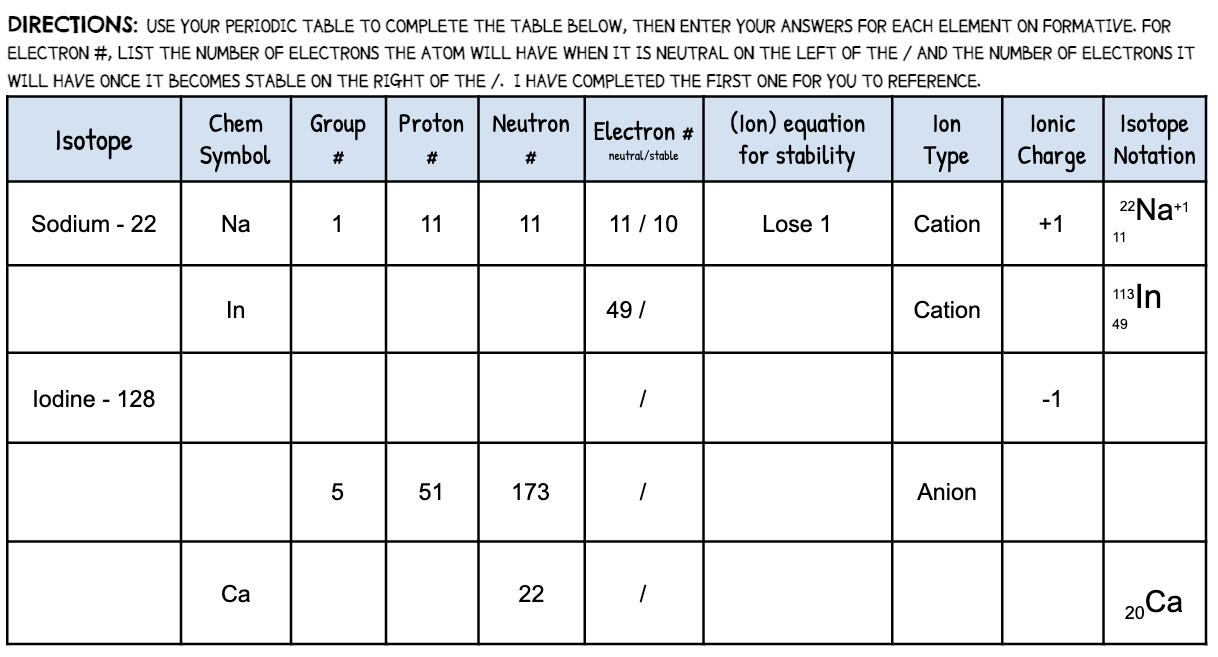
1. Use the yellow periodic table to identify the missing information about each isotope
2. Make sure you use the mass provided on the paper provided (image below).
3. Type the answer for each element below. Make sure you follow any directions about HOW to enter your answer so your response is correctly scored.
The Isotope's name is
This bond contains neutrally charged atoms
This bond occurs with atoms of differing electronegativity (one high, one low)
This bond occurs when valence electrons are shared through a sort of “tug-of-war” match between the atoms.
This bond occurs when nonmetals bond with other nonmetals of similar electronegativity
This bond occurs when valence elctrons are transferred from one atom to another
What type of chemical bond is present in a substance that is a brittle solid at room temperature, is insoluble in water, and has a low melting & boiling point?
Explain how an ionic bond is formed in two to three complete sentences.
Hint: There are three main steps. Your answer should be well written, using proper grammar and spelling. Your answer should include the terms "High electronegativity", "low electronegativity", "anion", "cation", "opposite charge", "ionic bond".
The name of the Isotope is
Group #
Proton #
Neutron #
# of Electrons when stable
For all boxes in the "(ion) Equation for Stability" column.
1. Type only the word "lose" or the word "gain" in blank 1
2. Type only the # representing the number of electrons it will lose or gain in blank 2
Example with Sodium from Row 1
Lose 1
Ionic Charge
Type the missing portion of the notation below
The Chemical Symbol is
Group #
Proton #
Neutron #
# of Electrons when neutral
# of Electrons when stable
For all boxes in the "(ion) Equation for Stability" column.
1. Type only the word "lose" or the word "gain" in blank 1
2. Type only the # representing the number of electrons it will lose or gain in blank 2
Example with Sodium from Row 1
Lose 1
Iodine - 128 forms a
Write out the Isotope notation for the Ion "Iodine-128"
Type the chemical symbol below. Use the correct Capitalizations
# of Electrons when neutral
# of Electrons when stable
For all boxes in the "(ion) Equation for Stability" column.
1. Type only the word "lose" or the word "gain" in blank 1
2. Type only the # representing the number of electrons it will lose or gain in blank 2
Example with Sodium from Row 1
Lose 1
What is the ionic charge?
Write out the Isotope notation for this ion.
The Isotope's name is
Group #
Proton #
# of Electrons when neutral
# of Electrons when stable
For all boxes in the "(ion) Equation for Stability" column.
1. Type only the word "lose" or the word "gain" in blank 1
2. Type only the # representing the number of electrons it will lose or gain in blank 2
Example with Sodium from Row 1
Lose 1
Ca will form a ____
What is the ionic charge?
Complete the Isotope notation for Ca.
Select ALL that are true about the substances in the picture