Log in
Sign up for FREE
arrow_back
Library

HW1: Data Collection

star
star
star
star
star
Last updated about 4 years ago
10 questions
2
2
2
2
2
2
2
3
Question 1
1.

Categorize the descriptions according to the data collection method they describe.

  • A population is divided into groups. Each group receives a different treatment, and the results are compared.
  • A sample from a neightborhood is asked if they want more streetlights on the street.
  • A researcher collects existing data and draws conclusions.
Question 2
2.

Categorize each description based on similarities between data collection methods.

  • yields more accurate results with larger sample sizes
  • the researcher must interact with the sample being studied
  • care must be taken to avoid bias
  • collect data already in existence
Question 3
3.

Which TWO sampling methods involve the highest risk of bias?

Question 4
4.

Question 5
5.

Managers of a forest reserve want to know what percent of the visitors with dogs keep their dogs on a leash. The park assigns an employee to count the numbers of visitors that do and do not use a leash.

What type of study is this?

Question 6
6.

A local newspaper polls citizens of a city about the construction of a new high school.

What type of study is this?

Question 7
7.

Where does randomness come into play when designing a study (surveys, experiments, or observational studies)?

Answer in full English sentences.

Question 8
8.

A civil engineer is conducting a survey to find out if city residents want the road widened for increased traffic flow. He conducts his survey by waiting at an interesection in the morning and asking his questions to vehicles stopped at the red light.

Is the data collected from this survey representative of the city's opinion? If not, where is the bias? What should the civil engineer do to reduce bias?

One point per question.

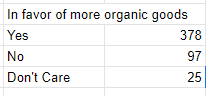
A grocery store surveys every fifth customer to determine whether it should consider expanding its organic foods department. The results are shown in the table.

2
Question 9
9.

Does the sampling method introduce bias? Why or why not?

2
Question 10
10.

About what percent of the customers favor the expansion?

Round your answer to the nearest percent.

The number of accidents on the street is compared to last year's rate.
A sample is taken from a population and asked questions.
People are asked to attend a meeting to discuss the need for new street lights.
Streetlights are installed on one street and people are then asked if they like the change.
Experiment
Observational Study
Sample Survey
can be carried out without the sample knowing who the researcher is
Both sample surveys and experiments
Both experiments and observational studies
Both observational studies and sample surveys
All data collection methods
the sample is made from some rule such as "every tenth person alphabetically"
the sample is made from a collection of random representatives from subgroups that have nothing to do with the trait being studied (like sampling one random person who has a birthday from each month)
the sample is made from a subgroup of the population that has nothing to do with the trait being studied (like sampling everyone who has a last name starting with an "A")
Dr. Demo wants to perform a clinical trial for a new drug. He has collected consents from one hundred patients. He will have 50 patients take the drug, and 50 patients take the placebo.

Which of the following selection methods introduces significant bias to his experiment? Select four.
Dr. Demo selects the first 50 patients to volunteer to take the drug.
Dr. Demo selects the patients who are over 50 years old to take the drug.
Dr. Demo selects the patients with the highest blood pressure to take the drug.
Dr. Demo selects the patients born in January through June to take the drug.
Dr. Demo selects the patients with last names starting with A through M to take the drug.
Dr. Demo selects the patients he believes will be most successful with the drug.
Dr. Demo selects patients with even social security numbers to take the drug.