Using the image provided, match each letter to the choice that best fits:
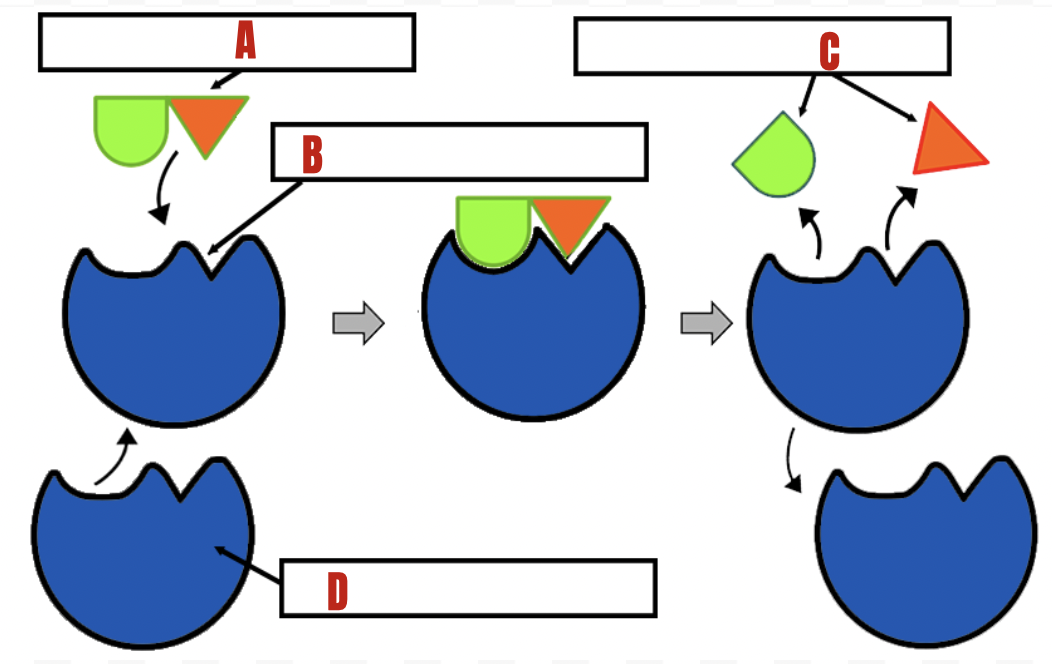
Using the image provided, match each letter to the choice that best fits:
D
B
A
C
Enzyme
Active Site
Substrate(s)
P
"Large" molecules that make up all living things are known as:
When ATP loses a phosphate group it becomes:
Match each macromolecule to its monomer:
Nucleotide
Triglyceride (a glycerol & 3 fatty acids)
Amino Acids
Monosaccahride
Nucleic Acid
Carbohydrate
Lipid
Protein
The main source of energy for the body is what macromolecule?
Fats, Oils and Waxes are known as what macromolecule?
This macromolecule stores excess energy as fat
The process of removing water in order to bond monomers, creating a macromolecule is called Hydrolysis.
The process of adding water in order to breakdown macromoleucles is called Hydrolysis.
Match each example to the correct macromolecule:
Enzyme
Glucose
Unsaturated Fat
DNA
Lipid
Nucleic Acid
Protein
Carbohydrate
Match each funtion to the its macromolecule
Immediate source of energy
Creates proteins and passses on genetic information to offspring
Stores exccess energy
Structural (building structures in our bodies) and Functional (facitilitating cell processes essential for survival)
Nucleic Acids
Protein
Lipid
Carbohydrate
Enzymes ______________________ the activation energy in order to _______________________ a chemical reaction.
The best analogy for an enzymes and its substrate would be which of the following?
Using the image provided, match each letter to the choice that best fits:
D
B
A
C
Enzyme
Active Site
Substrate(s)
P
What happens to an enzyme experiences conditions (tempurate & pH) outside its optimal range?
Using the analogy of a partially charged battery and a fully charged battery, explain the relationship between ADP and ATP.