4
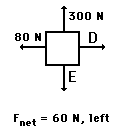
What is the net force on the object?
What is the net force on the object?
4
Explain what is happening to the object using the word 'acceleration'.
Explain what is happening to the object using the word 'acceleration'.
A 2-kg object is moving horizontally with a speed of 4 m/s.
How much net force is required to keep the object moving at this speed and in this direction?
In the helium balloon inside the car example, what was the conclusion the class reached as to why this did not violate the first law?
https://www.youtube.com/watch?v=XXpURFYgR2E
What is the gravitational force of 1kg?
A leftward force is applied to a dresser to accelerate it to the left across the bedroom floor. Ignore air resistance. (Grading on forces and magnitudes)
Why does constant velocity indicate NO net force?
What is the net force on the object?
Explain what is happening to the object using the word 'acceleration'.
In the situation above, the force of letter D must be
A doubling of the mass results in a of the acceleration (if force is held constant).
A rightward force is applied to a 10-kg object to move it across a rough surface at constant velocity. The coefficient of friction between the object and the surface is 0.2. Use the diagram to determine the gravitational force, normal force, applied force, frictional force, and net force. (Neglect air resistance.)
Explain what is meant by 'terminal velocity.'
Give an example of a action-reaction pair.
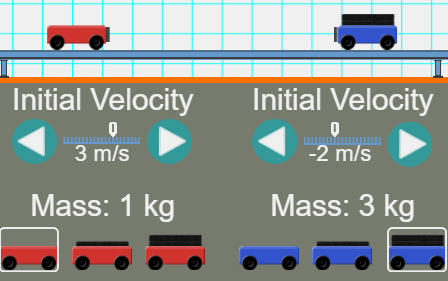
Determine the velocity of both the red and blue cart after the inelastic collision.