Twa kɔ nsɛm atitiriw so
Log in
Sign up for FREE
arrow_back
Laabri

Abridged Chapter 11-12: The Missouri Compromise and Slavery in the Western U.S.

star
star
star
star
star
Last updated about 2 years ago
10 Nsɛmmisa
1
RPU.01
1
RPU.01
1
IIUR.01
1
IITE.01

Printed on Map: "Designed to exhibit the comparative area of the free and slave states and the territory open to slavery or freedom by the repeal of the Missouri compromise. With a comparison of the principal statistics of the free and slave states, from the census of 1850."
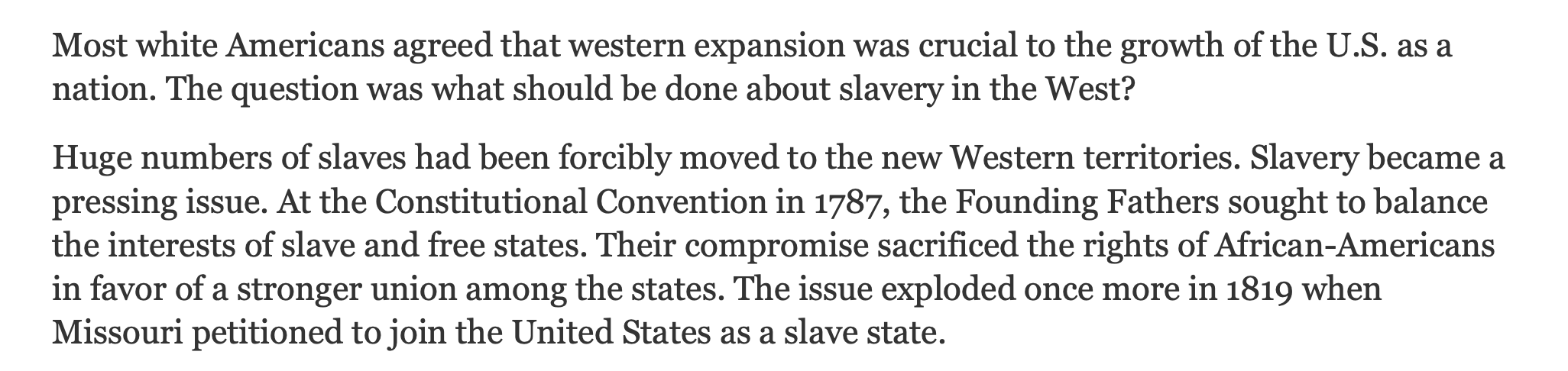
Map Key

Red = Free state

Dark Blue = Slave states are in dark blue

Green Blue = Territories that could be slave or free if the Missouri compromise was ended

Asemmisa {{asɛmmisaAhyɛnsode}}
1.

The main purpose of the passage is to

Note how Question #1 is about the entire article. Hence, you should wait until you read the entire article before you answer it! (Hint: You should do the same thing on the SAT Reading exam.)

1
Asemmisa {{asɛmmisaAhyɛnsode}}
2.

According to the passage, the reaction to the Missouri Compromise can best be described as

IIRC.01
Asemmisa {{asɛmmisaAhyɛnsode}}
3.

The MOST likely reason for including information about the Kansas-Nebraska Act of 1854 is to show

1
Asemmisa {{asɛmmisaAhyɛnsode}}
4.

It can be reasonably inferred that "self-determination" is

IIRC.02
1
IIRC.01
Asemmisa {{asɛmmisaAhyɛnsode}}
6.

Which answer choice BEST describes the central tension that led to the Missouri Compromise?

1
Asemmisa {{asɛmmisaAhyɛnsode}}
7.

Based on the information in the passage, it can be reasonably inferred that

IIRC.02
Asemmisa {{asɛmmisaAhyɛnsode}}
8.

Which choice provides the best evidence for the answer to the previous question? (from Paragraph 4)

1
Asemmisa {{asɛmmisaAhyɛnsode}}
9.

As used in line 1, "sentiment" most nearly means

IIWD.01
1
Asemmisa {{asɛmmisaAhyɛnsode}}
10.

The final paragraph develops a key concept of the article by

RTS.02

Finité. Don't forget to go back to question #1 and answer it! Then click "Submit" in Formative and "Mark as done" in Google Classroom.

Asemmisa {{asɛmmisaAhyɛnsode}}
5.

The passage indicates that Thomas Jefferson believed that the question over slavery would eventually lead to