Earth History - Absolute and Relative Dating
star
star
star
star
star
Last updated over 3 years ago
25 Nsɛmmisa
1
1
1
1
4
1

6
1
3
3
1
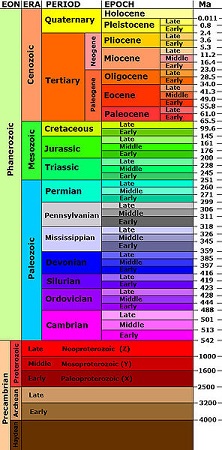
What period was 34 million years ago?
How many eras are there in the Phanerozoic Eon? Name them.
Scientists are able to conclude that a forested ecosystem existed in Antarctica millions of years ago by studying
A fault is found that cuts through lower rock layers but not those above it. What can most likely be concluded?
Which is used in radioactive dating?
The law of superposition states
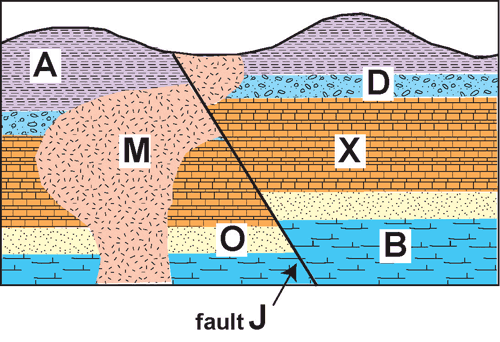
What order of events created this area? Youngest (top) to oldest (bottom)
O
M
J
B
D
A
X
Which principle of stratigraphy tells you that M is older than J? Use the above picture.
What order of events created this area? Youngest (top) to oldest (bottom)
M
B
A
J
R
F
S
X
K
P
Which principle of stratigraphy tells you P is older than B? Use the above picture.
A fossil was discovered that originally contained 500 grams of Carbon-14 now contains only 15.625 grams of Carbon-14. Approximately how many half lives has this sample experienced and how many years ago was this sample part of a living tree? What geological time period was this fossil from?
1 half-life for Carbon-14 = 5,730 years
A sample of igneous rock has only 100 grams remaining out of an initial 400 grams of Potassium-40. How many half-lives has this rock undergone and how old is it? What geologic time period was it formed?
1 half life for potassium-40 = 1.25 billion years
What is the only type of rock that can contain fossils?
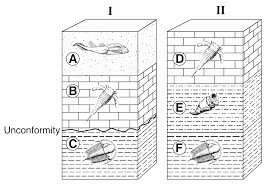
What section is missing from column I at the unconformity? Compare column I and II to identify the layers in order.
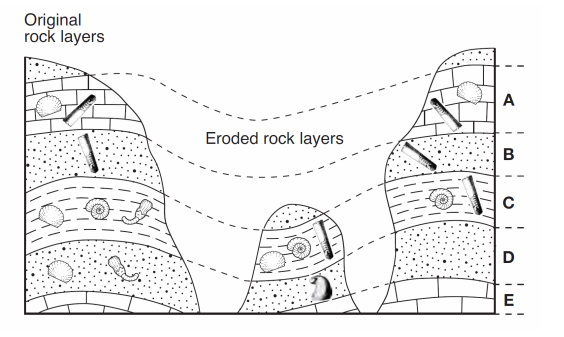
Which fossil could be classified as an index fossil?
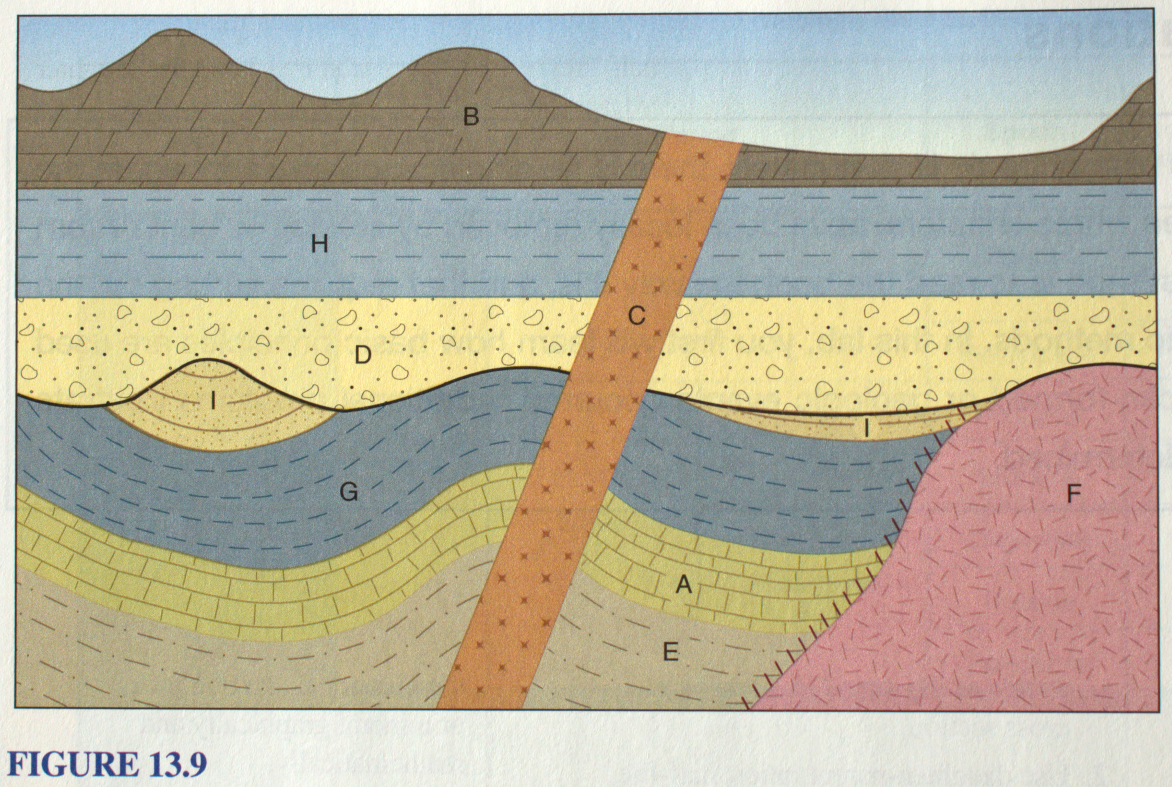
Which is older, D or F? What evidence (geologic sequencing law) supports your claim?
Use complete sentences for full credit.
Which principle of stratigraphy tells you that G is folded?
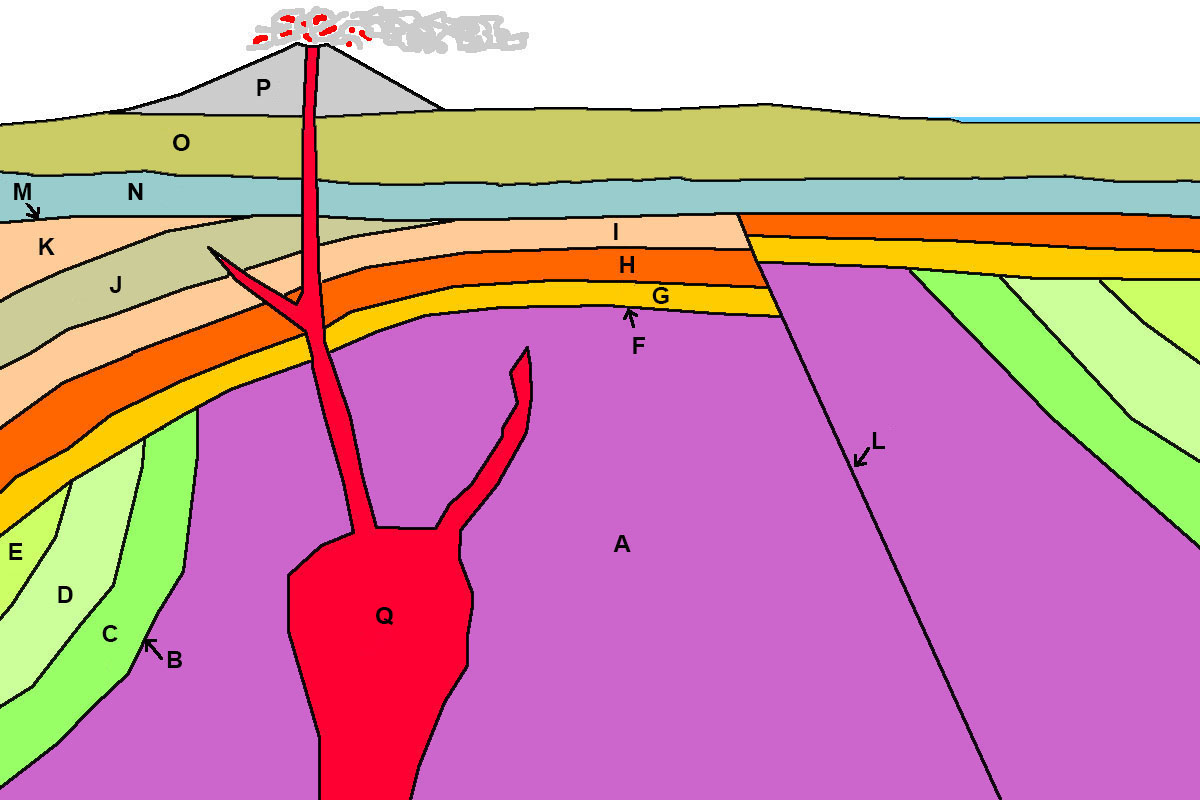
Which principle of stratigraphy would you use to figure out how old (relatively) fault L is?
How many years ago did the Paleozoic end?
How do you know that it is missing? What happened to the missing layer?
Use full complete sentences for credit.
Which principle of stratigraphy is being shown in the picture?
Which rock section is the youngest?
If you wanted to know the exact date of rock H, what could you use?
Which event is younger, fault L or volcano P?
Why are the batholyth Q and volcano P considered different rocks? Explain your answer is full complete sentences with as much detail as possible.
(Hint: use what you learned about volcanoes and plate tectonics.)
