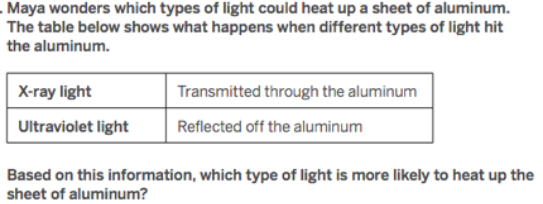
Why is there no change in the glass when X-Ray light is emitted on the glass?
CFS:
Accurately identifies the type of light reactions that cause changes in objects
Accurately describes the relationship between wave properties and outcomes
0 points
0
Question 2
2.
Why is there a change in the glass when the sun emits on the glass?
CFS:
Accurately identifies the type of light reactions that cause changes in objects
Accurately describes the relationship between wave properties and outcomes
0 points
0
Question 3
3.
If an object is going to change, what type of light interaction is necessary? Why is this?
CFS:
Accurately identifies the type of light reactions that cause changes in objects
Accurately describes the relationship between wave properties and outcomes
0 points
0
Question 4
4.
Do you think X-ray or Ultraviolet light can cause the object to change? What evidence do you have?
CFS:
Accurately identifies the type of light reactions that cause changes in objects
Accurately describes the relationship between wave properties and outcomes
0 points
0
Question 5
5.
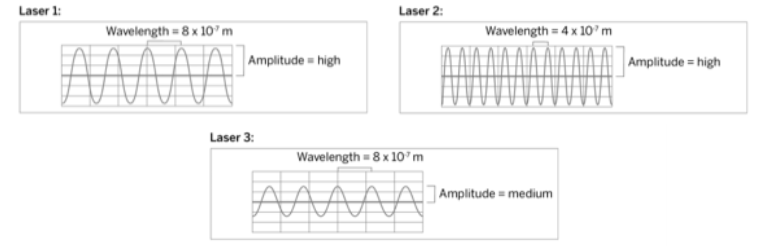
Which wave is the most intense (loudest or brightest)? What evidence do you have?
CFS:
Accurately identifies the type of light reactions that cause changes in objects
Accurately describes the relationship between wave properties and outcomes
0 points
0
Question 6
6.
Do you think any of the waves might emit the same type of wave? What evidence do you have?
CFS:
Accurately identifies the type of light reactions that cause changes in objects
Accurately describes the relationship between wave properties and outcomes
Part 1: Simulation: Reflection and Transmission
Amplify Science:
Unit 6: Light Waves
Chapter 3: More light interactions
Lesson 3.3: Reflection, Transmission, and Energy
In this mission, you will find two materials that transmit green light and two materials that reflect green light. Then, you will observe what happens to energy when light is transmitted or reflected. Use your observations in this mission to help you answer the Investigation Question: What happens to energy when light is transmitted through or reflected off a material?
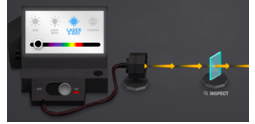
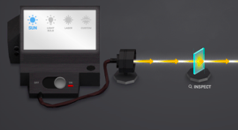
1. Open the Light Waves Simulation
2. Set the light source to LASER, set the color to GREEN, and turn it ON.
3. Search for materials that transmit or reflect green light by dragging them to a platform in the testing area, one at a time.
4. When you find a material that either transmits or reflects light, do the following:
• Turn Show Energy on to observe what happens to the energy in the light.
• Press INSPECT to observe whether the material changes.
• Record your observations in the data table below.
5. Repeat steps 3–4 until you have completed the data table with two materials that transmit green light and two materials that reflect green light.
0 points
0
Question 7
7.
Repeat steps 3–4 until you have completed the data table with two materials that transmit green light and two materials that reflect green light.
0 points
0
Question 8
8.
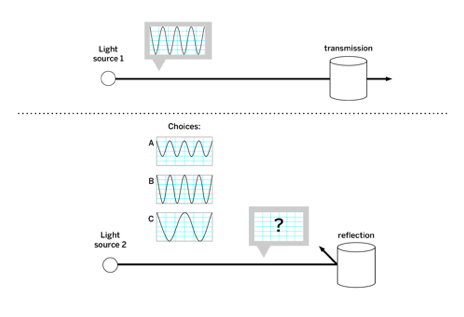
Why must the Lightsource 1 and 2 be different types of waves?
CFS:
Accurately identifies the differences in light sources
Accurately describes the relationship between wave properties and outcomes
2 points
2
Question 9
9.
How is Light Source 1 different from the type of light emitted by Source 2 (A and C)?
CFS:
Accurately identifies the differences in light sources
Accurately describes the relationship between wave properties and outcomes