Log in
Sign up for FREE
arrow_back
Library
U1 Solar System Unit Test
By Deb Hicks
star
star
star
star
star
Share
share
Last updated over 3 years ago
25 questions
Add this activity
1
6.8.a
1
6.8.i
1
6.8.b
1
6.8.b
1
6.8.c
1
1
6.8.i
1
6.8.d
1
6.8.d
1
6.8.e
1
6.8.h
1
6.8.g
1
6.8.a
1
6.8.a
1
6.8.a
1
6.8.a
1
6.8.b
1
6.8.b
1
6.8.c
1
6.8.e
1
6.8.e
1
6.8.h
1
6.8.i
1
6.8.i
1
6.8.g
Question 1
1.
How many planets are beliveved to be in our solar system?
Question 2
2.
Besides the Earth, where else in our solar system has there been manned spaced craft?
Question 3
3.
Which of the following is not a property of the outer planets?
Large
High amounts of gravity
Has rings
Rocky
Question 4
4.
Which object in the Solar System has the most mass?
Mercury
Jupiter
Earth
The sun
Question 5
5.
Choose the most accurate and complete definition of gravity
Gravity is the attraction between all objects that have mass; the greater the masses, the greater the attraction.
Gravity is the attraction of objects to the center of Earth.
Gravity is the push or pull on objects when they are accelerated to high speeds as they rotate around Earth or the sun.
Gravity is the attraction of the sun to all other objects in the solar system.
Question 6
6.
Which instrument used the effects of Earth's rotation?
Compass
Thermometer
Sundial
Barometer
Question 7
7.
Which invention help prove the sun is the center of the solar system?
microscope
Computer
Hot Air Balloons
Telescope
Question 8
8.
What causes day/night cycle on Earth?
Earth's rotation on its axis
Earth's revolution around the sun
the moon's revolution around Earth
the sun's revolution around Earth
Question 9
9.
Which statement about revolution is CORRECT?
The sun revolves around the planets and their moons.
Earth revolves around the moon and the sun revolves around Earth.
Planets are the only objects that revolve around anything in our universe.
The moon revolves around Earth and Earth revolves around the sun.
Question 10
10.
Which phase of the moon can a lunar eclipse occur?
Any phase of the moon
Waxing Gibbous
New moon
Full moon
Question 11
11.
What is the cause of tides on Earth?
The pull of gravity on Earth
The pull of gravity from Jupiter
The rotation of the Earth
The pull of gravity from the moon
Question 12
12.
Which season is it in the southern hemisphere in June?
Fall
Winter
Autumn
Summer
Question 13
13.
Which of the folowing is classified as a dwarf planet?
Pluto
the Moon
Jupiter
Mercury
Question 14
14.
Marty learned about the solar system. Which statement best describes how the planets in the solar system are the same?
All the planets have many moons.
All the planets orbit the Sun.
All the planets are about the same size.
All the planets have similar temperatures.
Question 15
15.
Which of these places in the solar system most likely contain volcanic rocks?
the surface of Mars
Saturn's rings
the Sun's core
Jupiter's red spot
Question 16
16.
Arrange the planets in order from closest to the sun, to furthest away.
Mercury
Uranus
Mars
Saturn
Jupiter
Venus
Earth
Neptune
Question 17
17.
Which statement is true about the solar system?
The gas planets are closer to the Sun.
The solid planets are closer to the Sun
The planets are arranged in order of increasing size
The solid planets are much larger than the gas planets
Question 18
18.
Which two solar system objects have the least amount of disance between them?
the Sun and Mars
Earth and Moon
the Sun and Earth
Earth and Jupiter
Question 19
19.
Which of the following helps keep the Moon in its orbit?
gravity
friction
latitude
longitude
Question 20
20.
Which phase of the moon occurs between the new moon and the first quarter?
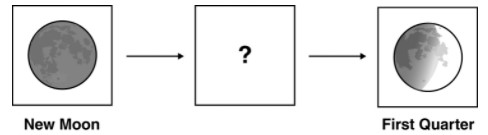
waxing quarter
waning crescent
waxing crescent
waxing gibbous
Question 21
21.
Which natural event occurs with the most frequency?
full moon
solar eclipse
sunrise
equinox
Question 22
22.
Tides on Earth are caused by the gravitational pull of -
Mars
asteroids
the Moon
Jupiter
Question 23
23.
Which planet does NASA scientist hope to send humans next?
Question 24
24.
A telescope would be the most useful in answering which questions?
How do rockets move in space?
What is on the surface onf the Moon?
How do worms breathe underground?
What shape is the human skin cell?
Question 25
25.
When the Northern Hemisphere is tilted away from the Sun causing the rays of light to hit Earth at large angles, which season occurs?