Log in
Sign up for FREE
arrow_back
Library

Topic 2.3.4.5.6.7-13 English Colonies test 11/22/2021

star
star
star
star
star
Last updated over 4 years ago
25 questions
Note from the author:
1
1
1
1
1
1
1
1
1
1
1
1
1
1
1
1
1
1
1
1
1
1
1
1
1
Paul Puchalski Lincoln Elementary School 13 Colonies Test.
Question 1
1.

Question 2
2.

Question 3
3.

Question 4
4.

Question 5
5.

Question 6
6.

Question 7
7.

Question 8
8.

Question 9
9.

Question 10
10.

Question 11
11.

Question 12
12.

Question 13
13.

Question 14
14.

Question 15
15.

Question 16
16.

Question 17
17.

Question 18
18.

Question 19
19.

Question 20
20.

Question 21
21.

Question 22
22.

Question 23
23.

Question 24
24.

Question 25
25.

Which of the following is the crop that made Jamestown successful?
corn
tobacco
cotton
sugar cane.
What religious group did the people we call the Pilgrims belong to?
A Puritans
B Roman Catholics
C Separatists
D Anglicans
Which religious group wanted to reform the Church of England and started the Massachusetts Bay Colony?
A Pilgrims
B Separartists
C Puritans
D Anglicans
Which of the following was the elected representative assembly in Massachusetts? >
A General Court
B House of Burgesses
C Parliament
D House of Delegates
Which of the following people believed the governor in Massachusetts had too much power and founded Connecticut?
A John Winthrop
B Roger Williams
C Benjamin Franklin
D Thomas Hooker
The Fundamental Orders of Connecticut ____________.
A limited the governor's power
B allowed complete religious toleration
C made being a Catholic illegal
D charged Anne Hutchinson with a crime
Which of the following best describes religious toleration?
A establishing a church all must attend
B a willingness to let others practice their own beliefs
C making certain religions illegal
D allowing only Puritans to vote
Which of the following started Rhode Island and believed in religious toleration?
A John Winthrop
B John Locke
C Roger Williams
D Thomas Hooker
Which of the following were owners of huge estates in New Netherland?
A patroons
B Pennsylvania Dutch
C Quakers
D Puritans
When the English captured New Netherland, they renamed the colony _________.
A Delaware
B New Jersey
C Maryland
D New York
What did Quakers believe?
A the Church of England required reform
B all men and women were equal before God
C women were not equal to men
D only Quakers should vote
Which of the following made farming easier in the Middle Colonies than in New England?
A milder winters and a longer growing season
B rocky soil
C closeness to the Atlantic Ocean
D all of the above
Which of the following groups of colonies had the most diverse population?
A New England
B Middle Colonies
C Southern Colonies
D all the colonies were diverse
Which of the following ruined his career in England by becoming a Catholic and wished to start a colony where Catholics could worship freely?
A John Winthrop
B Roger Williams
C James Oglethorpe
D George Calvert
The Act of Toleration provided religious freedom for all ________ in Maryland?
A religions
B Catholics
C Protestants
D Christians
Which colony was the only colony where Africans made up the majority of the population?
A Pennsylvania
B South Carolina
C Massachusetts
D New Netherland
Which colony did James Oglethorpe start as a place where debtors could make a fresh start?
A New York
B Delaware
C Georgia
D Virginia
What was the Middle Passage?
A the journey of Puritans from England to Massachusetts
B the journey of Quakers to Pennsylvania
C the passage of slave ships west across the Atlantic Ocean
D none of the above
Which of the following denied slaves their basic rights?
A Act of Toleration
B Fundamental Orders of Connecticut
C Slave Codes
D the Navigation Act
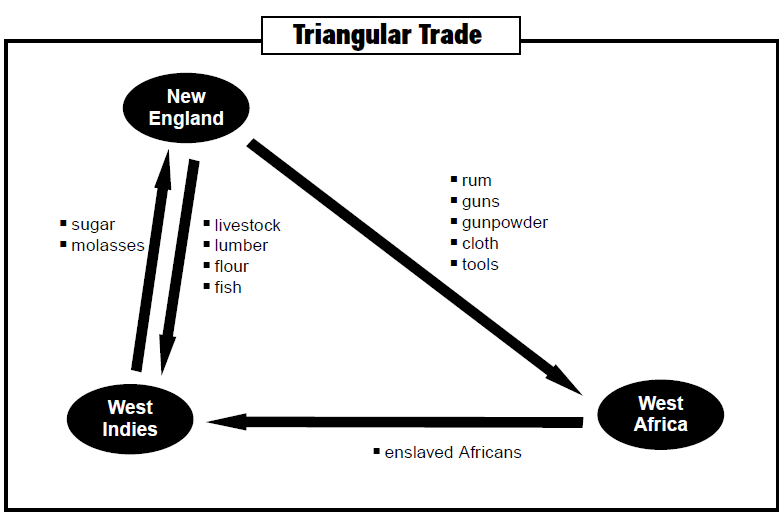
Use the chart above to infer the answer. Which of the following was a key part of the Triangular Trade Route?
A tobacco
B livestock
C rum made from molasses
D indigo
The Great Awakening was ________.
A Mr. Raisbeck getting up for work in the morning
B a religious movement that was saw an increase in religious toleration in the Colonies
C a religious movement that saw a decrease in religious toleration
D a movement that emphasized the use of human reason
Which colony set up the first public schools?
A Massachusetts
B South Carolina
C New Jersey
D Pennsylvania
Which of the following believed that people could gain knowledge from by observing and experimenting?
A John Winthrop
B Jonathan Edwards
C John Locke
D John Smith
What was the Enlightenment?
A a religious movement
B a movement that emphasized the use of human reason
C the discovery of electricity
D none of the above
Read the passage and question carefully. Determine the best answer to the question from the four answer choices provided.
Penn thought of his colony as a "holy experiment." He wanted it to be a model of religious freedom, peace, and Christian living.
Penn's Quaker beliefs led him to speak out for fair treatment of Native Americans. Penn believed that the land in North America belonged to the Indians.
He insisted that settlers should pay for the land. Native Americans respected him for this policy. As a result, Pennsylvania colonists enjoyed many years of peace with their Indian neighbors. One settler remarked, "as Penn treated the Indians with extraordinary humanity, they became civil and loving to us."
Considering this reading and other readings from your text, which of the following made Pennsylvania under William Penn different from other colonies?
A Religious freedom did not exist in Pennsylvania.
B Colonists in Pennsylvania generally treated American Indians with respect.
C There was frequently conflict with Native Americans in Pennsylvania.
D Some colonists were persecuted for their religious beliefs.