
1
1
1
1
1
1
1
1
1
1
1
1
1
1
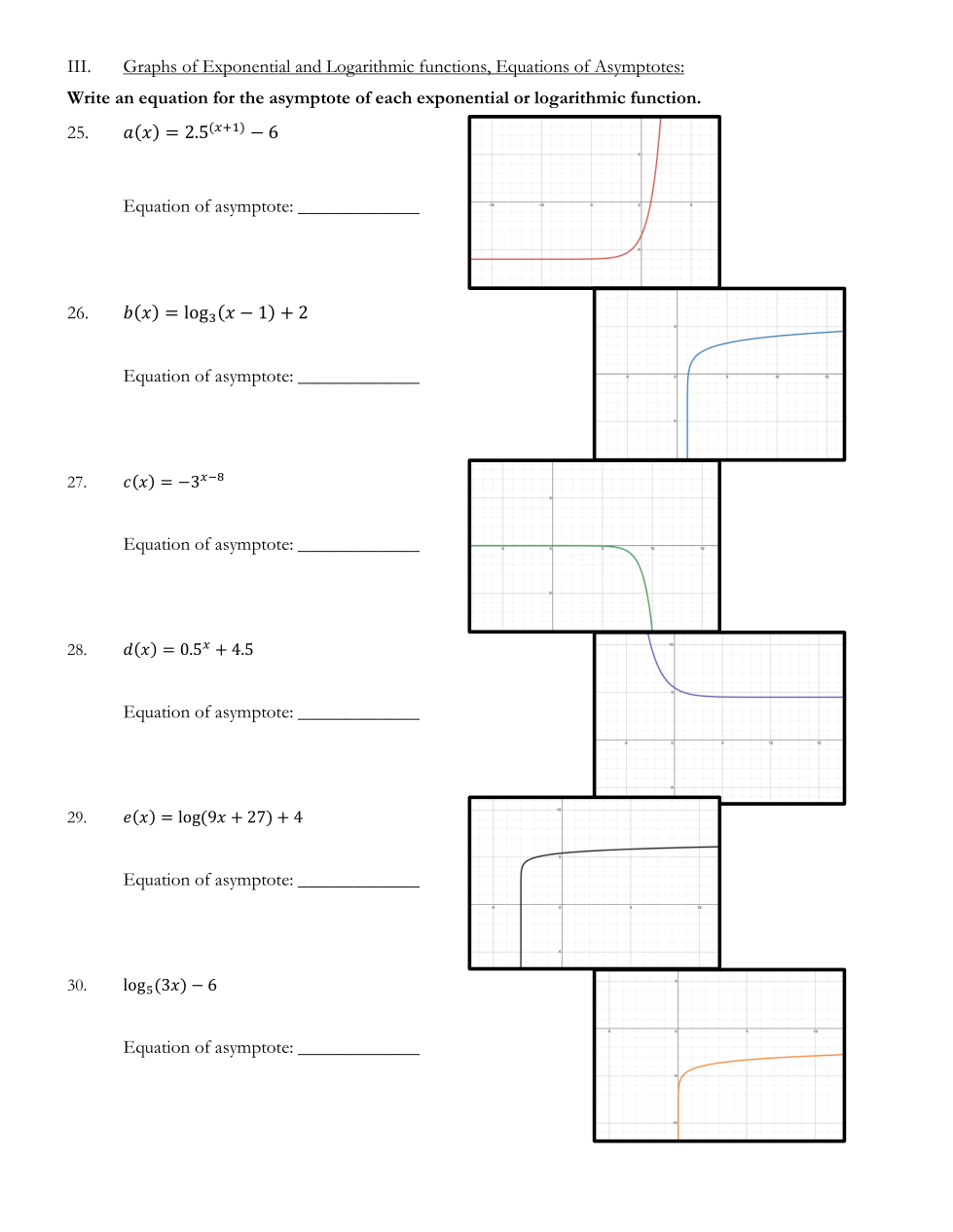
Write an equation for the asymptote of a(x).
Write an equation for the asymptote of b(x).
Write an equation for the asymptote of c(x).
Does this table show growth or decay?
What is the rate of growth/decay?
Write a function (f(x)) that models the data in the table.
Does the table show growth or decay?
What is the rate of growth/decay?
Write a function (f(x)) that models the data in the table.
Write a function (f(x)) to model the situation.
To the nearest dollar, how much will Anthony's home be worth in 2025?
Write a function (f(x)) to model the situation.
To the nearest dollar, how much money will Cale have after 6 hands?
Write a function (f(x)) to model the situation.
How many people will be zombies after 7 days?
Write a function (f(x)) to model the situation.
To the nearest dollar, how much will the car be worth when Lisa is 25?
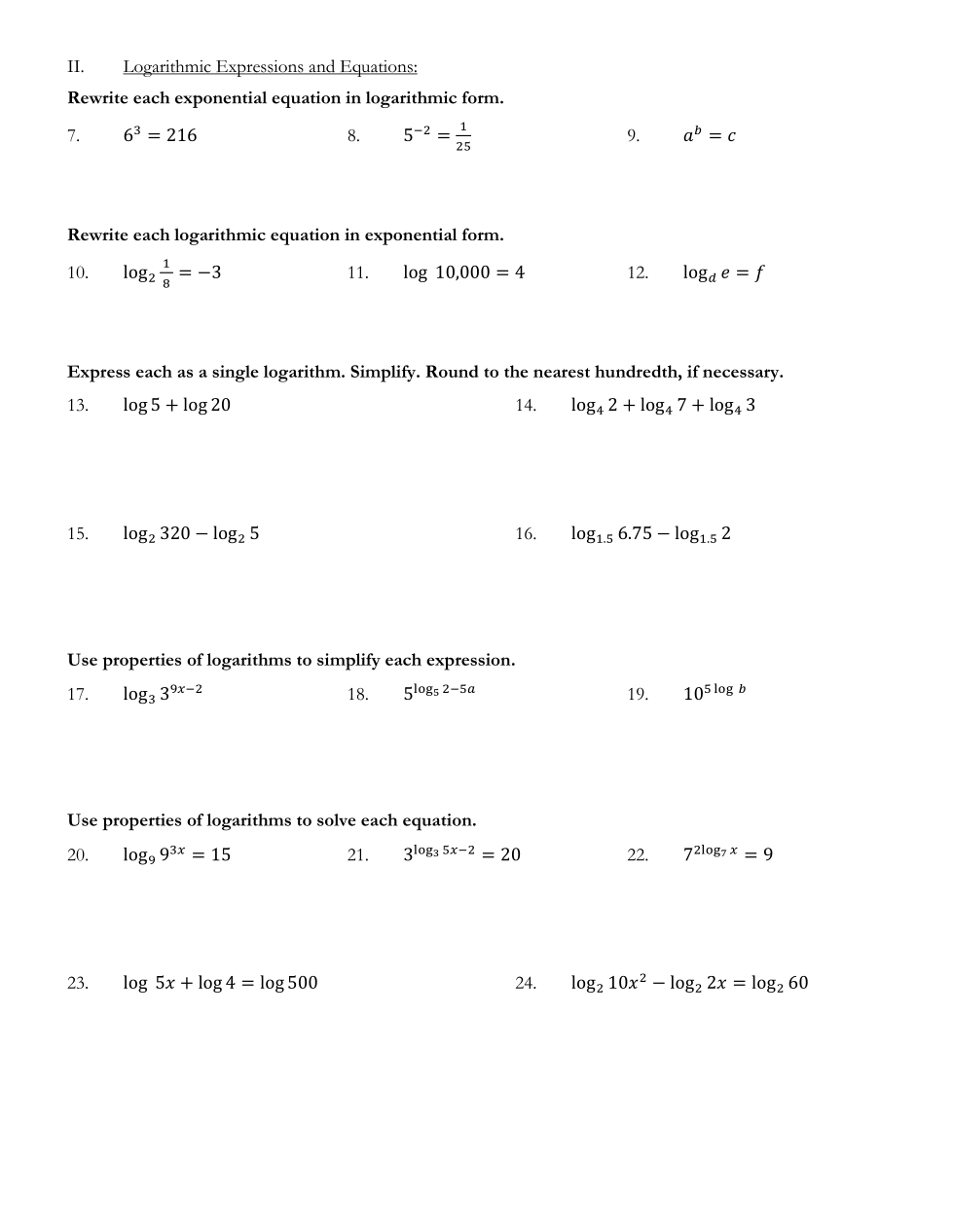
Rewrite 63 = 216 as a logarithmic equation.
Rewrite
as a logarithmic equation.
Rewrite ab = c as a logarithmic equation.
Rewrite
as an exponential equation.
Rewrite
as an exponential equation.
Rewrite
as an exponential equation.
Express log 5 + log 20 as a single logarithm.
Simplify. Round to the nearest hundredth, if necessary.
Express log42 + log47 + log43 as a single logarithm.
Simplify. Round to the nearest hundredth, if necessary.
Express log2320 - log25 as a single logarithm.
Simplify. Round to the nearest hundredth, if necessary.
Express log1.56.75 - log1.52 as a single logarithm.
Simplify. Round to the nearest hundredth, if necessary.
Simplify: log3 39x-2
Simplify:
Simplify:
Solve for x: log9 93x = 15
Solve for x:
Solve for x:
Solve for x:
Solve for x:
Write an equation for the asymptote of d(x).
Write an equation for the asymptote of e(x).
Write an equation for the asymptote of f(x).