Twa kɔ nsɛm atitiriw so
Log in
Sign up for FREE
arrow_back
Laabri

Generalizing Rules from Sequences

star
star
star
star
star
Last updated over 3 years ago
10 Nsɛmmisa
1
1
1
1
1
1
1
1
1
1

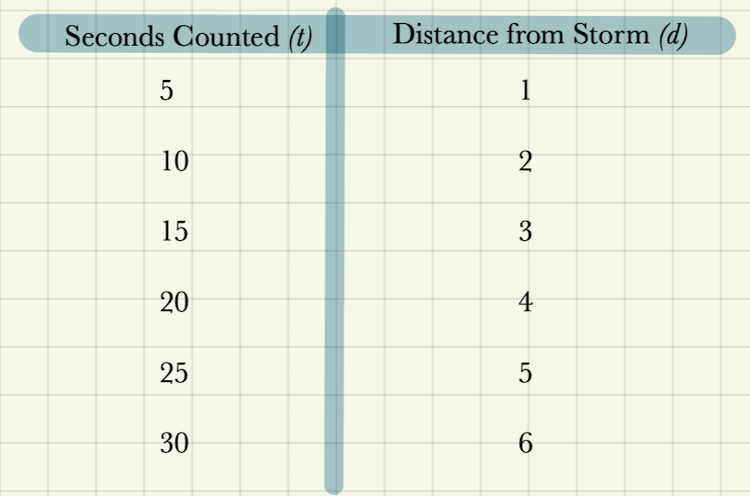
When a thunder and lightning storm approaches, you can calculate approximately how far away the storm is (in miles) by counting the time, in seconds between seeing the lightning and then hearing the thunder.

The table below shows the relationship between the seconds counted and how far away the storm is.
Asemmisa {{asɛmmisaAhyɛnsode}}
1.

Is the above given pattern linear? Explain.

Asemmisa {{asɛmmisaAhyɛnsode}}
2.

How can you calculate how far away the storm is after counting the seconds between seeing the lightning and hearing the thunder?

Asemmisa {{asɛmmisaAhyɛnsode}}
3.

If the time is represented by the letter t and the distance by the letter d, write the general rule that will help find the distance if the time is known.

Asemmisa {{asɛmmisaAhyɛnsode}}
4.

If you are 10 miles away from the storm, how many seconds would you expect to count between seeing the lightning and hearing the thunder?

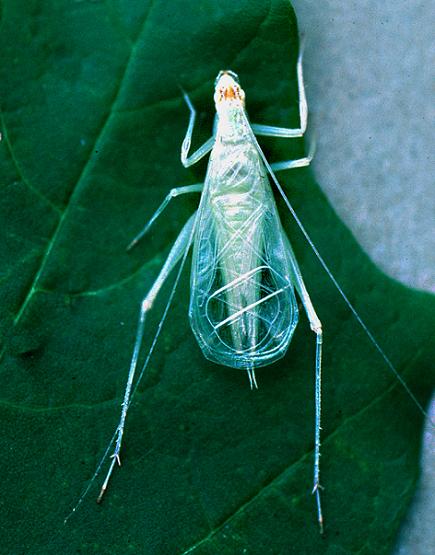
According to various sources and studies, you can estimate the outside temperature by counting the chirps of a snowy tree cricket!

One study found that when the temperature is 70 degrees Fahrenheit, the cricket chirps 30 times in each time period of 14 seconds. When the temperature is 80 degrees, the cricket chirps 40 times in the same time period. And when the temperature is 85 degrees it chirps 45 times.

Asemmisa {{asɛmmisaAhyɛnsode}}
5.

Set up a table with two columns, one for temperature (in Fahrenheit) and the other for the number of chirps in 14 seconds. Predict the pattern and fill in at least 3 additional values, (other than the ones already given to you.)

Asemmisa {{asɛmmisaAhyɛnsode}}
6.

If the temperature is represnted as T and the number of chirps per 14 seconds as n, then write down the general rule that shows the relationship between the two.

Asemmisa {{asɛmmisaAhyɛnsode}}
7.

Is this a linear pattern? Why do you think so?

The relationship between the cricket chirp and the temperature can also be studied using the Celsius scale instead of the Fahrenheit Scale. However, the pattern you will find will need to use 2 operations, division and addition.

When the temperature is 19 degrees, the cricket chirped 45 times in a 25-second period. At 21 degrees, the cricket chirped 51 times in the same time period. And when the temperature is 24 degrees, the cricket chirps 60 times in the same time period.

Asemmisa {{asɛmmisaAhyɛnsode}}
8.

Set up a table like you did in the previous question.

Asemmisa {{asɛmmisaAhyɛnsode}}
9.

What is the relationship between the temperature (T) in degree celsius and the number of chirps the cricket makes (n) in the given 25-second time period? Write the relationship as a mathematical rule.

Asemmisa {{asɛmmisaAhyɛnsode}}
10.

Is this a linear pattern? Justify your answer.