Horizontal integration differs from from vertical integration in that it...
In the late 1800s, workers tolerated poor wages and working conditions because they...
Which of the following was NOT an effect that electricity had on the United States?
The Chinese Exclusion Act of 1882...
How did Ellis Island differ from Angel Island?
Problem in the city included all of the following except
Which of these factors pulled immigrants to the United States?
What was one goal of the Americanization movement during the Progressive Era?
What was the Platt Amendment?
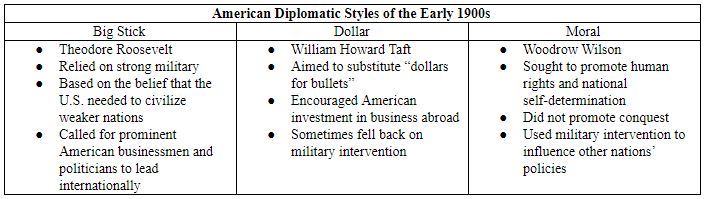
Which diplomatic style most promoted military action?
What was one result of "moral diplomacy"?
President Roosevelt sent troops to support Panamanian rebels in the fight against Colombia so...
How did the action of the U.S. govenment in the late 1800s impact Hawaii?
How did militarism contribute to increased imperialism?
A deep devotion to one's country:
American's Open Door Policy in China was designed to do which of the folowing?
The United States wanted overseas territories because the territories had which of the following?
Why did journalists call the Alaska purchase of 1867 "Seward's Folly"?
Roosevelt's "big stick" diplomacy...
"Moral Diplomacy" means that the U.S. government should do which of the following?
Why did Theodore Roosevelt run for the Presidency in 1912 after stepping aside in 1908?
What social problem did Upton Sinclair's novel The Jungle describe?
The demand for automobiles in the 1920s...
Which of the following authorized the federal government to raise a national army for entry into World War I through the compulsory enlistment of people?
Which of the following was a result of prohibitions impact on society?
Why was Germany asking Mexican to attack the United States in the Zimmerman Note during WWI?
Which of the following was the direct cause of World War I breaking out?
The 1920s are sometimes called the "Roaring Twenties" because...
What did President Wilson hope to accomplish with the League of Nations?
What is the best definition of installment buying?
What was the Great Migration?
Which of the following statements about women in the 1920s is true?
The "Bonus Army" marched on Washington, DC to pressure Congress to do which of the following?
How did Hoover's treatment of the "Bonus Army" affect his standing with the public?
Short Answer: 9 points each
Select two (2) of the following questions and be sure to answer each part of the questions. Write your answers on the spaces provided on the next page.
Urbanization, Immigration, and Industrialization (2.1 and 2.5)
a. Choose one of the following and explain how your choice led to the most growth and change to the United States during the late 1800s.
The Growth of the Railroad and Big Business
The Rise of the Factory/Industrial Sector
Immigration Stations (Ellis Island and Angel Island)
b. Contrast your choice against ONE of the other options, demonstrating why that option is not as significant as your choice.
Progressive Era (3.3 and 3.5)
a. Choose one of the following and explain how your choice shows the greatest impact/improvement on society in the United States during the 1800s.
A number of trusts are dissolved
Thousands of acres of forests are preserved
Acts are passed to protect the health of the consumer
b. Contrast your choice against ONE of the other options, demonstrating why that option is not as significant as your choice.
World War I (3.6 and 3.8)
a. Choose ONE of the following and explain why your choice represents the event that led to the declaration of war against Germany.
The Lusitania is torpedoed by a German U-Boat
The assassination of Archduke Franz Ferdinand
The British intercept the Zimmerman Telegram
b. Contrast your choice against ONE of the other options, demonstrating why that option is not as significant as your choice.
Write your response to first your chosen prompt below. Be sure to answer ALL parts of the prompt.
Write your response to second your chosen prompt below. Be sure to answer ALL parts of the prompt.