6th Grade: NewsELA: Ancient Egypt: Life along the Nile
star
star
star
star
star
Last updated about 4 years ago
5 questions

1
Explain the author's purpose for this first section. Use your knowledge of text structures and at least one detail from the text to support your answer.

1
Explain what the map visually represents. How does the map support the text from the section "Food for Thought"?
1
How does the section "Food For Thought" relate to the section "Prime Time”?

1
Read the section “Sand, Land And Civilization.”
Which paragraph BEST supports the idea that multiple deserts benefited the Egyptians?
Read the section “Sand, Land And Civilization.”
Which paragraph BEST supports the idea that multiple deserts benefited the Egyptians?
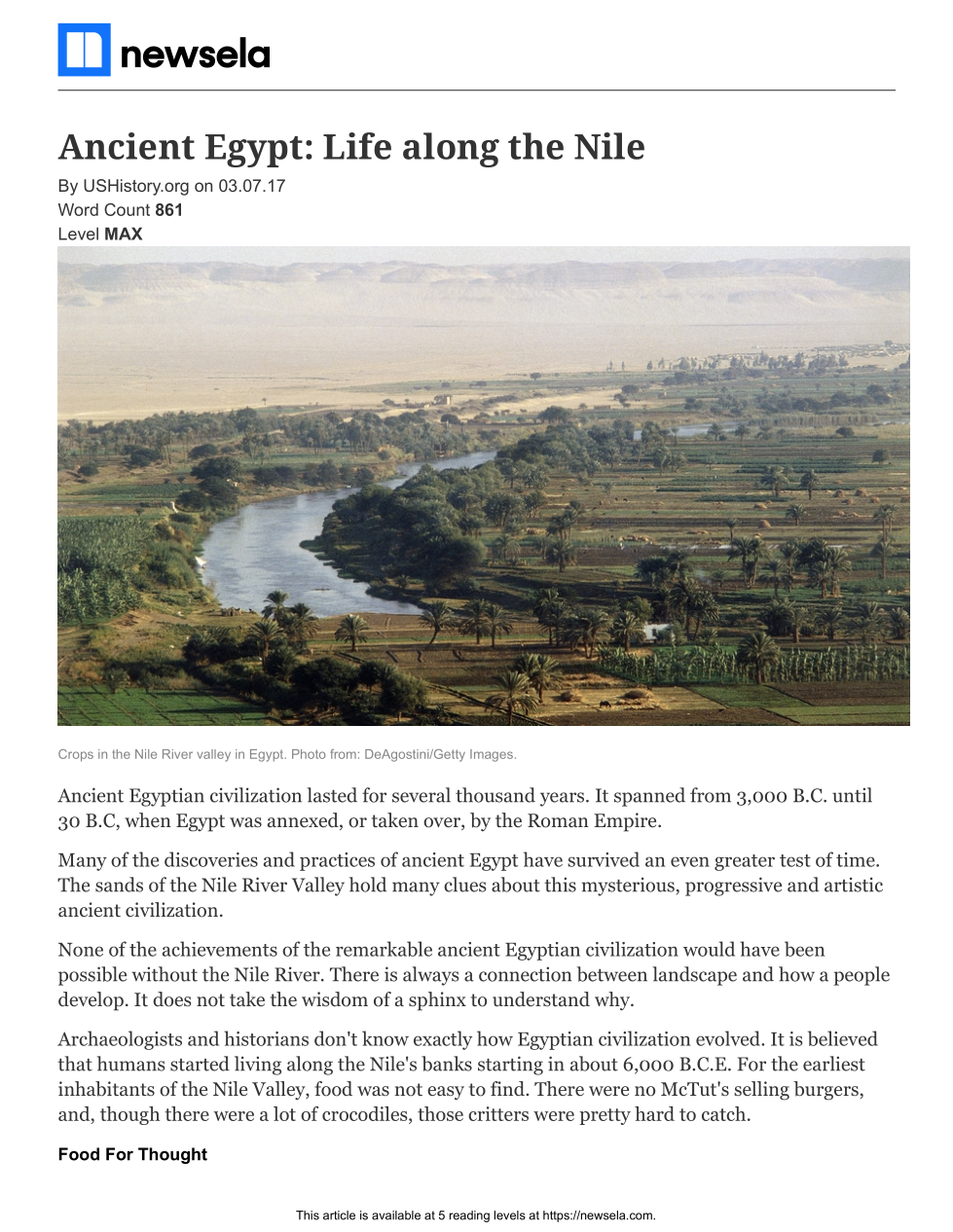
12. Even today, the world around the Nile is quite barren. Outside of the narrow swath of greenery next to the river, there is sand as far as the eye can see. To the Nile's west exists the giant Sahara Desert, the largest desert in the world. From north to south, the Sahara is between 800 and 1,200 miles wide; it stretches over 3,000 miles from east to west. The total area of the Sahara is more than 3,500,000 square miles. It's the world's biggest sandbox.
13. And, as if there weren't enough sand in the Sahara, east of the Nile are other deserts.
14. Although sand had limited uses, these deserts presented one tremendous strategic advantage: few invaders could ever cross the sands to attack Egypt — the deserts proved too great a natural barrier.
15. After learning to take advantage of the Nile's floods — and not having to fear foreign attacks — the Egyptians concentrated on improving farming techniques. As the years passed, Egyptians discovered that wheat could be baked into bread, that barley could be turned into soup (or even beer) and that cotton could be spun into clothing.
16. With many of life's necessities provided, the Egyptians started thinking about other things, such as art, government, religion and philosophy — some of the basics needed to create a civilization. Eventually, pyramids, mummies, Cleopatra and the Sphinx of Giza became touchstones of this flourishing culture.
1
Read the incomplete summary below. Choose the answer that BEST fits into the blank (---) to complete the summary.
"Ancient Egyptian civilization was able to flourish along the Nile River 5,000 years ago.------------ . The Egyptians are known for their art, government, religion and architectural marvels."
Read the incomplete summary below. Choose the answer that BEST fits into the blank (---) to complete the summary.
"Ancient Egyptian civilization was able to flourish along the Nile River 5,000 years ago.------------ . The Egyptians are known for their art, government, religion and architectural marvels."