Log in
Sign up for FREE
arrow_back
Library

Metallic Bonding 21-22

star
star
star
star
star
Last updated over 4 years ago
5 questions
1
1
1
1
6
Question 1
1.

Draggable itemarrow_right_altCorresponding Item
arrow_right_alt
arrow_right_alt
Question 2
2.

Draggable itemarrow_right_altCorresponding Item
arrow_right_alt
arrow_right_alt
Question 3
3.

Draggable itemarrow_right_altCorresponding Item
arrow_right_alt
arrow_right_alt
Question 4
4.

Draggable itemarrow_right_altCorresponding Item
arrow_right_alt
arrow_right_alt
Question 5
5.

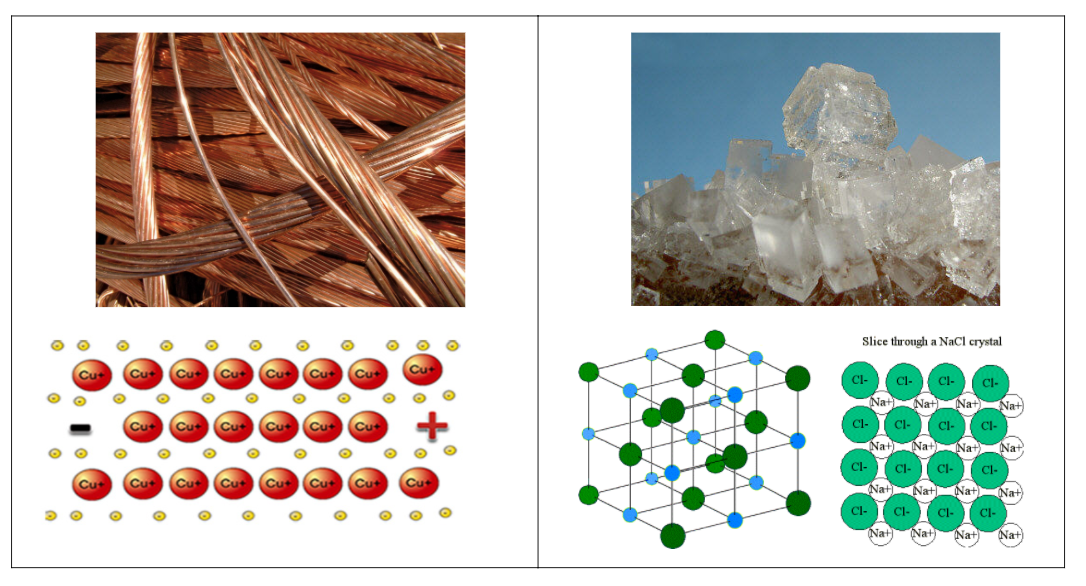
Use the above image of copper metal and dodium chloride in your evidence to justify why metals are able to be drawn into a thin wire and not ionic salts. Be sure to give detailed informationby both using and underlining or bolding the following 4 terms in your explanation: cation, anion, sea of electrons, and chemical bond.

Match the following.
Ionic Salt, NaCl
Ductile which means able to be drawn/pulled into a thin wire
Copper metal
Inflexible and stiff
Match the following.
Ionic Salt, NaCl
Malleable or able to be hammered or pressed into a thin sheet
Copper metal
Brittle and able to be crushed into a fine powder
Match the following.
Ionic Salt, NaCl
Good conductor of heat
Copper metal
Poor conductor of heat
Match the following.
Ionic Salt, NaCl
Good conductor of electricity
Copper metal
Poor conductor of electricity