predict the number of valence electrons in an atom using the periodic table.
predict the type of ion that an atom will form based on the atom’s location on the periodic table.
calculate the number of protons, neutrons, electrons, mass number and charge of an ion.
2 points
2
Question 1
1.
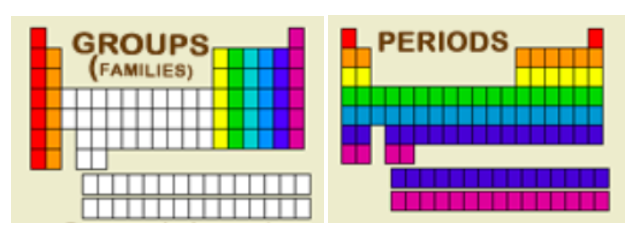
Two new words we will start using today are Group and Period.
Using the image above, pick the best description for each
8 points
8
Question 2
2.
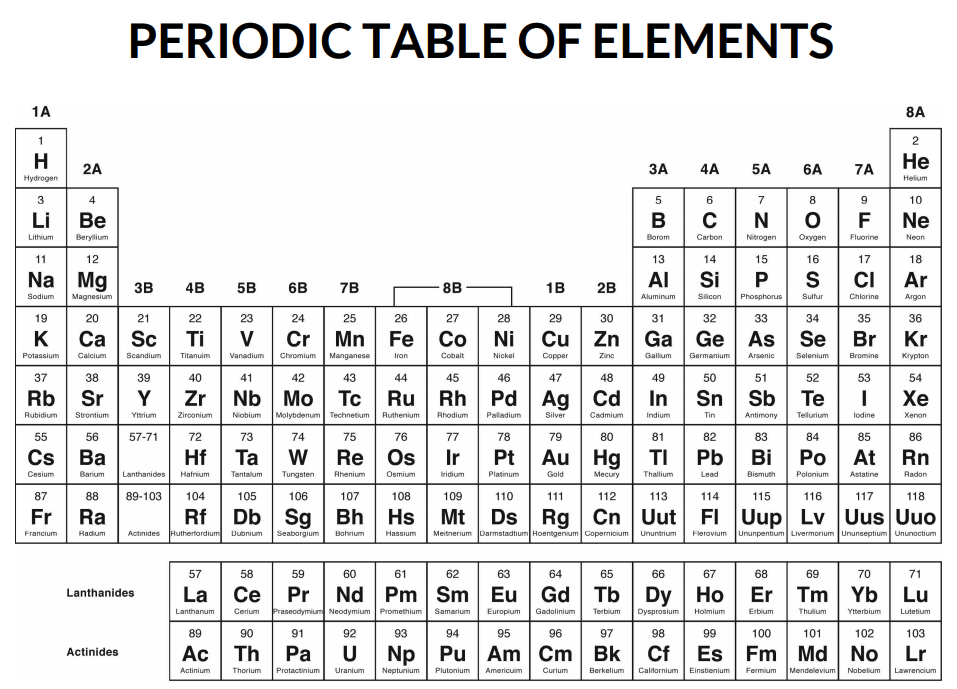
Use the periodic table above to put the following elements in order from fewest number of valence electrons to greatest number of valence electrons.
Rubidium
Iodine
Tellurium
Barium
Tin
Xenon
Gallium
Bismuth
6 points
6
Question 3
3.
For each element listed below:
Match the elements with their number of valence electrons
periodic table
Iron
Antimony
Krypton
Silver
Molybdenum
Copper
2 valence electrons
1 valence electron
8 valence electrons
10 valence electrons
5 valence electrons
9 valence electrons
4 valence electrons
Part 2: Ions
Why?
Many atoms present in nature are not in their 'atom' form. Rather, they are in 'ion' form. An atom's ion form is dependent on its number of valence electrons, and force of attraction between the nucleus and the electrons. In this part of the activity, you will determine what an ion is and how they are formed.
Directions: Use the Build an Atom or Element Builder simulation below to answer questions 4-11.
(Make sure to open the 'net charge' box!)
If you'd like to have 'Build an Atom' open in a different window, click on the following link: Build an Atom
6 points
6
Question 4
4.
Play with the simulation for a few minutes using the Atom screen. Write down three new things you notice as you play with the simulation.
2 points
2
Question 5
5.
What is the difference between a neutral atom and an ion?
4 points
4
Question 6
6.
Using what you learned from the simulation, define the term 'ion' in your own words(Use complete sentences in answering this question).
12 points
12
Question 7
7.
Use the simulation to build stable atoms (He) or ions (Li, Be, and B). Capture one of the stable atoms models or ions in the 'show your work' area.
(You may simply write the number of protons and neutrons in the nucleus, but please draw the electrons!)
2 electrons
3 electrons
4 protons
3 protons
2 protons
5 protons
4 electrons
5 electrons
Stable atom of helium (He)
Stable ion of lithium (Li+)
Stable ion of beryllium (Be2+)
Stable ion of boron (B3+)
2 points
2
Question 8
8.
What do you notice about the number of electrons in Li+, Be+2, B3+, and He?
4 points
4
Question 9
9.
Think about your answer for #8. Why do you think lithium always forms a +1 ion, beryllium always forms a +2 ion, and boron always forms a +3 ion(Use complete sentences to answer the question)?
12 points
12
Question 10
10.
Use the simulation to build stable models of atoms (Ne) or ions (F, F1-, O, O-2, N, and N-3).
<Include one picture of a stable atom or ion.>
7 protons
9 electrons
9 protons
8 protons
10 protons
8 electrons
7 electrons
10 electrons
Stable atom of Ne
Stable atom of F (F1-)
Stable atom of O (O2-)
Stable atom of N (N3-)
2 points
2
Question 11
11.
What do you notice about the number of electrons in F-, O2-, N3-, and Ne?
2 points
2
Question 12
12.
Think about your answer for #11. Why do you think fluorine always forms a -1 ion, oxygen always forms a -2 ion, and nitrogen always forms a -3 ion?
2 points
2
Question 13
13.
Consider the ions in the questions so far. How can you calculate the charge of an ion?
10 points
10
Question 14
14.
Label the smaller periodic table below with the charges that the ions form for each of the groups shown.
2 points
2
Question 15
15.
Elements in groups 1, 2, and 13 often form cations, while elements in groups 15, 16, and 17 often form anions. Considering this, which of the following are the best definitions for cation and anion?
2 points
2
Question 16
16.
Looking at the following dot diagram, how many valence electrons are paired?
2 points
2
Question 17
17.
Looking at the following dot diagram, how many valence electrons pairs are paired?
2 points
2
Question 18
18.
Looking at the following dot diagram, how many valence electrons are unpaired?