Log in
Sign up for FREE
arrow_back
Library

LNM1 Ch 5 Ex 4: Present Passive Infinitive

star
star
star
star
star
Last updated over 3 years ago
23 questions
Question 1 | 00:16
Question 2 | 00:28
Question 3 | 00:41
Question 4 | 01:10
Question 5 | 01:26
Question 6 | 02:33
Question 7 | 03:07
00:00/00:00
Question 1
00:16
keyboard_arrow_down
1
Question 2
00:28
keyboard_arrow_down
3
Question 3
00:41
keyboard_arrow_down
1
Question 4
01:10
keyboard_arrow_down
1
Question 5
01:26
keyboard_arrow_down
1
Question 6
02:33
keyboard_arrow_down
1
Question 7
03:07
keyboard_arrow_down
2

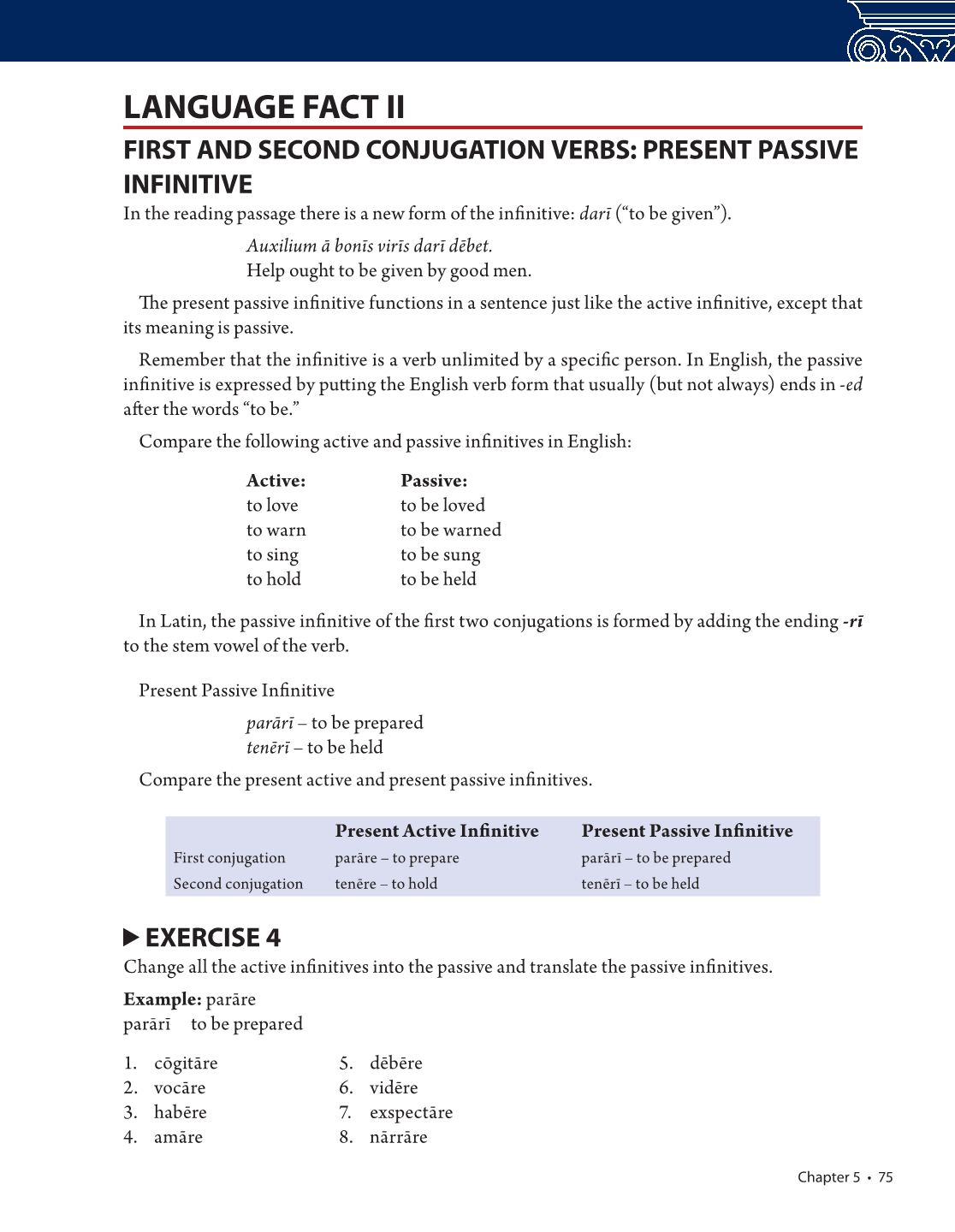
EXERCISE 4

Change all the active infinitives into the passive and translate the passive infinitives.
Example: parāre
parārī to be prepared

1. cōgitāre
1
Question 8
8.

Passive infinitive:

1
Question 9
9.

Translation:

2. vocāre
1
Question 10
10.

Passive infinitive:

1
Question 11
11.

Translation:

3. habēre
1
Question 12
12.

Passive infinitive:

1
Question 13
13.

Translation:

4. amāre
1
Question 14
14.

Passive infinitive:

1
Question 15
15.

Translation:

5. dēbēre
1
Question 16
16.

Passive infinitive:

1
Question 17
17.

Translation:

6. vidēre
1
Question 18
18.

Passive infinitive:

1
Question 19
19.

Translation:

7. exspectāre
1
Question 20
20.

Passive infinitive:

1
Question 21
21.

Translation:

8. nārrāre
1
Question 22
22.

Passive infinitive:

1
Question 23
23.

Translation:

Question 1
1.

How is an infinitive verb different from a regular verb?

Question 2
2.
The infinitive is the _______ form of the verb, but instead of _______ the action, the action is being _______ .
Question 3
3.

What is the ending for the present active infinitive?

Question 4
4.

What is the ending for 1st, 2nd, and 4th conjugation present passive infinitives?

Question 5
5.
All passive verbs in English utilize a form of _______.
Question 6
6.

What are three uses of the present passive infinitive?

Question 7
7.
Deponent verbs are verbs that look _______ but are translated _______ .