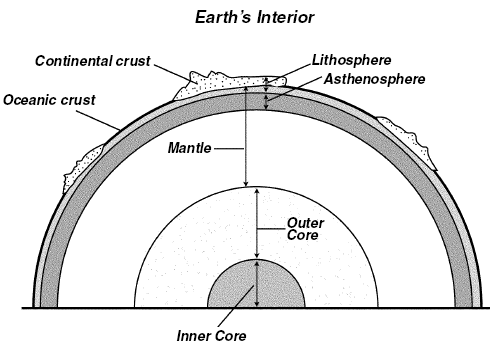
Which layer of Earth is made up partly of crust and partly of mantle material?
Which layer of Earth is made up partly of crust and partly of mantle material?
Water vapor is water in the form of
Holes drilled several kilometers into Earth’s crust provide direct evidence about Earth’s interior in the form of
What is the correct order (starting from the surface) of Earth’s layers?
Using data from seismic waves, geologists have learned that Earth’s interior is made up of several
Which of Earth’s layers is the thickest?
Which part of Earth contains most of its mass?
The energy that produces ocean waves comes from
Earth’s inner core is
Which part of Earth contains plates?
The process in which rock fragments freeze to the bottom of a glacier and then are carried away when the glacier moves is called:
A river flowing across a wide flood plain begins to form looplike bends called
Which feature typically contains water only during a rainstorm and right after it rains?
What is the relatively soft layer of the upper mantle called?
Geologists learn about Earth’s interior by studying
The mixture of sediments deposited directly by a glacier is called
Scientists think that the
As waves repeatedly hit the beach, some of the beach sediment moves down the beach with the current, in a process known as
According to the theory of plate
various directions.
The two processes by which waves erode the land are impact and
A valley glacier spreads out over a large island or continent.
Earth’s weather is the thin envelope of gases that surrounds Earth.
To study Earth’s interior, geologists often rely on indirect methods, such as evidence from fossils.
The stronger the wind, the larger the particles it erodes.
The outermost layer of Earth is called the mantle.
Glaciers can only form where more snow falls than melts.
Humans greatly impact air, water, land and life on Earth.
Name the 2 landforms created by water deposition.
Waves change direction as they near the shore because _______________________________________.
What is the relationship between temperature and depth inside the Earth? Is this relationship the same for pressure?
Name Two Glacial Landforms
Which layer of Earth is made up partly of crust and partly of mantle material?