Describe the left side end behavior of
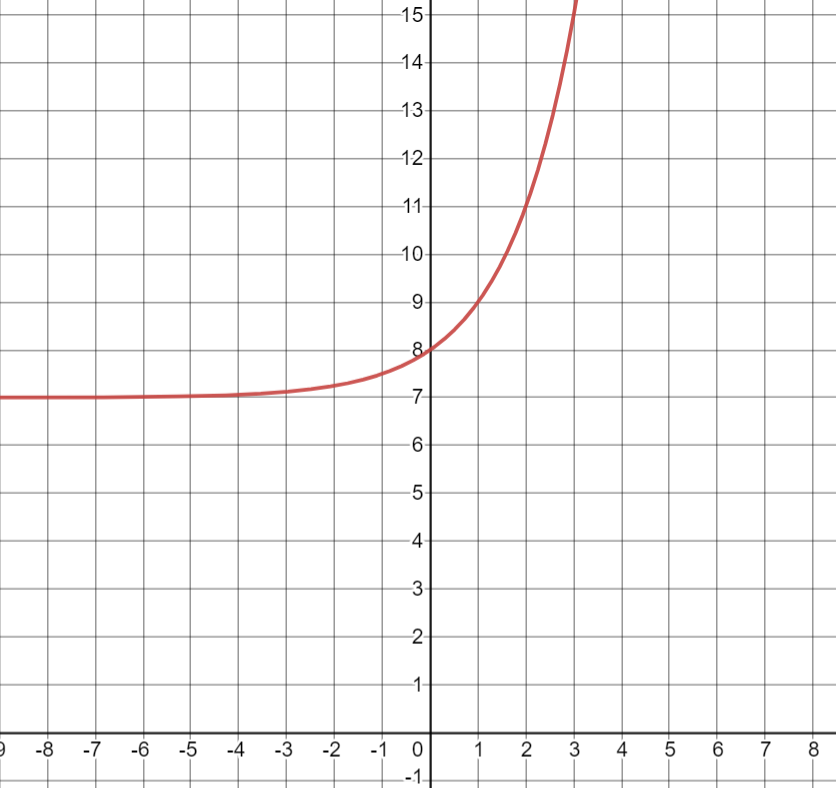
Describe the left side end behavior of
What is the equation of the exponential function with a base of 2,
which is shifted right 5 units and
up 4 units?
What is the equation of the exponential function with a base of 0.5,
which is reflected over the x-axis,
shifted left 6 units and
down 2 units?
Describe ALL the transformations for the function
Describe ALL the transformations for the function
Which of the following equations represents an increasing graph?
How can you determine if an exponential equation represents exponential decay?
Describe the left side end behavior of
Describe the right side end behavior of
Find the asymptote of the function
Find the asymptote of the function
Find the asymptote of the function
Find the asymptote of the function
Given the function
Given the function
Find the y-intercept of the function

Find the asymptote of the function
Describe the left side end behavior of
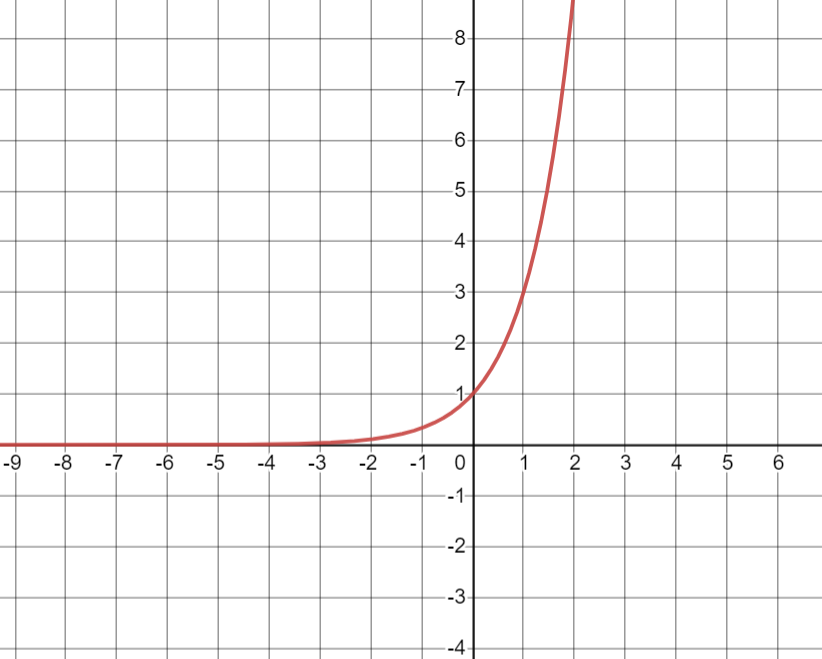
Describe the right side end behavior of
If you subtracted 3 from the exponent in an exponential function, what would happen to the graph?
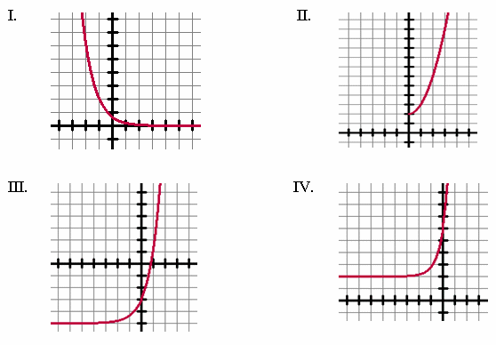
Identify the graph(s) of exponential growth.
Given the function
graphed below, identify the domain (possible x-values).
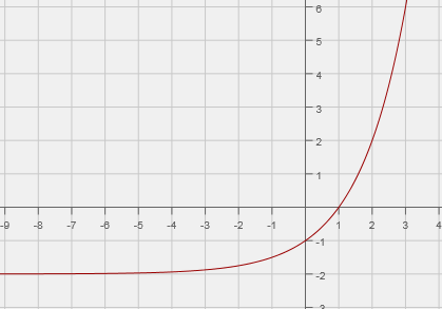
Given the function
graphed below, identify the range(possible y-values).
Given the function
graphed below, identify the asymtote.
Given the function
graphed below, identify the y-intercept(s).
Given the function
graphed below, identify the end behavior as x approaches negative infinity.
Given the function
graphed below, identify the end behavior as x approaches infinity.
Given the function
graphed below, is the function increasing or decreasing?