1/6 Pest Control/IPM

Last updated 7 months ago
20 questions
1

What are used to control insects, weeds, fungus, rodents, and bacteria that threaten our food supply?

1

Why was DDT eventally banned in the US? (NOT ALL)

1

What are some alternate methods to control pests instead of broad scale pesticides? (NOT ALL)

Part 1: Pesticide Spraying Case Study
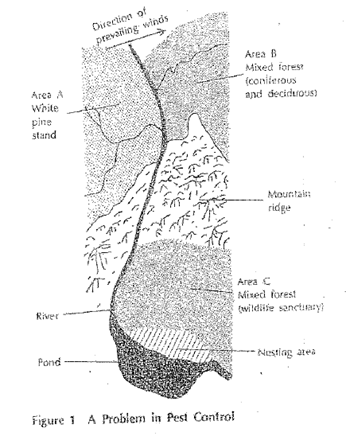
An insect pest has attacked about 20 percent of the trees in a pure stand of white pine. In an effort to reduce his economic loss, the owner has his forest crop sprayed each spring with a relatively new pesticide.
The species that he is trying to eliminate is normally preyed upon by other insects, a parasite, and songbirds from nearby woods. To the south of his property is a bird sanctuary for rare species of waterfowl and the carnivorous osprey.

He has been assured that natural barriers and the wind direction will keep the pesticide out of the wildlife area. The three areas shown in the diagram (Figure 1) were carefully studied over a five-year period by researchers from a nearby university.

Insect populations were estimated, fish and bird populations studied, soil samples collected, and pesticide concentrations measured in an effort to determine the overall environmental influence of this new pesticide. The results are recorded in Table 1.
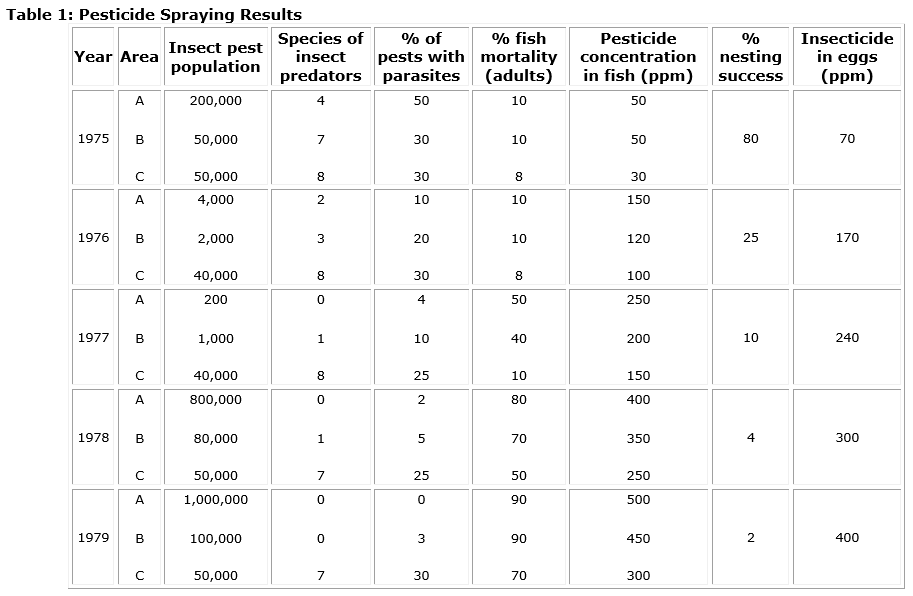
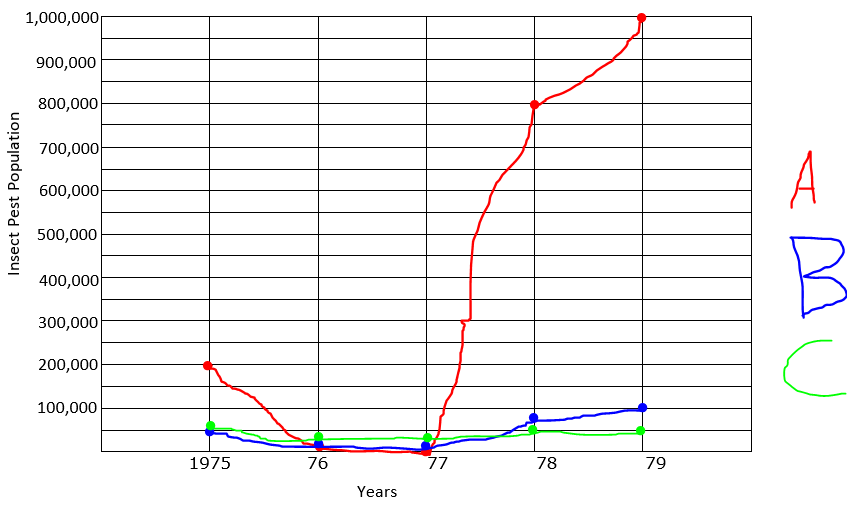
The graph shows the changes over time of the population of insect pests in each area: A, B, and C.

A great graph I know!

1

Why did the population of pests in Area A increase in 1978 when, in 1977, it appeared that the pest had been almost completely eliminated?

1

What indication is there that Area C has not been directly affected by the aerial spraying of the pesticide?

Think about the effect that the pesticide had on natural pest controls in each area.

1

Which categories would be considered natural pest controls? (NOT ALL)

1

How did this eventually influence the size of the populations of natural predators?

Consider the effect that the pesticide had on fish and bird species.

1

Why is the concentration of pesticide so high in fish and bird species?

1

What change in the concentrations of pesticide in the fish and bird life represent the point where significant change in mortality occurs?

1

Draw a food chain that would link the pine stand vegetation to the poor nesting success of the birds.

1

Explain how the use of this pesticide affected species diversity and therefore environmental stability?


Some background information:
· Spring: Apple trees and grapevines blossom around the same time. When the petals fall, tiny leaves begin to emerge.
· Summer: Leaves mature and small, immature fruit begins to develop where the flower had formed.
· Fall: Fruits mature and grow to harvestable size. After harvest time, leaves drop and plants go dormant for the winter.
· Winter: Plants are still alive but are dormant, meaning there is no noticeable growth of foliage. Bark is exposed to elements, and sometimes branches may freeze and die.
· Bt stands for Bacillus thuringiensis, which is a microbial insecticide. T his is an insecticide that contains a bacterium that acts as a parasite.
· Pheromones are chemicals released into the environment in small amounts by many organisms. Through coevolution, insects and plants have adapted many similar attractants, either for mating or pollination.
1

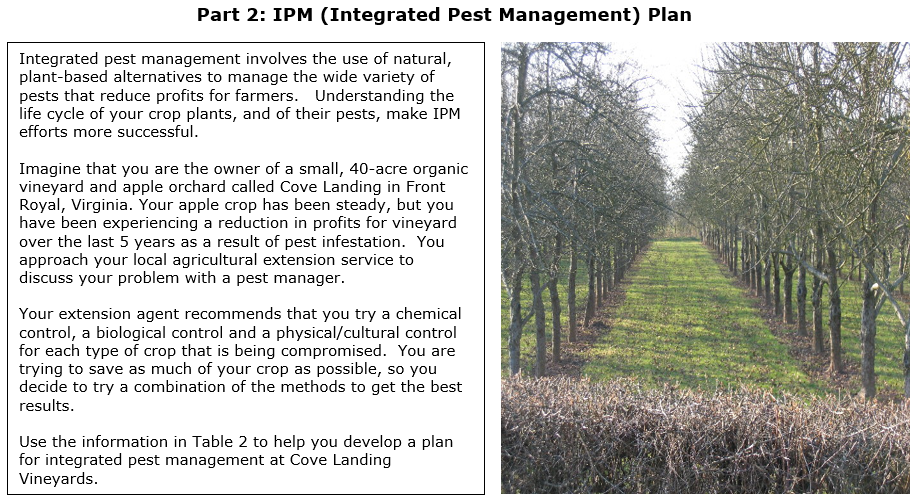
Most IPM plans involve seasonal practices that depend on the life cycle of crops and their pests. What are the first things you would likely do as the spring season gets under way to help protect your early growth with minimal environmental interference?

1

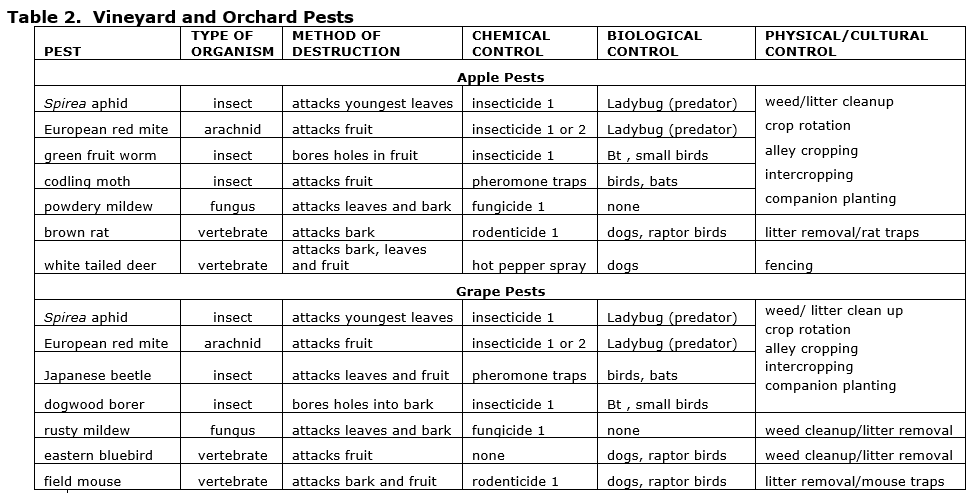
Your apple trees are growing well and producing healthy fruit in early summer, but your grape vines look wilted and have little holes all over them. You also notice a preponderance of moth larvae and Japanese beetles have started to emerge. What could you do to protect your investment?

1

The European red mite has been found in several early apple samples. You want to use an insecticide, but you’re not sure which one to select. Insecticide 1 is known to kill all insects with one or two sprayings, but it takes a bit long to break down. Insecticide 2 breaks down to harmless components very quickly, but is more effective on arachnids than Insecticide 1. You want to kill mites, but not the predatory spiders that inhabit virtually every outdoor arena. Which insecticide would you use?

1

Justify your reasoning.

1

Vineyards and orchards operate all year round. What are some things from the recommended list that you could do year-round to help control pests?

1

Identify ONE benefit for the use of commercially produced chemical pesticides:

1

Identify ONE drawback for the use of commercially produced chemical pesticides:

1

Identify ONE benefit to the use of integrated pest management practices:

1

Identify ONE drawback to the use of integrated pest management practices: