Log in
Sign up for FREE
arrow_back
Library

Unit 04 - Practice Test

star
star
star
star
star
Last updated over 3 years ago
34 questions
1
2
6
4
4
6
6
4
4
4
5
4
4
2
4
4
4
2
4
4
Question 1
1.

Question 2
2.

Question 3
3.

Question 4
4.

Question 5
5.

What is the gravitational force of 1kg?

Question 6
6.

A football is moving upward and rightward towards the peak of its trajectory. Ignore the air resistance. (Grading on forces and magnitudes)

Question 7
7.

A rightward force is applied to a dresser to accelerate it to the right across the bedroom floor. Ignore the air resistance. (Grading on forces and magnitudes)

Question 8
8.
The _______ is the vector _______ of all the _______ that act upon an object.
Question 9
9.

4
Question 10
10.

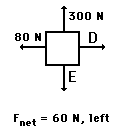
What is the net force on the object?

4
Question 12
12.
In the situation above, the force of letter D must be _______ Newtons, and letter E must be pulling with a force of _______ Newtons.
Question 13
13.
The _______ of an object as produced by a net force is _______ proportional to the _______ of the net force, in the _______ direction as the net force, and _______ proportional to the mass of the object.
Question 14
14.
Doubling of the net force results in a __________ of the acceleration (if the mass is held constant).
Question 15
15.
A doubling of the mass results in a __________ of the acceleration (if force is held constant).
4
Question 16
16.

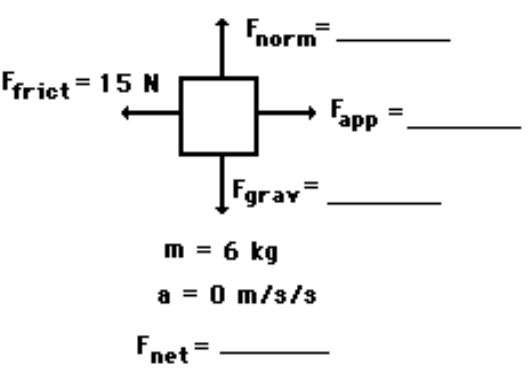
Fgrav=

4
4
4
4
4
4
4
4
Question 25
25.

Question 26
26.
For every action, there is an _______ and _______ reaction.
Question 27
27.
Momentum can be defined as " _______ in _______ "
Question 28
28.

Question 29
29.
In an isolated system, the total momentum of the two objects before the collision is __________ the total momentum of the two objects after the collision.
Question 30
30.

Draggable itemarrow_right_altCorresponding Item
arrow_right_alt
arrow_right_alt
arrow_right_alt
arrow_right_alt
arrow_right_alt
4
Question 31
31.

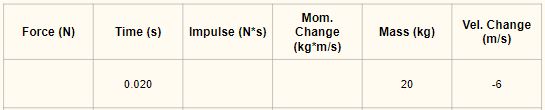
What is the missing value for Force?

4
4
Question 34
34.
The more momentum that an object has, the harder that it is to stop. Thus, it would require a _______ amount of force or a longer amount of _______ or both to bring such an object to a halt.
The more mass and object has, the ___________________ inertia it has
more
less
A 2-kg object is moving horizontally with a speed of 4 m/s.
How much net force is required to keep the object moving at this speed and in this direction?
12 N
8 N
0 N
4 N
In the helium balloon inside the car example, what was the conclusion the class reached as to why this did not violate the first law?

https://www.youtube.com/watch?v=XXpURFYgR2E
The air inside the car had a greater mass than the air in the balloon. This air moved as predicted by the first law. Since the air outside the balloon had less mass it forced the balloon with more mass to go in the opposite direction.
The air inside the car had a greater mass than the air inside the balloon. This air moved as predicted by the first law. Since the air outside the balloon had more mass it forced the balloon with less mass to go in the opposite direction.
The class decided that it did violate Netwon's First Law, because anything can violate a law of Physics.
The air inside the car had less mass than the air inside the balloon. This air moved as predicted by the first law. Since the air outside the balloon had less mass it forced the balloon with more mass to go in the opposite direction.
One Newton of Force is equal to ______________
1g • 9.8m/s/s
1kg • 1m/s/s
1kg • 1m/s
1g • 1m/s/s
1kg • 9.8m/s/s
1g • 1m/s/s
Why does constant velocity indicate NO net force?
for something to be moving at a constant velocity means there must be a force acting upon it somewhere (Mr. Fischers Example of the Laptop Case)
net forces are connected to velocity, not acceleration
constant velocity means no acceleration, and for there to be a net force there must be acceleration
constant velocity means that there is acceleration, and therefore means that there is no net force
Question 11
11.

Explain what is happening to the object using the word 'acceleration'.

Question 17
17.

Fnorm=

Question 18
18.

Fapp=

Question 19
19.

Fnet=

Question 20
20.

Fgrav=

Question 21
21.

Fnorm=

Question 22
22.

Fnet=

Question 23
23.

Ffrict=

Question 24
24.

'mu' =

Explain what is meant by 'terminal velocity.
Terminal velocity is when fair becomes greater than fgrav and then the net force or acceleration on the object increases.
Terminal velocity is when fgrav and fair become equal and then there ceases to be any net force or acceleration on the object.
Terminal velocity is when net force and fair become equal and then there ceases to be any fgrav on the object.
Terminal velocity is when fgrav and net force become equal and then there ceases to be any fair on the object.
What is the formula for momentum?
P=m°a
F=m°v
Pnet=m°a
P=m°v
Fnet=m°v
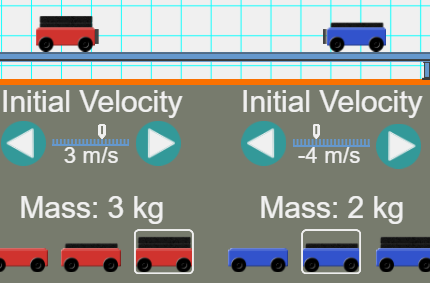
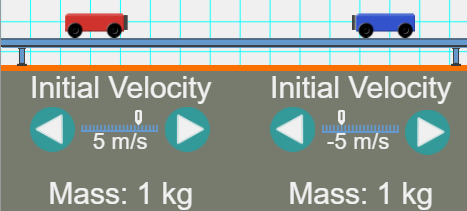
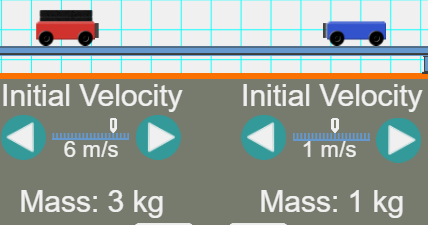
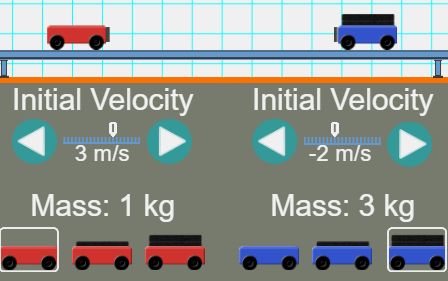
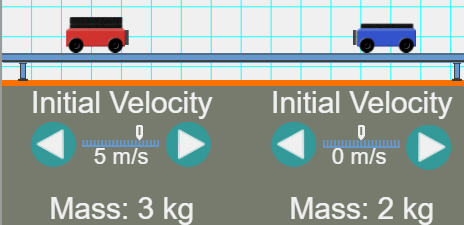
Match the inelastic collision situation with the outcome.
0 m/s
3 m/s
- 0.7 m/s
0.2 m/s
4.8 m/s
Question 32
32.

What is the missing value for Impulse?

Question 33
33.

What is the missing value for Momentum Change?