Log in
Sign up for FREE
arrow_back
Library

Unit 3 Final Test A

star
star
star
star
star
Last updated over 2 years ago
25 questions
1
1
1
1
1
1
1
1
1
0
1
1
1
1
1
1
1
1
1
1
1
1
1
1
1
Question 1
1.

Question 2
2.

Question 3
3.

Question 4
4.

Question 5
5.

Question 6
6.

Question 7
7.

Question 8
8.

Question 9
9.

Question 10
10.

Question 11
11.

Question 12
12.

Question 13
13.

Question 14
14.

Question 15
15.

Question 16
16.

Question 17
17.

Question 18
18.

Question 19
19.

Question 20
20.

Question 21
21.

Question 22
22.

Question 23
23.

Question 24
24.

Question 25
25.

The uneven distribution of Earth's mineral, energy, and groundwater resources is the result of________________________________.
radiation from the sun
past and current geologic processes
burning fossil fuels
carbon emissions
Categorize these natural resources as either renewable or non-renewable:
Water (in aquifers)
Sunlight
Air
Fossil Fuels
Plants and Animals
Water (above ground)
Rocks and Minerals
Renewable Resources
Non-Renewable Resources
What is it called/what is produced when fossil fuels are burned?
biomass
nonrenewable resources
radiation
carbon emissions
What is the sum of all of the resources a human consumes and all of the waste created and left behind?
sustainable
Human footprint
renewable resources
Fossil fuels
These are resources that CANNOT be replaced during our lifetimes.
Non-Renewable Resources
Renewable Resources
Water Resources
Resources from the Sun
People try to conserve some resources, like fossil fuels, because they are not replaceable. Why can’t these resources be replaced?
No one can afford to buy more of them.
They must be transported long distances.
It is impossible to extract more from the earth.
Processes that make them take a long time.
Select all the fossil fuels we have learned about in class:
Oil
Natural Gas
Coal
Water
Copper
Iron
People move into and begin living in an area that previously had no human activity. What will most likely be the effect on the amount of water?
There will be less available for other living things.
Water will be more evenly distributed in the area.
Most of the fresh water in the area will be converted to salt water.
The amount of fresh water suitable for drinking will increase.
Select the choice below that describes the best how petroleum is created:
Decomposing swamp plants become trapped in sediment. Layers and layers of rock apply immense heat and pressure over millions of years, eventually turning the organism's remains to liquid.
Decomposing tiny marine animals become trapped in sediment. Within a few years their remains have created oil from the soil.
Decomposing tiny marine animals become trapped in sediment. Layers and layers of rock apply immense heat and pressure over millions of years, eventually turning the organism's remains to liquid.
Decomposing swamp plants become trapped in sediment. Within a few years their remains have created oil from the soil.
The claim is made that carbon emissions can be reduced by increasing the amount of electricity produced by wind. Which pair of graphs, showing data for CO2 emissions, and wind production of electricity, would support this claim?
Scientists estimate that our total resources will only support 2 billion people.
True
False
What word describes not being harmful to the environment and not depleting natural resources
human footprint
sustainable
biomass
fossil fuels
Metals such as copper are found where _________________
current oceans are
oil is found
layers of mud are pressed down
plate boundaries meet
Oil and natural gas are found in areas where there are past or present ________________.
Grasslands
Tundra
Rainforests
Oceans
In areas where biodiversity is high the destruction of a given number of square miles of habitat would likely affect a greater number of species
True
False
Would feeding an ever-growing population be a positive or negative human impact on our environment?
negative
positive
Are infrastructure changes a major postitive or negative human impact on our environment?
negative
positive
Anything humans use that are obtained from the Earth?
Human Footprint
Geologic Processes
Natural Resources
Biodiversity
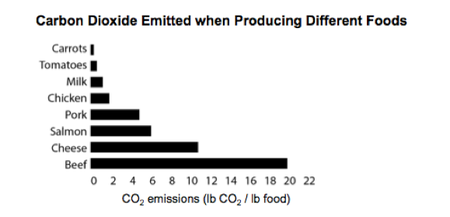
Which of the following claims is supported by the data?
Producing food from plants results in more carbon dioxide emissions than from animals.
Producing 1 lb of carrots results in more CO2 emissions than producing 1 lb of tomatoes
Carbon emissions are higher for the production of beef than for chicken and pork combined.
The highest carbon emissions come from the production of dairy products.
What happened during the 19th century that led to humans using fossil fuels for industry and infrastructure?
Civil War
American Revolution
Farming and Agriculture
Industrial Revolution
Do greenhouse gasses help us trap heat so our planet stays warmer, or release heat so we cool off?
release heat
trap heat
Which of the following would be evidence of climate change?
Weather events becoming less severe
Shrinking ice sheets
Sea levels decreasing or staying the same
Global temperatures remaining the same
When carbon dioxide is released into the atmosphere from fossil fuel combustion, plants in the biosphere are able to absorb and store some of it. This is why plant life is called a __________________?
Carbon sink
Carbon emissons
deforestation
Photosynthesis
Deforestation __________ the amount of carbon dioxide in the atmosphere.
increases
reduces
Deforestation causes: (select all that apply)
reduces the amount of plants available to absorb carbon dioxide from the atmosphere
carbon dioxide to be released in the atmosphere when the forests are burned
an increase in biodiversity