Read or listen to the story first, then answer the questions using complete sentences.
Read or listen to the story first, then answer the questions using complete sentences.
Central Idea
Informational text generally includes a central idea, the idea that the text is mostly about. Individual paragraphs may have their own central ideas. The central idea is sometimes stated in
the first or last sentence. Authors use evidence, such as facts and examples, to support the central ideas.
Answer the questions about paragraph 11 on page 341 of Children of the Great Depression.
What is the central idea of this paragraph?
What text evidence supports the central idea?
How does this central idea fit into the overall theme of the selection?
What is the central idea of these paragraphs?
What evidence does the author use to support the central idea?
Summarize this section, including only the most important information.
Text Structure
Text structure refers to the way writing is organized. Authors can use several different text structures, including cause and effect and sequential order. One of the most common text
structures is comparison/contrast. In this form of organization, writers tell how different ideas, people, or things are alike and how they are different.
Answer the questions about page 344 of Children of the Great Depression.
What text structure can you identify in paragraphs 21 and 22?
What transitional words or phrases signal this text structure?
How does this text structure improve readers’ understanding of the selection?
What comparison is made in paragraph 19?
What contrast appears in paragraph 20? What words signal that contrast?
Text and Graphic Features
Authors use text features, such as headings, introductions, and boldfaced words, to draw attention to specific parts of a text and to help readers find information. They use graphic
features, such as photographs and diagrams, to explain ideas in a visual way or to add information related to the ideas in the text. Using a text and its features together helps readers
gain a clearer or deeper understanding of the author’s ideas.
Answer the questions about pages 339–340 of Children of the Great Depression.
According to paragraphs 5–9, what was life like for children who worked during the Depression?
How do the graphic features support the text?
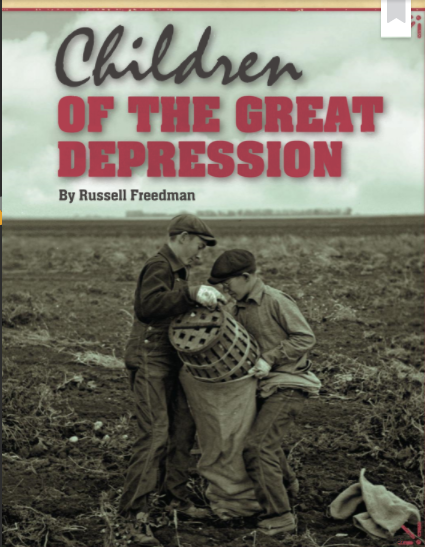
What can you predict from the photo on page 337?
How do the text and graphic features on page 345 help you predict what the text is going to be about?
How does the graphic feature help you better understand the text?
If you were to add another text or graphic feature, what would it be? What do you think it would add to the text?