Semester 1 - 30min Physics Final

Last updated about 3 years ago
28 questions
Unit 01 - Process of Science
4

Put the scientific method in order

  1. Test hypothesis
  2. Analyze data
  3. Make an observation
  4. Design experiment
  5. Ask a question
  6. Report results
  7. Create hypothesis
  8. Research
2

What persuasion technique is based on the credibility of the speaker?

6

Match the types of evidence to the examples: (can use the same one more than once)

  • Empirical
  • Logical
  • Anecdotal
  • Pressure according to barometer.
  • A before and after photo of a weight-loss commercial.
  • Telling someone how you solved a similar problem.
  • The amount of money that was spent on each student in the mathematics department this year was almost $1.30
  • Starting carpenters pay this year is $48,000
  • When you ask google the temperature outside today.
4

In technical communication we are looking for ....

8

Tori heard an observation from a student in class stating that not eating any food 3 hours before bedtime leads to high-quality sleep. SO she designed an experiment. Click and drag the items on the left to the categories on the right. (Some items may be used more than once)

  • Independent Variable
  • Dependent Variable
  • Hypothesis
  • Potential error
  • Experimental Control
  • Eating food or not eating food 3 hours before bedtime
  • High-Quality Sleep
  • Same bed each night
  • Same time each night
  • Same bedtime routine each night
  • Not eating food 3hours before bedtime will lead to high-quality sleep
  • Using phone right before bed
  • Really bad storm
Unit 02 - Constant Velocity
2

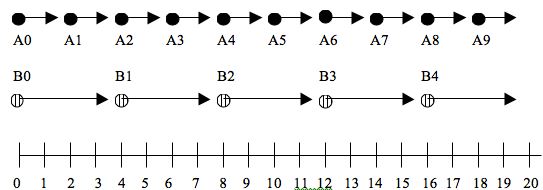
What was the position of object A after 2 seconds?

2

What was the position of object B after 3 seconds?

4

What was the velocity of object A?

4

What was the velocity of object B?

2

Which object was traveling towards the reference point?

4

Create a Motion Map from scratch to fit the following situation:

The ball rolled backward at 3m/s for 8s. It then stopped for 4s.

4

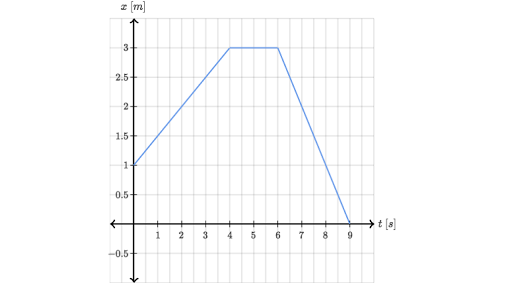
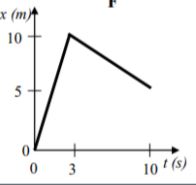
Describe what occurred within the following Position vs Time Graph


6

Which statements best describe this graph?

Unit 03 - Acceleration
4
The velocity-time graph for a two-stage rocket is shown below. Use the graph and your understanding of slope to drag and drop the acceleration of the rocket during the listed time intervals.


The acceleration of the object from t=0 to t=1 is ______________________ .
The acceleration of the object from t=1 to t=4 is ______________________ .
The acceleration of the object from t=4 to t=12 is ______________________ .
Other Answer Choices:
40 m/s/s
20 m/s
40 m/s
-1 m/s/s
2 m/s/s
1 m/s/s
-40 m/s/s
0 m/s
0 m/s/s
- 20 m/s/s
20 m/s/s
4


What is the graphical interpretation of the motion of the car?

0

Explain the velocity of a thrown object. Your response should address the velocity change of the rise, the peak, and the fall.

0

Acceleration due to gravity ...

6

What is the time it took for the vase to hit the ground?

6

What is the landing speed?

Unit 04 - Forces and Momentum
2

A 2-kg object is moving horizontally with a speed of 4 m/s.
How much net force is required to keep the object moving at this speed and in this direction?

4

One Newton of Force is equal to ______________

6

A thrown desk is moving upward and leftward towards the peak of its trajectory. Ignore the air resistance. (Grading on forces and magnitudes)

4

Why does constant velocity indicate NO net force?

4
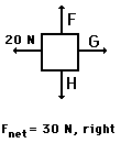
Using the bank to click and drag the items to make the statement true.
In order for Fnet to be 30N, right: F must equal ______________________ , G must equal ______________________, and H must equal ______________________ .
Other Answer Choices:
50 N
G
H
0 N
80 N
- 10 N
F
2
Doubling of the net force results in a __________ of the acceleration (if the mass is held constant).
2
A doubling of the mass results in a __________ of the acceleration (if force is held constant).
2

Explain what is meant by 'terminal velocity.'

4
The more momentum that an object has, the harder that it is to stop. Thus, it would require a __________ amount of force or a longer amount of __________ or both to bring such an object to a halt.