What persuasion technique is based on the credibility of the speaker?
1 point
1
Question 3
3.
What persuasion technique is based on logic and facts?
1 point
1
Question 4
4.
Match the types of evidence to the examples: (can use the same one more than once)
Empirical
Logical
Anecdotal
Pressure according to barometer.
Your friend telling you some gossip about another person.
Telling someone how you solved a similar problem.
The amount of money that was spent on each student in the science department this year was almost 134$
Starting teachers pay this year is $38,000
1 point
1
Question 5
5.
Match the types of evidence to the examples: (can use the same one more than once)
Empirical
Logical
Anecdotal
Pressure according to barometer.
Your friend telling you some gossip about another person.
Telling someone how you solved a similar problem.
The amount of money that was spent on each student in the science department this year was almost 134$
Starting teachers pay this year is $38,000
2 points
2
Question 6
6.
Select the metric units only
6 points
6
Question 7
7.
Let's say you want to develop an experiment to test whether staying up late affects your level of concentration throughout the day. What is your independent and dependent variables?
6 points
6
Question 8
8.
What is your definition of an independent variable?
2 points
2
Question 9
9.
Why do we report results?
2 points
2
Question 10
10.
Put the lab results sections in order.
Discussion
Introduction
Results
Methods
1 point
1
Question 11
11.
In technical communication we like ....
8 points
8
Question 12
12.
Tori heard an observation from a student in class stating that drinking body armor hydrates you after a workout better than water or Gatorade. After some research, she makes the assertion that Body Armor hydrates you more than any other sports drink or just plain water. She then begins to design her experiment. Match the parts of the experiment to the experiment she plans to conduct.
Independent Variable
Dependent Variable
Experimental Control
Hypothesis
Potential error
Types of drinks. Water, Gatorade, Body Armor.
Same workout before drinking
Same person during the workout
Using an athlete and a non-athlete to do the tests
Testing using the same workout routine
How hydrated the person is after drinking
Telling the person what drink is which before they drink it
Unit 02 - Constant Velocity
2 points
2
Question 13
13.
What was the position of object A after 6 seconds?
2 points
2
Question 14
14.
What was the position of object B after 2 seconds?
4 points
4
Question 15
15.
What was the velocity of object A?
4 points
4
Question 16
16.
What was the velocity of object B?
2 points
2
Question 17
17.
Which object was traveling away from the reference point?
4 points
4
Question 18
18.
Create a Motion Map from scratch to fit the following situation:
The ball rolled backward at 2m/s for 3s. It then stopped for 6s. And then the ball traveled forward at 6m/s for 2s.
4 points
4
Question 19
19.
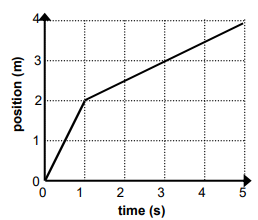
Describe what occurred within the following Position vs Time Graph
4 points
4
Question 20
20.
Draw and label the graph of the three different scenarios with three different colors.
You sat 11 meters away from the starting line.
You ran at 5m/s for 3 seconds
You ran at 3m/s for 2 seconds, stopped for 1 second, then continued running at 3m/s
4 points
4
Question 21
21.
What is the objects average speed?
4 points
4
Question 22
22.
What is the objects average velocity?
6 points
6
Question 23
23.
Select all of the items that are FALSE
4 points
4
Question 24
24.
What does this indicate?
9 points
9
Question 25
25.
Analyze then describe what is happening with objects 1 and 2 within each given section (A, B, C).
Unit 03 - Acceleration
4 points
4
Question 26
26.
Rank the cars from top (smallest) acceleration to bottom (greatest) acceleration.
red
green
blue
4 points
4
Question 27
27.
Consider the position-time graph. Each one of the three lines on the position-time graph corresponds to the motion of one of the three cars. Match the appropriate line to the particular color of the cars in problem #1.
Draggable item
arrow_right_alt
Corresponding Item
red
arrow_right_alt
B
blue
arrow_right_alt
A
green
arrow_right_alt
C
4 points
4
Question 28
28.
The velocity-time graph for a two-stage rocket is shown below. Use the graph and your understanding of slope calculations to determine the acceleration of the rocket during the listed time interval.
What is the acceleration of the rocket from t=9 -> t=12 ?
4 points
4
Question 29
29.
What is the graphical interpretation of the motion of the car?
4 points
4
Question 30
30.
What is the graphical interpretation of the motion of the car?
4 points
4
Question 31
31.
The slope of a Velocity vs Time Graph is interpreted as _______ . BUT! On a Position vs Time graph the slope is considered the _______.
4 points
4
Question 32
32.
Demonstrate 'freefall' on a position vs. time graph and on a velocity vs. time graph.
2 points
2
Question 33
33.
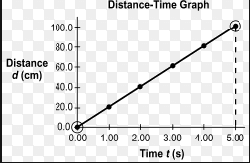
REVIEW: Look at the distance-time graph below.
What is the acceleration of the object?
6 points
6
Question 34
34.
What is acceleration? Type a definition for this term in your own words.
2 points
2
Question 35
35.
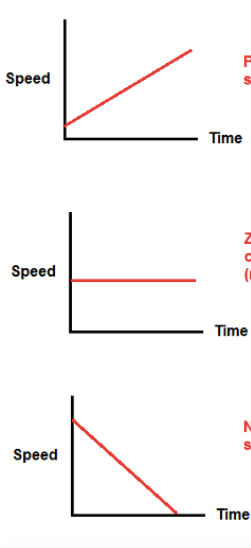
Describe the acceleration.
2 points
2
Question 36
36.
Describe the acceleration.
2 points
2
Question 37
37.
Describe the acceleration.
4 points
4
Question 38
38.
Acceleration due to gravity ...
6 points
6
Question 39
39.
What was the speed of the ball when it hit the ground below the cliff?
6 points
6
Question 40
40.
What is the distance of the ball above its initial position when it reaches the peak?
Unit 04 - Forces and Momentum
2 points
2
Question 41
41.
A 2-kg object is moving horizontally with a speed of 4 m/s.
How much net force is required to keep the object moving at this speed and in this direction?
6 points
6
Question 42
42.
In the helium balloon inside the car example, what was the conclusion the class reached as to why this did not violate the first law?
https://www.youtube.com/watch?v=XXpURFYgR2E
6 points
6
Question 43
43.
A leftward force is applied to a dresser to accelerate it to the left across the bedroom floor. Ignore air resistance. (Grading on forces and magnitudes)
4 points
4
Question 44
44.
Why does constant velocity indicate NO net force?
4 points
4
Question 45
45.
What is the net force on the object?
4 points
4
Question 46
46.
Explain what is happening to the object using the word 'acceleration'.
2 points
2
Question 47
47.
A doubling of the mass results in a __________ of the acceleration (if force is held constant).
8 points
8
Question 48
48.
A rightward force is applied to a 10-kg object to move it across a rough surface at constant velocity. The coefficient of friction between the object and the surface is 0.2. Use the diagram to determine the gravitational force, normal force, applied force, frictional force, and net force. (Neglect air resistance.)
2 points
2
Question 49
49.
Explain what is meant by 'terminal velocity.'
4 points
4
Question 50
50.
Give an example of a action-reaction pair.
4 points
4
Question 51
51.
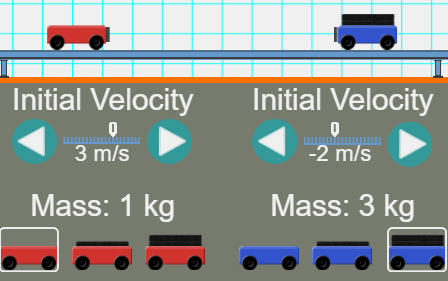
Determine the velocity of both the red and blue cart after the inelastic collision.