Log in
Sign up for FREE
arrow_back
Library

HONORS CIVIL WAR to RECONSTRUCTION

star
star
star
star
star
Last updated over 2 years ago
50 questions
1
1
1
1
1
1
1
1
1
1
1
1
1
1
1
1
1
1
1
1
1
1
1
1
1
1
1
1
1
1
1
1
1
1
1
1
1
1
1
1
1
1
1
1
1
1
1
1
1
Question 1
1.

INTEGRITY OATH
I, ____________, give my word that I will not discuss any element of this exam with anyone FOR 24 HOURS. I will not convey any information to aid or assist anyone in preparing for this exam. I further promise that I did not receive any inappropriate assistance in preparing for this exam. I understand that sharing
or discussing anything regarding this exam before they have taken the exam will be considered cheating. I understand that providing information to another or receiving information from another is cheating. I further understand that anyone caught cheating will be given a zero for this exam and will be dealt with harshly. By typing my name below, I understand the expectations and agree to abide by them.

MULTIPLE CHOICE: Please read each question carefully. THINK before you look at the options, think how you would answer it. As you then look at each option, choose the BEST ONE. Do not go back and change your answer later UNLESS you read the question wrong the first time ... TRUST YOUR GUT!
Question 2
2.

Question 3
3.

Question 4
4.

Question 5
5.

Question 6
6.

Question 7
7.

Question 8
8.

Question 9
9.

Question 10
10.

Question 11
11.

Question 12
12.

Question 13
13.

Question 14
14.

Question 15
15.

1
Question 17
17.

Question 18
18.

Question 19
19.

Question 20
20.

Question 21
21.

Question 22
22.

Question 23
23.

Question 24
24.

Question 25
25.

Question 26
26.

Question 27
27.

Question 28
28.

Question 29
29.

Question 30
30.

Question 31
31.

Question 32
32.

Question 33
33.

Question 34
34.

Question 35
35.

Question 36
36.

Question 37
37.

Question 38
38.

Question 39
39.

Question 40
40.

Question 41
41.

Question 42
42.

Question 43
43.

Question 44
44.

Question 45
45.

Question 46
46.

Question 47
47.

Question 48
48.

Question 49
49.

Question 50
50.

Which statement about the results of the Civil War is most accurate?
a. Federal supremacy was strengthened.
b. Constitutional government was proven ineffective.
c. Universal suffrage was generally accepted.
d. Sectional disputes ceased to exist.
What was the major reason the Radical Republicans opposed President Abraham Lincoln's
Reconstruction plan?
a. The plan demanded payments from the South that would have damaged its economy.
b. The plan postponed the readmission of Southern States into the Union for many years.
c. The plan granted too many rights to formerly enslaved persons.
d. The plan offered amnesty to nearly all Confederates who who swear allegiance to the United States.
The North’s “victory” at Antietam allowed President Lincoln to
a. force the border states to remain in the Union.
b. keep General McClellan as commander of the Union forces.
c. issue the Emancipation Proclamation.
d. suppress Copperhead opposition in the North.
The Reconstruction period, an important objective of congressional action was to
a. maintain Republican domination of the National Government.
b. restore pre-Civil War conditions to the South.
c. destroy the economy of the South.
d. develop two equal political parties in the South.
. . . With malice toward none, with charity for all, with firmness in the right as God gives us to see the right, let us strive on to finish the work we are in, to bind up the nation's wounds, to care for him who shall have borne the battle and for his widow and his orphan, to do all which may achieve and cherish a just and lasting peace among ourselves and with all nations.— Abraham Lincoln, Second Inaugural Address, March 4, 1865

This statement above reveals President Lincoln's support for
a. a new peace treaty with Great Britain.
b. universal male suffrage.
c. a fair and generous peace.
d. harsh punishment for Confederate leaders.
The Confederate cause was weakened by
a. the fact that the Confederate states deeply believed in a states’ rights ideology.
b. a President who catered to public opinion and did not work hard at his job.
c. the failure of the Southern people to commit to the ideal of Southern independence.
d. a lack of strong military leadership.
The South hoped to gain diplomatic recognition and active support from Great Britain because
a. slavery was still legal in the British Empire.
b. British public opinion generally supported the South.
c. British factories needed Southern cotton.
d. Britain wanted the help of the South to regain the Oregon Territory.
e. the North had placed high tariffs on British good
One of the causes of the horrific nature of Civil War battles was
a. the specific targeting of civilians.
b. the widespread use of fire to “burn out” defenders.
c. the targeting of generals and other high-ranking officers.
d. the increased accuracy and range of weapons.
In the North, the major burden of fighting fell to the working people, because draft laws
a. allowed wealthy to hire substitutes to serve for them.
b. barred wealthy from enlisting.
c. limited non-fighting jobs in the military to the wealthy.
d. completely exempted the wealthy.
Which of the following statements about the Emancipation Proclamation is NOT accurate?
a. It immediately freed all slaves living in the United States.
b. It freed slaves only in the Confederacy or in areas of active rebellion.
c. It led to the creation of all-black units in the Union Army.
d. It was issued in part because slave labor was helping the Confederate cause.
e. It gave the North a high moral reason for continuing the war.
The excerpt below was printed in a magazine in the South in 1866:
We should be satisfied to compel them to engage in coarse, common manual labor, and to punish them for dereliction of duty or non-fulfillment of their contracts with such severity, as to make them useful, productive laborers.

Which of the following would the author of this excerpt most likely have supported?
a. the formation of the Freedmen's Bureau.
b. the ratification of the Fourteenth Amendment.
c. the passage of Black Codes and Jim Crow laws.
d. the relocation of emancipated slaves to colonies in Africa.
In the North, the major burden of fighting fell to the working people, because draft laws
a. allowed wealthy to hire substitutes to serve for them.
b. barred wealthy from enlisting.
c. limited non-fighting jobs in the military to the wealthy.
d. completely exempted the wealthy.
During the Civil War, African Americans in the North
a. were not allowed to join the Union Army.
b. were allowed to join the Union Army but saw no combat.
c. fought in regiments of black soldiers with white officers.
d. were integrated into white regiments.
e. were permitted to select their own officers.
In 1868, President Andrew Johnson was impeached after he removed a Lincoln appointee from the office without first getting approval from the Senate. President Johnson was impeached because he had violated which law?
a. Military Reconstruction Act
b. Tenure of Office Act
c. Civil Rights Act of 1866
d. Morrill Act
Question 16
16.

Why was Lincoln so reluctant to support immediate freedom for the slaves?
a. He wanted to relocate them back to their home in Africa, but couldn’t find funding.
b. He feared alienating border-state.
c. He knew many northerners were racially prejudiced.
d. He was worried once slaves were freed, England would join the Confederacy.
“Forty acres and a mule” refers to
a. the proposal to get land into the hands of freed slaves.
b. the terms of the Homestead Act of 1862.
c. the allotment given to Native Americans under the Dawes Severalty Act.
d. the inducement given recent immigrants if they would settle outside of urban centers.
Which of the following best describes Grant’s approach in his final campaign against Lee?
a. forcing Lee to take the offensive so Grant could capitalize on his superior defensive talents.
b. keeping the pressure on Lee with constant assault or siege.
c. taking Richmond in a single overpowering strike against Lee.
d. using the terrain to force Lee into difficult fighting scenarios.
Which statement best describes the Confederate economy?
a. The Confederate economy was primarily agricultural.
b. The Confederate economy was split evenly between agriculture and manufacturing.
c. The Confederate economy was primarily based on the cattle industry.
d. The Confederate economy was primarily based on the manufacturing industry.
The passage below is an excerpt from the Fourteenth Amendment:

No State shall make or enforce any law which shall abridge the privileges or immunities of citizens of the United States; nor shall any State deprive any person of life, liberty, or property, without due process of law; nor deny to any person within its jurisdiction the equal protection of the laws.

This amendment was proposed by Congress in response to which of the following?
a. the rise of violence against emancipated slaves.
b. the passage of Black Codes throughout the South.
c. the emergence of white resistance to the civil rights movement.
d. the attempts of Democrats to limit the voting rights of African Americans.
The impeachment of Andrew Johnson
a. resulted in his conviction and removal from the office of president.
b. resulted in a vote of acquittal with a huge majority of senators favoring Johnson.
c. was the only time in American history that a president has faced impeachment.
d. was organized by Radical Republican opponents who saw him as interfering with Reconstruction.

Carpetbaggers
a. were Southerners who used Reconstruction for personal gain, usually through corruption.
b. were welcomed wholeheartedly in the South because of the political experience they brought.
c. greatly aided in the South's Reconstruction with their selfless devotion to the defeated Southern citizens.
d. were Northerners who came South and took political office in the newly created Southern political system.
In the early stages of the Civil War, Lincoln declared that the war was being fought
a. in order to end slavery in the border states.
b. to keep the Union together.
c. in order to restore the Missouri Compromise.
d. to punish the South for maintaining a policy of slavery.
The Confederate strategy involved ALL the following EXCEPT
a. capturing Washington D.C.
b. winning European aid.
c. maintaining a defensive position.
d. controlling the coastline.
The first bill ever passed over a presidential veto was the
a. Wade-Davis bill.
b. Freedmen's Bureau extension bill.
c. Civil Rights Act of 1866.
d. Tenure of Office Act.
President Lincoln's Reconstruction plans were committed to
a. rapid readmission of the southern states to the Union.
b. punish the South for provoking the Civil War.
c. racial equality for the freedmen.
d. sharing with Congress the decisions in establishing Reconstruction policies.
e. protecting the rights of African Americans.
The 14th amendment provides that no "state [shall] deprive any person of life, liberty, or
property, without due process of law; nor deny to any person within its jurisdiction the equal
protection of the laws."

A direct result of this amendment was that
a. the process of amending the Constitution became slower and more complex.
b. the guarantees in the Bill of Rights were applied to state actions.
c. every citizen gained an absolute right to freedom of speech and assembly.
d. the power of the Federal Government was sharply reduced.
What does the term total war describe?
a. Sherman’s policy of destroying everything in order to show civilians the impact of the war.
b. The fact that the Civil War battlegrounds stretched from Northern Virginia to Louisiana.
c. General Winfield Scott’s original plan to destroy the Confederacy.
d. Grant’s destruction of the Native Americans to keep them from coming into American territory.
One significant difference between the North and the South as the war went on was that
a. northern civilians suffered more than their Southern counterparts.
b. the South became poorer while the North tended to prosper.
c. northern agriculture declined while Southern agriculture leapt ahead.
d. northern industrial capacity declined during the war years.
e. southern industry boomed during the war years.
The Freedmen's Bureau did all of the following EXCEPT
a) set up courts to adjudicate labor matters.
b) provide food and shelter to refugees of the Civil War.
c) act as an unemployment agency for blacks.
d) provide economic independence for blacks.
e) establish schools to educate blacks.
The North’s war strategy centered on ALL the following EXCEPT
a. capturing the Confederate capital.
b. dividing the South geographically.
c. invading the South.
d. gaining England’s support in the conflict.
The debate over ratification of the Thirteenth Amendment demonstrates that ___________.
a. by war's end there was widespread support in the North to abolish slavery.
b. those who supported the end of slavery also supported full civil rights for blacks.
c. it was not a foregone conclusion at the end of the Civil War that there would be sufficient support to abolish slavery via constitutional amendment.
d. ending slavery required just compensation to slave owners for the destruction of their “property.”
President Andrew Johnson was NOT
a. a southerner.
b. a Democrat.
c. an opponent of slaveowners.
d. a great humanitarian.
e. a Unionist.
Why was the defeat at Vicksburg, MS a significant loss for the Confederate Army?
a. Great Britain refused to support the Confederacy after the defeat.
b. At this point, all Confederate soldiers lost all hope in their cause.
c. It allowed the Union Army to have total control of the Mississippi River.
d. Their defeat caused confederate leaders to stop sending government aid.
When it was issued in 1863, the Emancipation Proclamation declared free only those slaves
a. who had fled their masters and joined the Union Army.
b. in states still in rebellion against the United States.
c. in the Border States and areas under Union Army control.
d. in Washington D.C.
Sherman's "march from Atlanta to the sea" was especially notable for
a. its brilliant strategy against powerful Confederate forces.
b. its generosity towards the captured Southern sympathizers.
c. its brutal use of destruction against the Southern civilian population.
d. its impact in inspiring Northern public opinion to turn against slavery.
Thaddeus Stevens, Charles Sumner, and Benjamin Wade were leaders of the
a. Copperheads.
b. War Democrats.
c. Radical Republicans.
d. Lincoln Republicans.
Lacking sufficient money from taxes or bonds, the Confederacy was forced to print money to pay its bills, causing
a. rapid inflation in the south.
b. on-going trade deficits with Britain.
c. decreased availability of credit.
d. overextension of banking institutions.
Which of the following best describes the Battle of Antietam?
a. It was the last major battle of the war involving General Robert E. Lee.
b. It was fought in the South and became a major turning point in the war.
c. It was the shortest Civil War battle and contained the least amount of casualties.
d. It was the first major battle on Union soil and the bloodiest day in U.S. battle history.
On the complex question of returning the defeated Confederate states to the Union,
a) southerners believed that they had legally seceded and would have to be formally readmitted back into the Union.
b) Charles Sumner believed that the Confederate states had ceased to exist as states and must be treated as conquered territory.
c) Radical Republicans believed that secession was illegal and that former Confederate states needed no formal readmission to the Union.
d) northerners felt the South had committed treason and should lose Congressional representation.
e) President Lincoln believed secession was illegal, but that southern states still needed to be formally readmitted to the Union.
Which of the following individuals was NOT hanged by the US government for their involvement in the assassination of Abraham Lincoln?
John Wilkes Booth
Mary Surratt
Lewis Powell
George Atzerodt
The provision of the Radical Republicans’ plan for Reconstruction that Southern States found most objectionable was that a former Confederate State could not be readmitted to the Union unless that State
a) gave land and money to former slaves.
b) granted full citizenship to former Confederate leaders.
c) ratified the 14th amendment.
d) agreed to modernize its economy.
In the 1866 elections,
a) President Johnson conducted a highly successful “swing around the circle” campaign tour.
b) radicals replaced moderates as the dominant faction in congress.
c) Republicans lost their majority control of Congress.
d) a number of white southern Republicans were elected.
The due process clause of the 14th Amendment to the United States Constitution most nearly means that
a) all labor-management contracts must be reviewed by a commission of the federal government.
b) members of minority groups must be given preferential treatment in employment.
c) the selection of the President and Vice President must follow a prescribed set of steps.
d) a standard set of procedures must be followed before any action is taken to punish persons accused of breaking the law.
Following the Civil War, the consuming passion of most white Southerners was:
a) returning to the antebellum slavery system.
b) bringing industry and economic prosperity to the South.
c) re-establishing white supremacy and the social order.
d) rebuilding the South's infrastructure.
e) regaining the South's former position in the Union.
Base your answer to the question below on the passage below:
"[The registrar] brought a big old book out there, and he gave me the sixteenth section of the constitution of Mississippi, . . . I could copy it like it was in the book, but after I got through copying it, he told me to give a reasonable interpretation and tell the meaning of the section I had copied. Well, I flunked out." Source: A History of the United States since 1861 The main intent of the literacy test described in the passage was to
a) encourage reform of the political system.
b) encourage Mississippi residents to learn about their state’s legal system.
c) prevent African Americans from exercising a basic right.
d) enforce the provisions of the United States Constitution.
Both Lincoln and Johnson shared the view that Reconstruction
a) should punish the South for secession.
b) needed to be a complete socio-economic transformation.
c) prohibited any real conciliation of North and South.
d) was a Presidential function.
Which of the following events occurred first?
a) The Reconstruction Act was passed by Congress.
b) The 13th Amendment passed Congress.
c) The Joint Committee on Reconstruction held hearings.
d) Abraham Lincoln was assassinated.
The process of depriving African-Americans of the right to vote in the South
a) did not occur - it is a myth perpetuated by northerners who wish harm on the South.
b) was opposed by the Ku Klux Klan.
c) was begun in all the Southern states immediately after Reconstruction ended.
d) was not supported by members of the Democratic party.
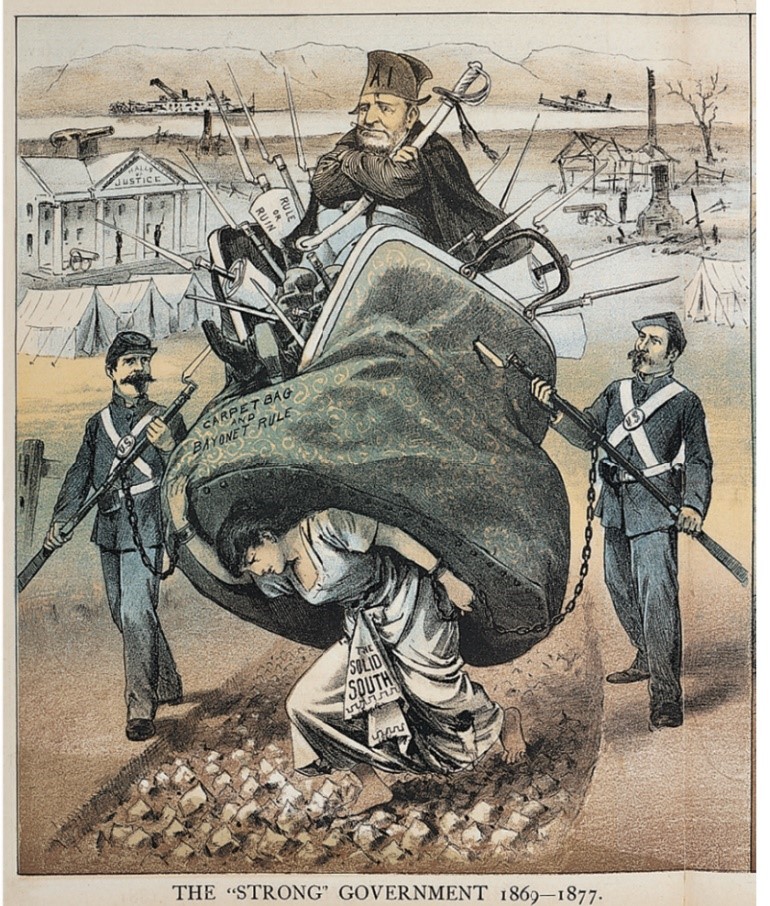
Which congressional action led to the Southern viewpoint expressed in this cartoon?
a. passage of the Homestead Act
b. strengthening of the Fugitive Slave Laws
c. military occupation of the former Confederate States
d. ending the Freedmen’s Bureau
e. First Reconstruction Act.