How much energy is available to the organisms in level C?
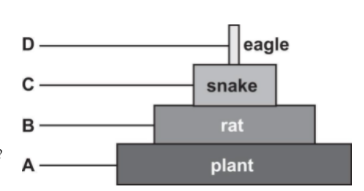
How much energy is available to the organisms in level C?
HS-LS2a/b-1,4, CCC: Scale, Proportion, and Quantity/Energy and Matter
Multiple Choice (3 points each)
How much energy is available to the organisms in level C?
Carrying capacity for a population of primary consumers, such as deer, _______________________________.
Which of the following statements about the logistic model of population growth is incorrect?
An insect that has evolved to resemble a plant twig will probably be able to avoid
In a certain ecosystem, field mice are preyed upon by snakes and hawks. The introduction of wild dogs into this system adds a third mouse predator. The most likely short-term result of this addition is:
A biology student takes fish, algae, pond plants, invertebrates, and bottom sediment from a local pond and establishes them in an aquarium. When the system is stable, the student seals it into a large, airtight glass box and leaves the box in a sunny location. After 3 months, the organisms in the aquarium appear alive and healthy. Which statement about the experiment is true?
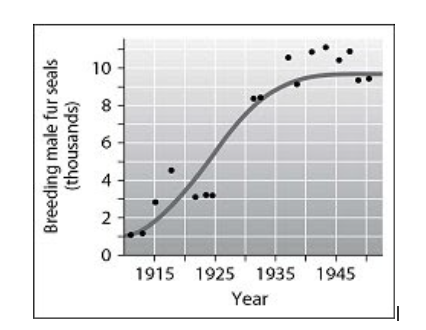
According to this graph of the population growth of fur seals, in what year did the population first reach its carrying capacity?
A population of deer is introduced to an island ecosystem with no natural predators and an abundant supply of food and water. Which of the following models of population growth would most accurately describe the initial phase of the deer population's trajectory?
Logistic growth is a model of population change that most accurately describes a population that:
In a population study, which of the following events would NOT contribute to a decline in population size?
Which of the following would be a limiting factor for growth of a population of downy woodpeckers living in the Ozark Mountains of southwestern Missouri?
If an ecosystem has a carrying capacity of 1,000 individuals for a given species and 2,000 individuals of that species are present, we can predict that the population
Which of the following populations probably exhibits exponential growth?
Consider this segment of a food web: Snails and grasshoppers eat pepper plants, spiders eat grasshoppers, shrews eat snails and spiders, owls eat shrews. The shrew occupies the trophic level(s) of __________.
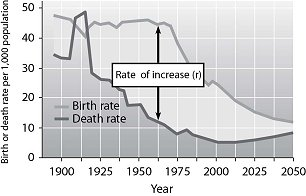
According to this graph of population growth in Mexico, in what year was the rate of population increase in Mexico the greatest?
PE Question (energy and matter)
Information: On a barren mid-Atlantic island, a small community of organisms has established itself. The primary producers are a species of cactus and seaweed. These plants provide the foundation for the island's food web.
Producers: Cactus (on the island) and seaweed (in the surrounding ocean).
Herbivores: Moths that feed on cast-off feathers and a beetle that feeds on dung.
Carnivores: Booby and noddy seabirds that eat fish from the surrounding waters; a tick that feeds on the birds; and spiders that eat the moths and beetles.
Decomposers: Fungi that break down dead organic material, including the birds' dung.
a. Modeling the Ecosystem (4 points)
Construct a detailed food web that illustrates the flow of energy through this ecosystem. In your model, label each organism with its correct trophic level (e.g., producer, primary consumer, secondary consumer).
b. Explaining Energy Transfer (6 points)
Explain, in detail, why only a fraction of the energy from one trophic level is available to the next. Describe at least three specific ways that energy is lost from the food web between trophic levels.
CCC: Scale, Proportion, Quantity (worth 4 pts)
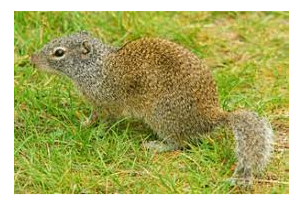
Information: A forest fire recently devastated a 50-acre section of land, leaving behind a barren landscape of ash and exposed soil. Over the next few years, this area underwent secondary succession, transitioning into a prairie ecosystem. This new habitat is adjacent to an existing prairie where a population of Franklin's ground squirrels resides. These ground squirrels are a specialist species that depends on prairie habitats for food and shelter.
a. The Impact on Carrying Capacity (2 points)
Explain how the new prairie habitat will affect the carrying capacity for the Franklin's ground squirrel population. In your answer, define carrying capacity and identify the key limiting factors that will change and allow the population to grow.
b. Reaching a New Equilibrium (2 points)
Describe the process by which the ground squirrel population will grow and eventually stabilize. In your explanation, use the terms exponential growth, and logistic growth to describe how the population will eventually reach the new carrying capacity.
CER: Claim, Evidence, and Reasoning (worth 15 pts)
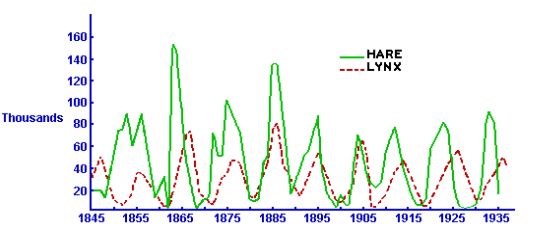
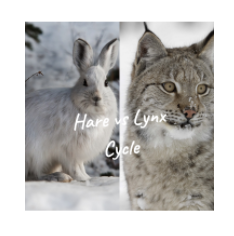
Question: Based on the data in the graph, which population—the predator (lynx) or the prey (hare)—is the primary driving force behind the cyclical relationship?
a. Claim (2 points)Make a claim by stating which population is the primary driver. You may also argue that they are equally interdependent.
b. Evidence (4 points)Provide two specific pieces of evidence from the graph to support your claim. Your evidence must include an analysis of the timing of the population peaks and troughs for both species.
c. Reasoning (4 points)Explain the ecological principles that connect your evidence to your claim. If you claimed one population is the primary driver, explain the biological mechanism by which it controls the other population. If you claimed interdependence, explain how both populations influence each other.
See the rubric to ensure you get the greatest amount of points for your answer.