Log in
Sign up for FREE
arrow_back
Library

Triangle Angle Sum and Exterior Angle Properties (GeoGebra)

star
star
star
star
star
Last updated over 4 years ago
10 questions
Note from the author:
1
1
Students explore properties of triangles using GeoGebra and develop an intuitive understanding of proofs of the triangle sum theorem and external angle properties.
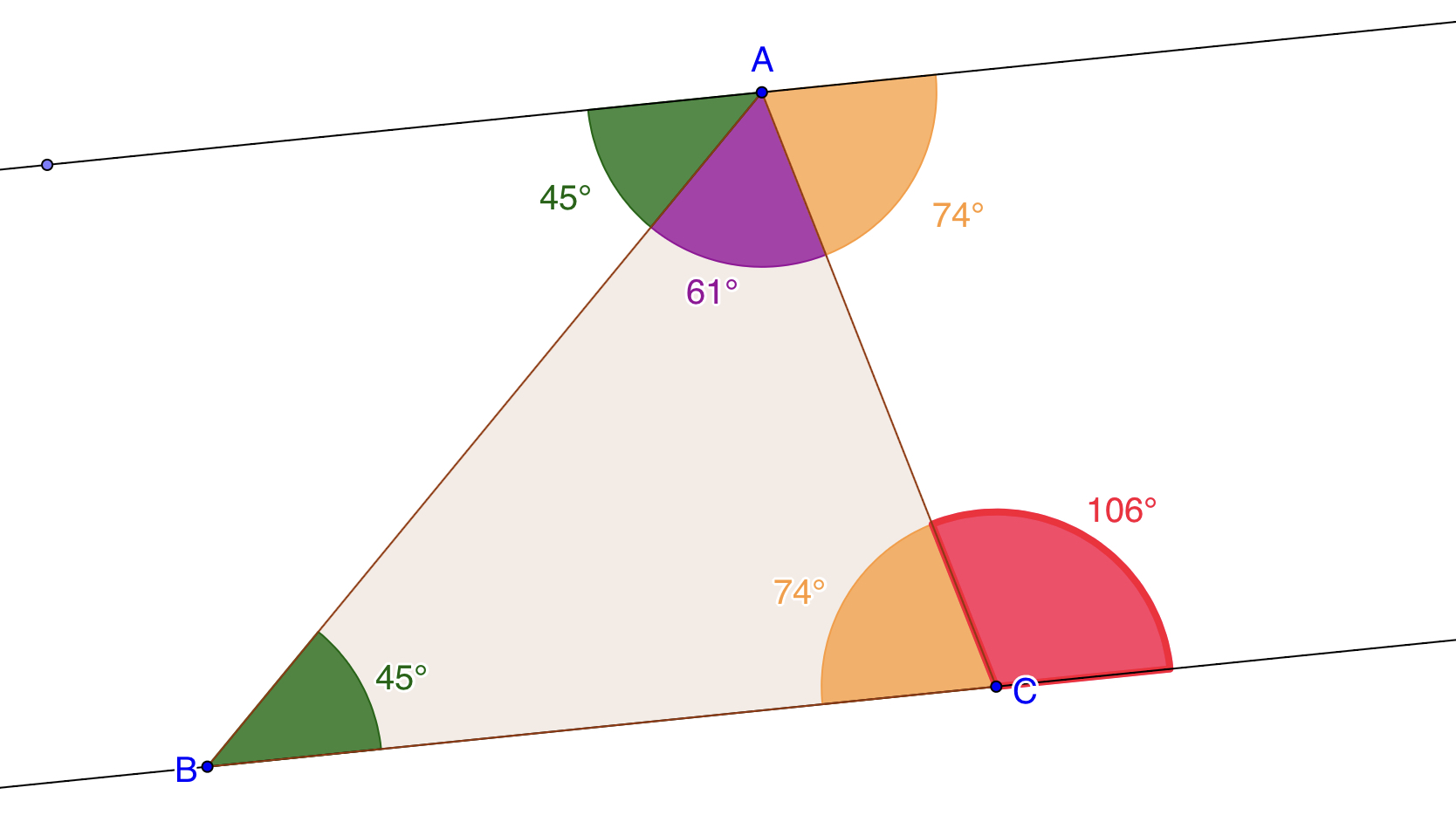
In this interactive lesson, you will utilize geometry software to experiment and understand two import results.


Let's start with the triangle sum property.

1
Question 1
1.

Add the three internal angles of the triangle. What do they sum to?

1
1
1
Question 4
4.

Try moving the two sliders in the top-left corner. You can also move the vertices to change the shape of the triangle. Describe your observations about the angles.

Question 5
5.

Next, you are going to discover the exterior angle property.

1
Question 6
6.

By the Triangle Angle Sum property, what is the value of the sum of the internal angles: \angle A + \angle B + \angle C = ?

1
1
1
Question 10
10.

Summarize all important results you've learned in this section.

Question 2
2.

Now, try moving the vertices to change the shape of the triangle. What happens to the sum of the internal angles when the triangle shape changes?

Question 3
3.

By moving the vertices, can you make a new triangle whose internal angle sum is different from your answer(s) above? Describe your observations about this below.

Select ALL true statements about the interior angles of triangles.
If you rotate the angles in the applet above, all three internal angles fit on a straight line.
The sum of internal angles of any triangle is 180ยบ.
\angle A + \angle B + \angle C = 180^{\circ}
Question 7
7.

Question 8
8.

On the whiteboard, combine your results above and show your work to prove that the external angle of a triangle is equal to the sum of what two other angles?

Question 9
9.

Suppose we label the (internal) orange angle as \angle C and the red angle as \angle C'.

Select ALL true statements.
\angle C and \angle C' fit on a straight line.
\angle C + \angle C' = 180^{\circ}
Select ALL true statements.
\textcolor{red}{\angle C'} = \textcolor{purple}{\angle A} + \textcolor{green}{\angle B}
An exterior angle is equal to the sum of the two opposite interior angles.