NS 2.6 (1/28)
star
star
star
star
star
Last updated over 2 years ago
10 questions
Sort the ostrilope cards with your partner, according to the instructions below. Then Sort the cards three times. Rearrange cards as necessary each time you resort.
- First, sort the cards by armor level (weakest to strongest).
- Then, sort the cards by number of offspring in an environment with Carnithons (fewest to most).
- Finally, sort the cards by lifespan in an environment with Carnithons (shortest to longest)
0
- First, sort the cards by armor level (weakest to strongest).
- Then, sort the cards by number of offspring in an environment with Carnithons (fewest to most).
- Finally, sort the cards by lifespan in an environment with Carnithons (shortest to longest)
- First, sort the cards by armor level (weakest to strongest).
- Then, sort the cards by number of offspring in an environment with Carnithons (fewest to most).
- Finally, sort the cards by lifespan in an environment with Carnithons (shortest to longest)
0
Which armor trait is adaptive and will become more common over many generations?
0
Select any of the responses below that help explain how that trait will become more common. Check your answer and discuss it with your partner.
Creating a Bottleneck Effect in an Ostrilope Population in the Sim
Goal: In fewer than 30 generations, change the starting ostrilope population into a population of at least 70 individuals with low variation in color traits (4 traits or fewer). Do this without adding a predator.
Do:
- Decide on a strategy to reduce the variation of the ostrilope population.
- Open the Natural Selection Simulation and open the mode: Color Change Mission.
- Try out your strategy by making any changes in either Build or Run.
- Use the histograms in Analyze or the Traits Histogram Window in Run to see if your strategy was successful.
Tips:
- You can modify abiotic factors in Run at any time by pressing the Abiotic Factors icon in the lower-right corner of the screen.
- Do not make any changes to the starting ostrilope population settings.
- Return to Build and press REBUILD to reset the Sim to the default settings.
0
Do:- Decide on a strategy to reduce the variation of the ostrilope population.
- Open the Natural Selection Simulation and open the mode: Color Change Mission.
- Try out your strategy by making any changes in either Build or Run.
- Use the histograms in Analyze or the Traits Histogram Window in Run to see if your strategy was successful.
Do:
- Decide on a strategy to reduce the variation of the ostrilope population.
- Open the Natural Selection Simulation and open the mode: Color Change Mission.
- Try out your strategy by making any changes in either Build or Run.
- Use the histograms in Analyze or the Traits Histogram Window in Run to see if your strategy was successful.
0
How did you change the distribution of color traits in the ostrilope population?CFS:- accurately describes the relationship between environmental changes and population variations
- describes the cause and effect relationship between environmental factors and species trait
How did you change the distribution of color traits in the ostrilope population?
CFS:
- accurately describes the relationship between environmental changes and population variations
- describes the cause and effect relationship between environmental factors and species trait
0
Why do you think your strategy worked?CFS:- accurately describes the relationship between environmental changes and population variations
- describes the cause and effect relationship between environmental factors and species trait
Why do you think your strategy worked?
CFS:
- accurately describes the relationship between environmental changes and population variations
- describes the cause and effect relationship between environmental factors and species trait
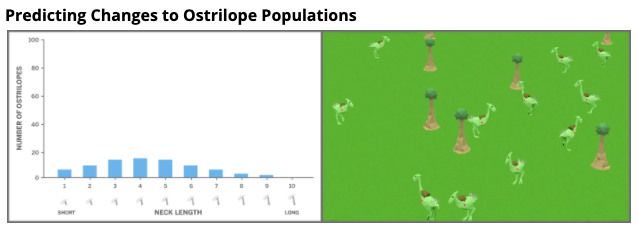
Consider a population of Ostrilopes that live in an environment where all the Thornpalms are tall (Level 8). The Ostrilope population has the distribution of neck lengths shown in the histogram above. Longer necks make it easier for ostrilopes to eat taller Thornpalms.
0
According to the histogram, which traits for neck length are the most common in the starting population?
0
Which traits for neck length do you predict will be the most helpful for survival in this environment?
0
Predict what the ending histogram would look like using the provide information above.
0
Explain which traits for neck length you predict will become most common over time?CFS:- accurately describes the relationship between environmental changes and population variations
- describes the cause and effect relationship between environmental factors and species trait
Explain which traits for neck length you predict will become most common over time?
CFS:
- accurately describes the relationship between environmental changes and population variations
- describes the cause and effect relationship between environmental factors and species trait