NS 1.3 (1/7) Version B
star
star
star
star
star
Last updated about 3 years ago
8 Nsɛmmisa
0
0

0
0
Unit 8: Natural Selection
Chapter 1: Environmental Change and Trait Distribution
Lesson 1.3: Exploring Variation and Distribution in Populations
Complete each mission in the Sim by adjusting the trait-level and variation sliders. Zoom in to the environment to observe the individual organisms. draw the histogram of each mission, then mark each mission as complete as you go.
draw the histogram of each mission, then mark each mission as complete as you go.
Describe which graph has more variation in the graphs above (mission 1 and 2).
"I think graph (1/2) have more variation because ..."
Draw the histogram of each mission, then mark each mission as complete as you go.
Draw the histogram of each mission, then mark each mission as complete as you go.
Mission 7: Choose one of the carnithon features. Set up a carnithon population with the highest level of variation possible.
Describe which graph has more variation in the graphs above (mission 5, 6, and 7).
"I think graph (5,6,7) has the most variation because ..."
Draw the following histograms with a population of 12 individuals on the graphs plots below:
Record your histrograms here:
How can histograms be used to help describe a population?
"Histograms can describe a population because ..."
The following data was collected as a scientist walked through a forest. Write down two true statements about the variation and distribution in height amongst the cherry trees in this forest based on the histogram below.
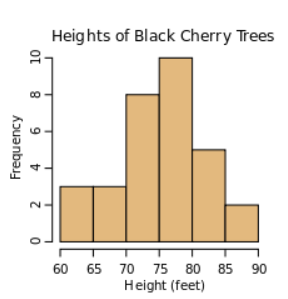
"The population has:
1. High variation
2. ...
3....