Log in
Sign up for FREE
arrow_back
Library

Energy transfers and questions from Topic 1

star
star
star
star
star
Last updated 3 months ago
61 questions
1
1
1
1
1
1
1
1
1
1
1
1
1
1
1
1
1
1
1
1
1
1
1
1
1
1
1
1
1
10
10
10
10
1
2
2
2
2
2
2
2
1
1
1
1
1
1
1
1
1
1
Question 1
1.

Question 2
2.

Question 3
3.

Question 4
4.

Question 5
5.

Question 6
6.

1.Calculate the mean from the following. Give answer to 1 decimal place:
2.2 2.8 3.5

Question 7
7.

The transfer of thermal energy through a substance by the vibration of particles is?

1. Convection
2. Conduction
3. Radiation
4. Insulator

Question 8
8.

A substance that does not easily transfer thermal energy e.g. rubber, is named?

1. Convection
2. Conduction
3. Radiation
4. Insulator

Question 9
9.

A substance that does allow thermal energy to pass through e.g. copper, is named?

1. Convection
2. Conductor
3. Radiation
4. Insulator

Question 10
10.

________ is the transfer of thermal energy from hot to cold places by the rise of particles in a fluid.

1. Convection
2. Conduction
3. Radiation
4. Insulation

Question 11
11.

How does the energy of the sun reach Earth?

1. Convection
2. Conduction
3. Radiation
4. Insulation

Question 12
12.

Question 13
13.

Question 14
14.

Question 15
15.

Question 16
16.

Question 17
17.

Question 18
18.

Question 19
19.

Question 20
20.

Question 21
21.

Question 22
22.

Question 23
23.

Question 24
24.

Question 25
25.

Question 26
26.

Question 27
27.

Question 28
28.

Question 29
29.

Question 30
30.

Question 31
31.

Question 32
32.

Question 33
33.

Question 34
34.

Question 35
35.

Question 36
36.

Question 37
37.

Question 38
38.

Question 39
39.

Question 40
40.

Question 41
41.

1
1
1
1
1
1
1
1
1
1
Question 52
52.

Question 53
53.

Question 54
54.

Question 55
55.

Question 56
56.

Question 57
57.

Question 58
58.

Question 59
59.

Question 60
60.

Question 61
61.

Energy can be ……
a)Created
b)Transferred
c)Destroyed
What energy store is in a cup of hot tea
a) Thermal
b) Nuclear
c) Gravitational
d) Chemical
The units for energy are
a) Newton’s
b) Joules
c) Jewls
d) Seconds
What energy store is in ball before it is dropped to the ground
a) Electrostatic
b) Chemical
c) Gravitational
d) Kinetic
What energy store is in a battery?
a) Nuclear
b) Chemical
c) Kinetic
d) Gravitational
Roasting marshmallows over a fire is an example of-
Conduction
Convection
Radiation
An ice cube melting in your hand is an example of-
Conduction
Convection
Radiation
Ironing clothes is an example of-
Conduction
Convection
Radiation
The liquid moving in a lava lamp is an example of-
Conduction
Convection
Radiation
Heat from the sun warming your face is an example of-
Conduction
Convection
Radiation
Warming your hands on a cup of hot cocoa is an example of-
Conduction
Convection
Radiation
Energy cannot be...
Wasted or useful
Created or destroyed
Stored or transferred
Which equipment would you use to measure 93ml of water?
Beaker
Newton Meter
Measuring cylinder
What is the correct definition of efficiency?
A measure of the total amount of energy
A measure of the amount of energy that is usefully transferred
A measure of the amount of energy that is usefully stored
State the equation used to calculate efficiency
Efficiency = useful energy / wasted energy
Efficiency = wasted energy / total energy
Efficiency = useful energy / total energy
If a kettle has an efficiency of 0.875, what is this efficiency written as a percentage?
87.5%
8.75%
875%

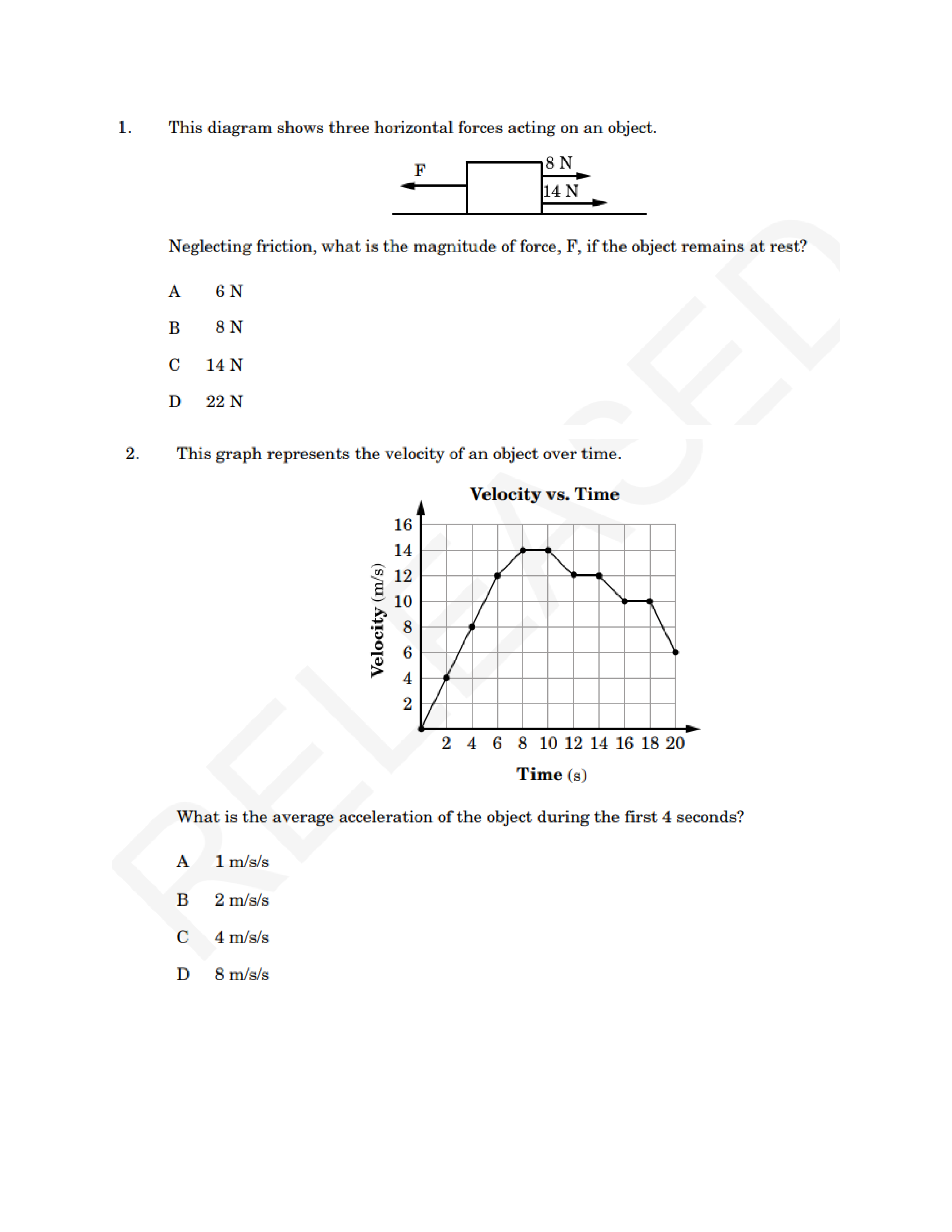
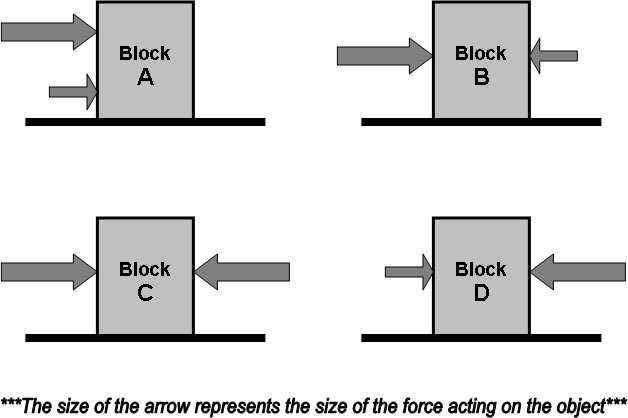
Which of the blocks shown would not move when exposed to the forces ?
Block C
Block D
Block A
Block B
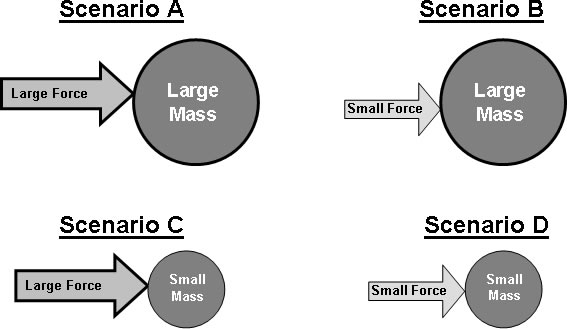
The ball in Scenario D is moving at the same speed as the ball in Scenario A. This is because
the ball in Scenario D must have unseen forces acting on it.
the ball in Scenario D has a smaller diameter, but it is the same weight as the ball in Scenario A.
the surface in Scenario D is lubricated.
the relationship of force to mass are the same in both scenarios.
The best way to counteract momentum is by _____________________.
A friction.
B braking.
C accelerating.
D jumping.
What is the unit for momentum?
A kg m/s
B newtons
C m/s
D kg
What is momentum?
A A push or pull on an object.
B The velocity an object moves.
C A measure of an object's motion and the likelihood that it will remain in motion.
D The heaviness of an object and the direction in which the object is moving.
As the mass increases, the amount the spring stretches…
decreases
increases
stays the same
When we stretch a spring, the force acting through it is…
gravitational force
elastic force
tension
When hot air rises, this is an example of...
Conduction
Convection
Radiation
Refraction
You accidentally touch a hot stove and burn your hand. This is an example of...
Radiation
Convection
Refraction
Conduction
The metal part of the seat belt burns your leg when you sit on it after the car sat in the sun all day is an example of...
Radiation
Conduction
Refraction
Convection
How do you get a sun burn?
Conduction
Radiation
Convection
Refraction
A hot air balloon moving up and down in the sky is an example of-
Conduction
Convection
Radiation
Which of the following is NOT an example of matter?
Beaker
Soda
Air
Light
Which of these statements is true for potential and kinetic energy?
Both depend on mass
Both potential and kinetic energy have to do with motion
Both potential and kinetic energy are a form of electricity
Both potential and kinetic energy are stored
An illustration of a roller coaster is provided. At which point in the roller coaster's journey along the track does it have the greatest kinetic energy?
W
X
Y
Z
A book is sitting on a shelf. How could you decrease the potential energy of the book?
Move it to a lower shelf
Move it to a higher shelf
Open it to the middle
Slide it along the shelf
An object's potential energy would be most influenced by which of the following:
Kinetic energy
Temperature
Acceleration
Mass
What type of electromagnetic wave are we observing when we (humans) see colors?
Gamma waves
Visible light
X-rays
Infrared waves
Sound can travel through outer space.
True
False
Question 42
42.
Question 43
43.
Question 44
44.
Question 45
45.
Question 46
46.
Question 47
47.
Question 48
48.
Question 49
49.
Question 50
50.
Question 51
51.
Which word means energy in motion?
A kinetic energy
B potential energy
C friction
D gravity
Which word means how fast an object is moving?
A speed
B push
C gravity
D force
Which word means stored energy an object has because of its position ?
A kinetic energy
B potential energy
C friction
D gravity
Which word means force that pulls objects to Earth ?
A kinetic energy
B potential energy
C friction
D gravity
What is friction?
A the ability to do work, either to make an object move or to change matter
B force between surfaces that resists the motion of one surface past another surface; friction creates heat
C an object’s direction and speed
D Scientist who came up with 3 laws of motion; also the unit used to measure the amount of force applied
What is energy?
A the ability to do work, either to make an object move or to change matter
B force between surfaces that resists the motion of one surface past another surface; friction creates heat
C an object’s direction and speed
D Scientist who came up with 3 laws of motion; also the unit used to measure the amount of force applied
For every action is there is an equal and opposite reaction.
Newton's 1st law
Newton's 2nd law
Newton's 3rd law
Newton's 4th law
The mathematical relationship between momentum, mass, and velocity is
momentum = velocity/mass
momentum = mass/velocity
momentum = mass x velocity
velocity = momentum + mass
If momentum is conserved, then the total momentum after a collision is equal to
the momentum of the more massive object
the total momentum before the collision
the total force before the collision
the momentum of the faster object
Which of the following best show the mathematical relationship between force, mass, and acceleration.
Force = mass + acceleration
Force = mass x velocity
Force = mass x acceleration
Force = mass / acceleration
A
B
C
D
A
B
C
D
A
B
C
D
A
B
C
D
A
B
C
D
A
B
C
D
A
B
C
D
A
B
C
D
A
B
C
D
A
B
C
D