6-3 Practice
star
star
star
star
star
Last updated over 3 years ago
17 Nsɛmmisa
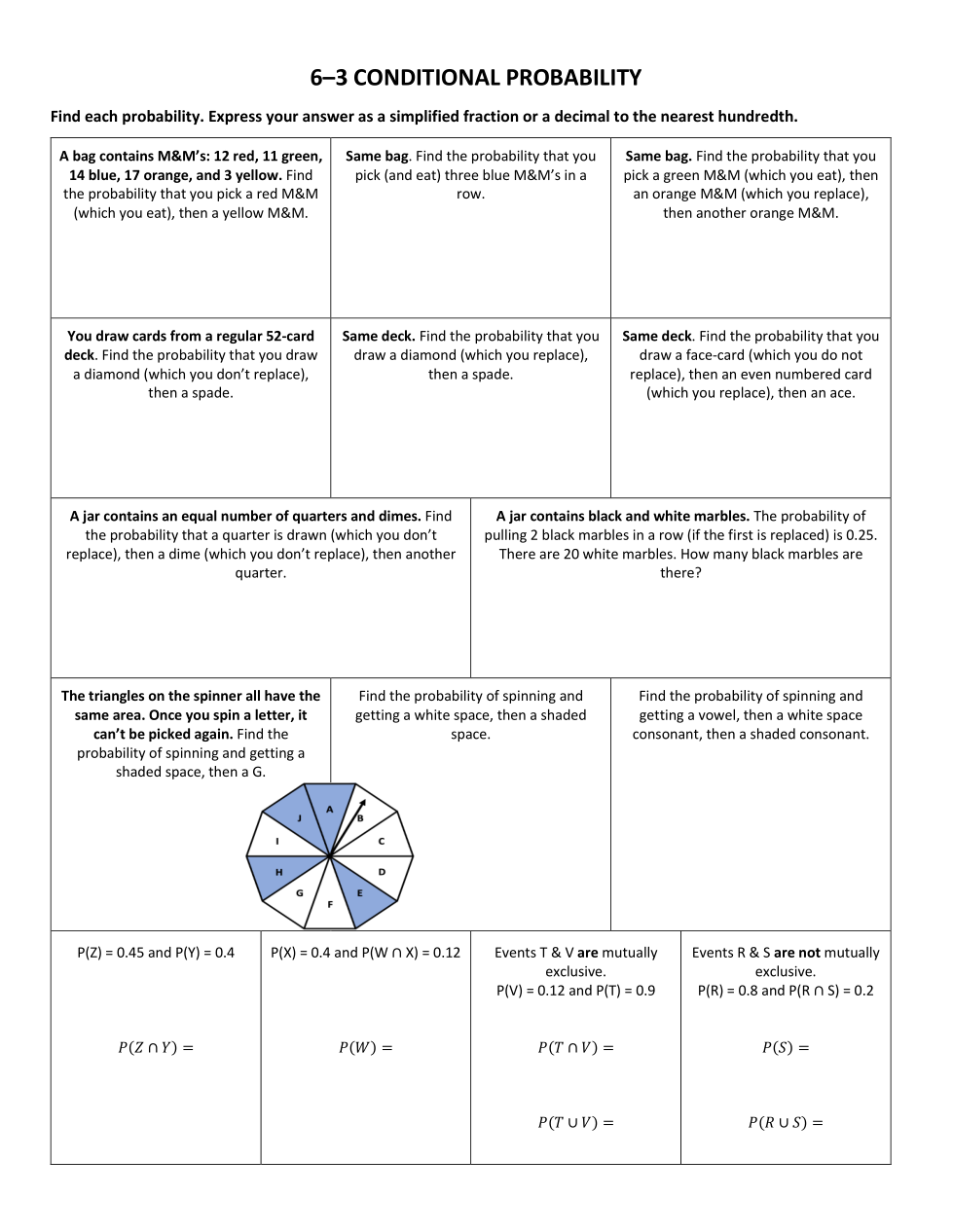
Find the probability that you pick a red M&M (which you eat), then a yellow M&M.
Find the probability that you pick (and eat) three blue M&M's in a row.
Find the probability that you pick a green M&M (which you eat), then an orange M&M (which you replace), then another orange M&M.
Find the probability that you draw a diamond (which you don't replace), then a spade.
Find the probability that you draw a diamond (which you replace), then a spade.
Find the probability that you draw a face-card (which you do not replace), then an even numbered card (which you replace), then an ace.
A jar contains 20 quarters and 20 dimes. Find the probability that a quarter is drawn (which you don't replace), then a dime (which you don't replace), then another quarter.
The probability of pulling 2 black marbles in a row (if the first IS replaced) is 0.25. There are 20 white marbles. How many black marbles are there?
Find the probability of spinning and getting a shaded space, then a G.
Find the probability of spinning and getting a white space, then a shaded space
Find the probability of spinning and getting a vowel, then a white space consonant, then a shaded consonant.
P(Z) = 0.45 and P(Y) = 0.4. What is P(Z and Y)?
P(X) = 0.4 and P(W and X) = 0.12. What is P(W)?
T & V are mutually exclusive. P(V) = 0.12 and P(T) = 0.9. What is P(T and V)?
T & V are mutually exclusive. P(V) = 0.12 and P(T) = 0.9. What is P(T or V)?
R & S are not mutually exclusive. P(R) = 0.8 and P(R and S) = 0.2. What is P(S)?
T & V are not mutually exclusive. P(R) = 0.8 and P(R and S) = 0.2. What is P(R or S)?