7
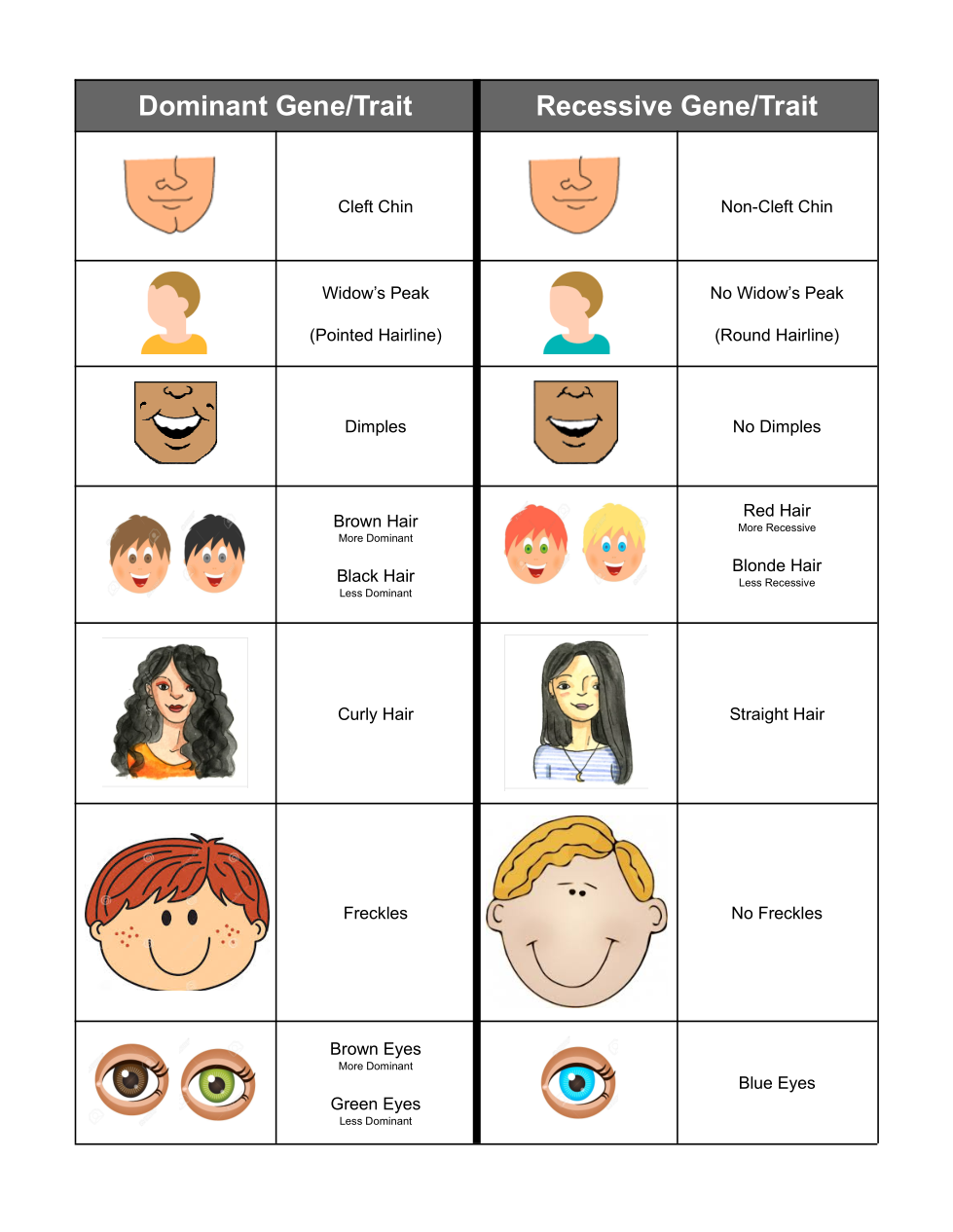
My Traits
Chin
Hairline
Dimples
Hair Color
Hair Type
Freckles
Eye Color
A characteristic that an organism can pass to offspring through genes
A physical trait you CAN see
An allele that is masked (hidden/not seen) when a dominant allele is present
An allele whose trait always shows up in the organism when it is present
Any chromosome that is NOT a sex chromosome
Changing the structure of a gene; can be an insertion, deletion, or rearrangementComplete sets of genes present in a cell or organism
The genetic makeup of an organism (Traits you CAN'T see)
Form the cells; control cell processes (large, complex molecules that play many critical roles in the body)
Complete sets of genes present in a cell or organism
Microscopic strands made of DNA;
46 in each human 23 from one parent, 23 from the other parent
Set of information that controls a trait
Study of heredity
The different forms of a gene
The passing of traits from parent to offspring
Trait you are born with
Trait you gain over time
Match the triat with if it is inherited or aquired
Inherited Traits | Aquired Traits | |
|---|---|---|
Natural Hair Color | ||
Memories | ||
Knowledge | ||
Having Freckles | ||
Eye Color | ||
Calluses |
My Traits
Chin
Hairline
Dimples
Hair Color
Hair Type
Freckles
Eye Color
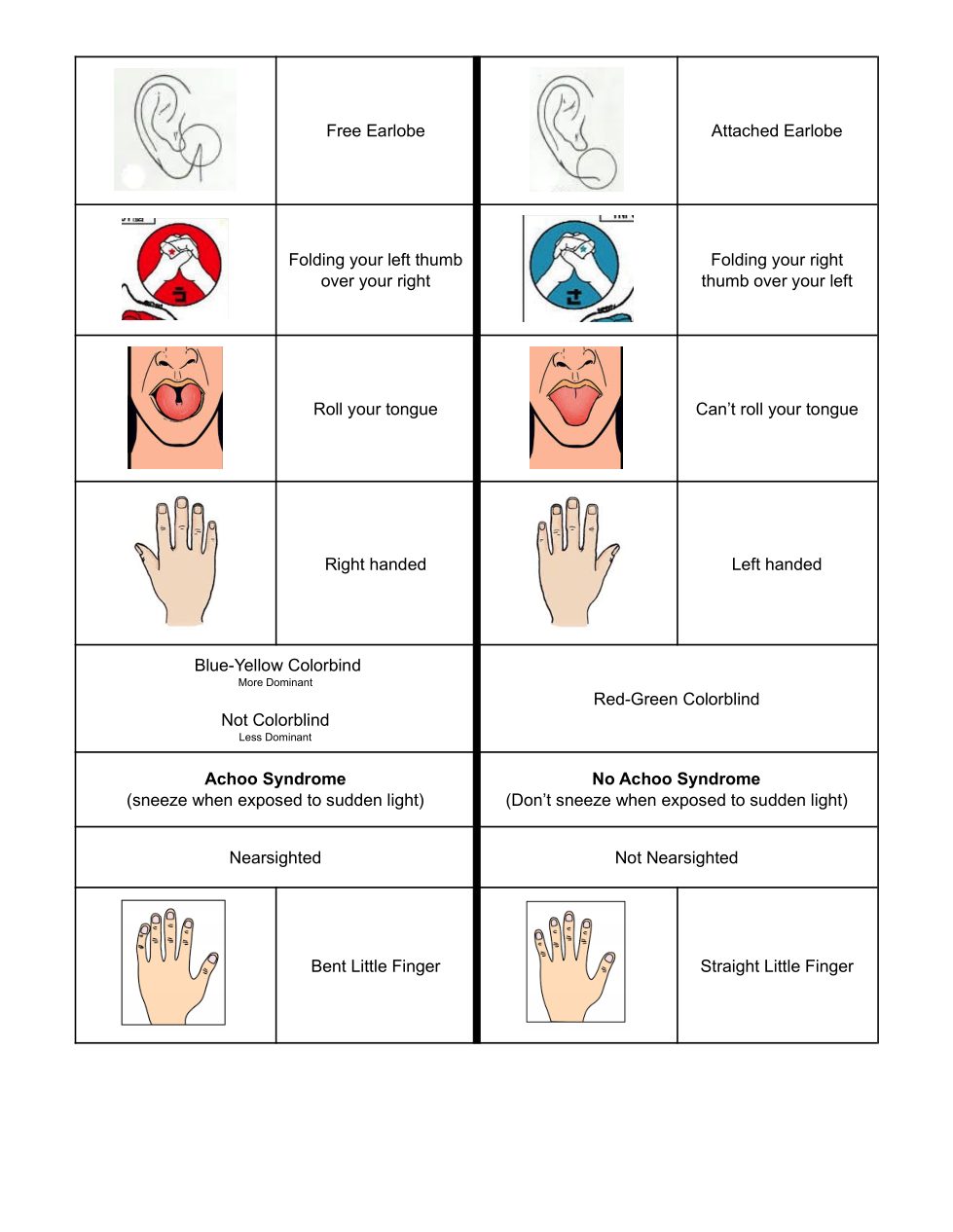
My Traits
Ears
Folding Hands
Tounge
Handed
*Note: Handedness is influenced by multiple factors, including genetics, environment, and chance.
Colorblind
Achoo Syndrome
Sighted
Bent Little Finger
In Punnett Squares...
letters represent dominant traits.
letters represent recessive traits.
A Punnett Square is made up of FOUR boxes.
Each box represents the probability of that trait/gene combination being the one the offspring will have.
The percentage for each box is
Two Matching Dominant Genes
Two Matching Recessive Genes
One Dominant and One Recessive Gene (The dominant gene will be visible and the recessive gene will be hidden)
AA
Pp
tt
gg
Ll
TT
You are looking at the possibility of the color of eyes a child will have.
With the dominant (E) brown eyes over the recessive (e) blue eyes.
Parent 1 has homozygous recessive (ee). Parent 2 has Heterozygous (Ee)
Parent 2: Ee
Parent 1 ee
Brown Eye (EE, Ee) Chances: %
Blue Eye (ee) Chances: %
In dogs, the gene for fur color has two alleles.
The dominant allele (F) codes for grey fur. The recessive allele (f) codes for black fur.
The Female dog is Heterozygous (Ff), The male dog is homozygous recessive (ff).
Parent 2: ff
Parent 1 Ff
Grey Fur (FF, Ff) Chances: %
Grey Fur (ff) Chances: %
In dogs, the gene for fur color has two alleles.
The dominant allele (F) codes for grey fur. The recessive allele (f) codes for black fur.
The female dog has black fur (ff). The male dog has black fur (ff).
Parent 2: ff
Parent 1 ff
Grey Fur (FF, Ff) Chances: %
Black Fur (ff) Chances: %
In dogs, the gene for fur color has two alleles.
The dominant allele (F) codes for grey fur. The recessive allele (f) codes for black fur.
The female dog is heterozygous (Ff). The male dog is heterozygous (Ff).
Parent 2: Ff
Parent 1 Ff
Grey Fur (FF, Ff) Chances: %
Black Fur (ff) Chances: %
In fruit flies, red eyes are dominant (E).
White eyes are recessive (e).
The female fly has white eyes (ee) and the male fly has homozygous dominant red eyes (EE)
Parent 2: EE
Parent 1 ee
Red Eye (EE, Ee) Chances: %
White Eye (ee) Chances: Blank %
Hairy knuckles are dominant (H),
While non-hairy knuckles are recessive (h).
The female is homozygous recessive (hh) and the male is homozygous dominant (HH)
Parent 2: hh
Parent 1 HH
Hairy Knuckles (HH, Hh) Chances:
Non-Hairy Knuckles (hh) Chances:
Cats with bobtails are recessive (t)
Normal tails are dominant (T).
The female is homozygous recessive (tt) and the male is heterozygous (Tt)
Parent 2: tt
Parent 1 Tt
Normal Tail (TT, Tt) Chances:
Bobtail (tt) Chances:
Having a widow's peak is dominant (A)
and not having one is recessive (a).
If one parent is (Aa), and he and the other (Aa), what are the possible phenotypes and genotypes of their children?
Parent 2: Aa
Parent 1 Aa
Widow's Peak (AA, Aa) Chances:
No Widow's Peak (aa) Chances: