Period 4, Day 2: To Compromise or Not to Compromise?
star
star
star
star
star
Last updated over 1 year ago
10 questions
Note from the author:
Content Objective: I will be able to determine the short-term and long-term success of the Missouri Compromise.
Standard Objective: I will be able to draw reasonable inferences and logical conclusions from text.
Content Objective: I will be able to determine the short-term and long-term success of the Missouri Compromise.
Standard Objective: I will be able to draw reasonable inferences and logical conclusions from text.
0
Warm Up: Please rate how well you understood last night's pre-work on a scale from 1 to 4. If you have any questions, drop them in the "Show Your Work" area.
1
Warm Up: Have you ever traveled to another state? If so, where did you go and what was it like?
As you share out with your small group, use the "Show Your Work" function to look up where each state mentioned is on the U.S. map!
Warm Up: Have you ever traveled to another state? If so, where did you go and what was it like?
As you share out with your small group, use the "Show Your Work" function to look up where each state mentioned is on the U.S. map!
0
Warm Up: One interesting historical fact I learned from the pre-work is…

1
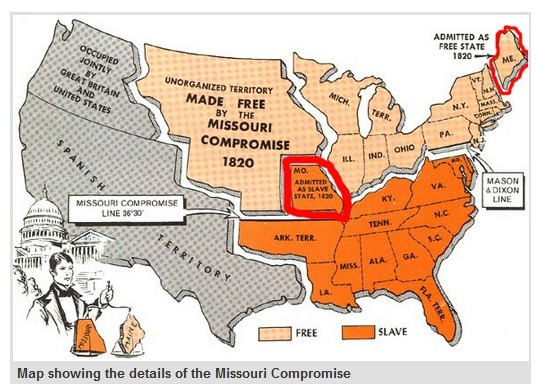
Building Knowledge Together: Based on the map (on left), what can you infer about the terms of the Missouri Compromise in 1820?
1
Building Knowledge Together: Let's make sure we're all on the same page!
When Missouri applied to become a state in 1820, there were currently _______ free states and 11 _______ states. The addition of Missouri into the Union would have upset the _______ of free states and slave states, so Henry Clay proposed a compromise which allowed Missouri to join as a _______ state if Maine joined as a free state, thereby keeping the balance between Northern and _______ state representation equal in the _______. This agreement is known by historians as the Missouri Compromise that established the 36°30' line, which determined that all states _______ the line would become free states - except for _______ - while all states below the line would become slave states.
1
Make a Prediction: What do you think would happen if only one slave labor OR one Free Soil territory petitions for statehood in the future (after 1820)?

1
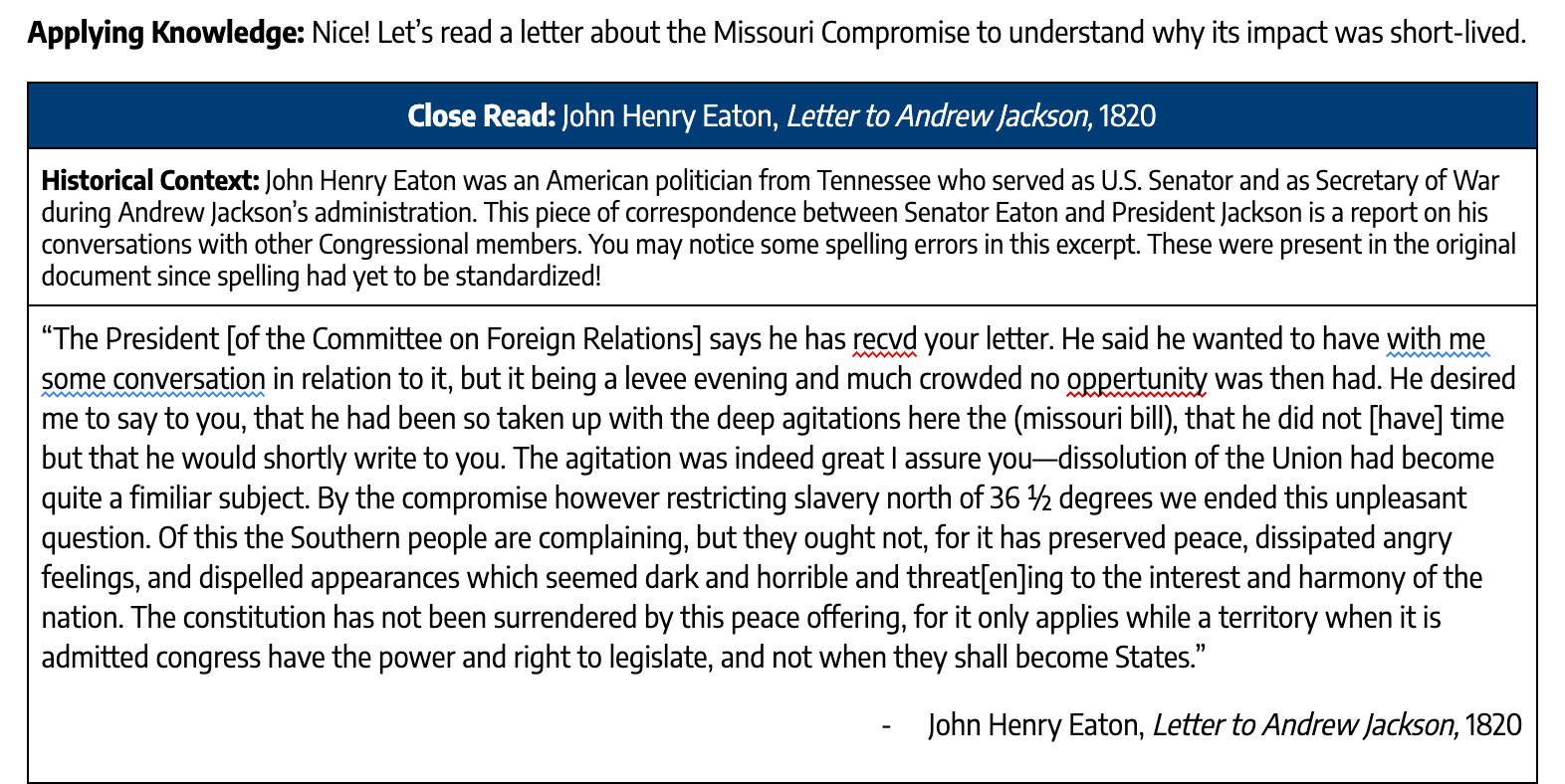
Applying Knowledge: According to Senator Eaton, what was the political climate like surrounding the Missouri Compromise?
1
Applying Knowledge: According to the excerpt, how does the South’s perspective on the Missouri Compromise compare with that of Senator Eaton’s perception?
1
Exit Ticket: Do you feel like the Missouri Compromise was able to successfully address the issue of slavery? Explain why or why not.
0
Exit Ticket: Please evaluate how well you understood today’s lesson on a scale from 1 to 4: