NS 2.2 (1/14) Version B
star
star
star
star
star
Last updated about 3 years ago
11 Nsɛmmisa
0
0

0
0
0
Thick Feathered Ducks
Create a histogram that will explain the change of increased thick feathered ducks.
Include the environmental changes that would make this shift possible.
What rational environmental evidence do you have to support why the duck population changed over time?
CFS:
accurately describes the relationship between environmental changes and population variations
describes the cause and effect relationship between environmental factors and species traits
"I think that the population chagned... because ..."
Dolphin Dorsal fin size
Large dorsal fins allow dolphins to swim faster and escape their predators.
Create a histogram that will explain the increased dorsal fin size.
Include the environmental changes that would make this shift possible.
Create a histogram that will explain the increased dorsal fin size.
What rational environmental evidence do you have to support why the dolphin population changed over time?
CFS:
accurately describes the relationship between environmental changes and population variations
describes the cause and effect relationship between environmental factors and species traits
"I think that the population changed... because ..."
Log into:
Amplify Science
Unit 8: Natural Selection
Chapter 2: Natural Selection and Reproduction
Lesson 2.2: Survival and Reproduction
Observing Reproduction in the Sim
Consider the key concept: Individuals inherit their genes from their parents, and these genes determine their traits.
traits in a population are selectively chosen in a generation.
traits in a population are passed down from generation to generation
Part 2: Observing Reproduction in the Natural Selection Simulation
Goal: Gather evidence to support or refute the claim that ostrilopes with adaptive traits have more offspring than ostrilopes with non-adaptive traits.
Do:
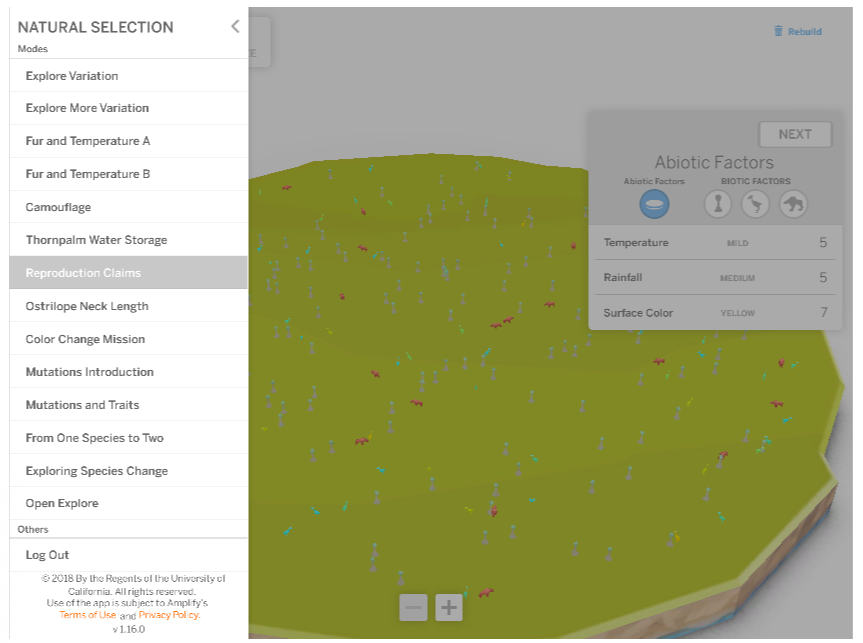
Open the Natural Selection Simulation and open the mode: Reproduction Claims.
Tip:
If the ostrilope dies before reproducing, record a 0 in the data table.
Zoom into the environment in Build and select an ostrilope with one of the color traits in the table below.
Press RUN and count the number of times that ostrilope reproduces before dying.
Record that number in the data table below.
What pattern describes the relationship between how long an ostrilope lived and how many offspring it had?
"I think that the relationship between life length and offspring is... because ..."
Which ostrilopes became more common over time, and why?
"I think that the ostrilopes that will be more common over time are... because ..."
If the color of the environment became blue, which ostrilopes do you think would become more or less common, and why?
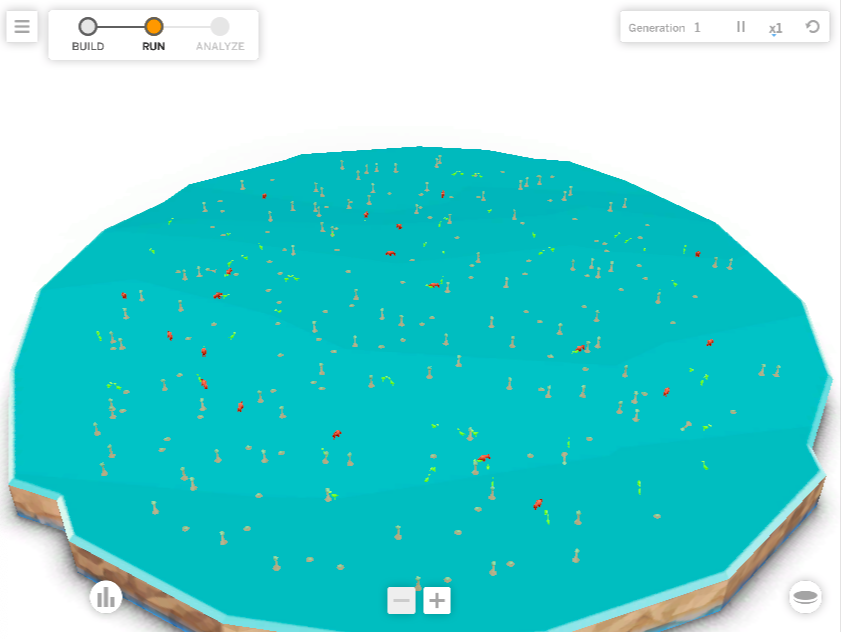
"I think that if the environment became blue the ostrilopes that would become more common are... because ..."
What pattern describes the relationship between how long an ostrilope lived and how many offspring it had?
[Hint: Try to complete this sentence: Ostrilopes that lived longer had (more / fewer / the same number of ) offspring than . . .]
Claim: Ostrilopes with adaptive traits are more likely to reproduce than ostrilopes with non-adaptive traits.
Does the data from the entire class support or refute this claim?
"I think that ostrilopes with adaptive traits are [more / less] likely to reproduce because ..."
Which ostrilopes became less common over time, and why?
"I think that the ostrilopes that will be less common over time are... because ..."