NS 1.5 (1/11) Version B
star
star
star
star
star
Last updated about 3 years ago
9 Nsɛmmisa
0
0
0
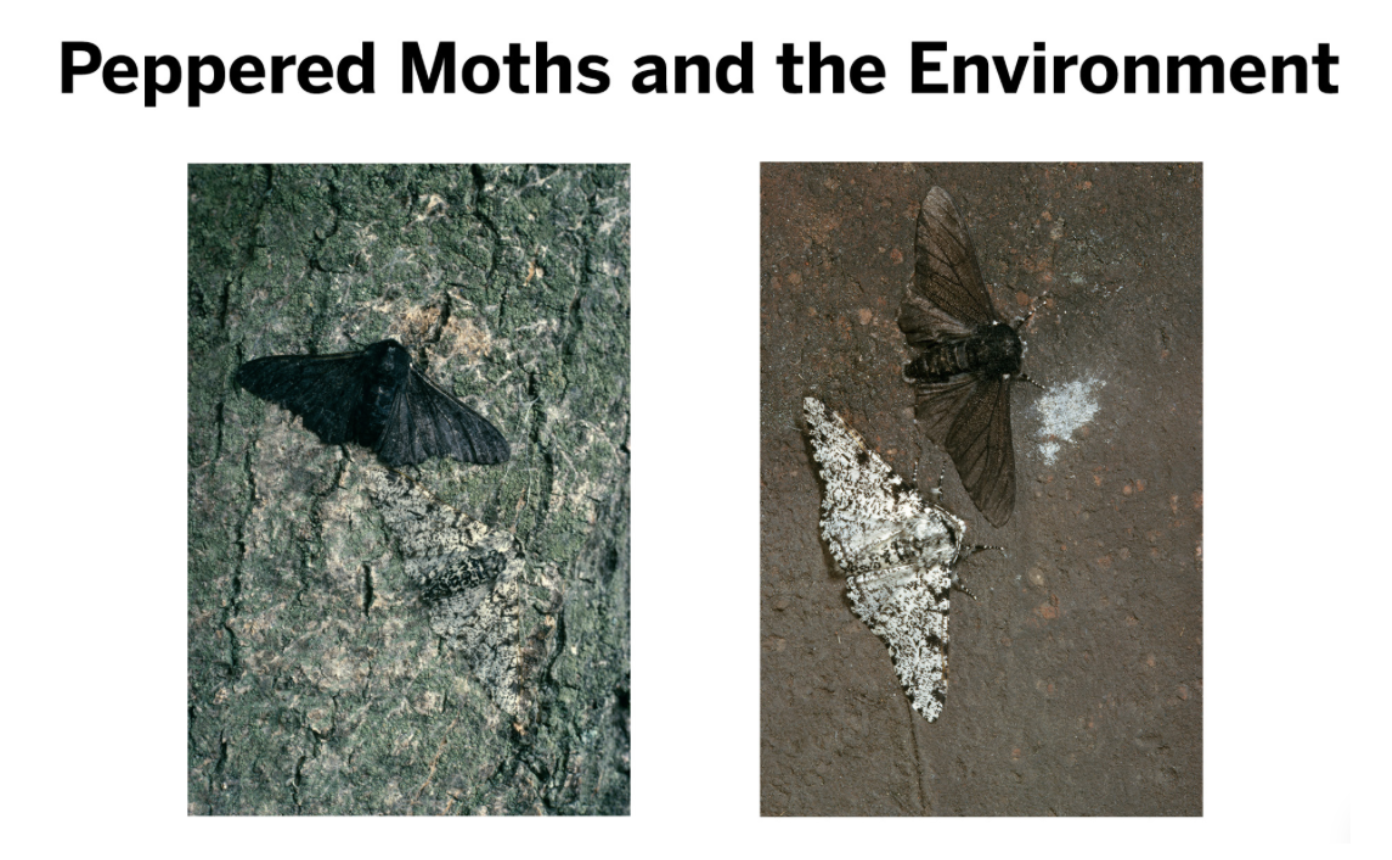
How does the above photo display adaptation?
CFS:
accurately describes the relationship between environmental changes and population variations
describes the cause and effect relationship between environmental factors and illuminated species traits
"I think that the pictures shows moths adaptiations... because ..."
Which trait became more common over time? Why do you think this happened?
CFS:
accurately describes the relationship between environmental changes and population variations
describes the cause and effect relationship between environmental factors and species traits
"I think that the trait that will become more common of time is ... because ..."
Is blending in with the environment always helpful for survival? Why or why not?
CFS:
accurately describes the relationship between environmental changes and population numbers
describes the cause and effect relationship between environmental factors and species traits
"I think that blending into the environment [is / is not] always helpful... because ..."
Log into:
Amplify Science
Unit 8: Natural Selection
Chapter 1: Environmental Change and Trait Distribution
Lesson 1.5: Adaptive Traits
Environment A:
Goal: Gather evidence to support or refute the claim: Yellow color is always an adaptive trait in a yellow environment.
Do:
Open the Natural Selection Simulation and open the mode: Camouflage.
Under Biotic Factors: Carnithons, make sure Include Carnithons is selected.
Under Abiotic Factors, change the Surface-Color slider to Yellow Level 7.
Press RUN and observe ostrilopes with different color traits for 50 generations. You can also refer to the Traits Histogram Window while the Sim is running.
After 50 generations, press ANALYZE and compare the color traits in the starting ostrilope population to the population after 50 generations.
Tip:
· Do not change the initial ostrilope distribution of traits.
· Carnithons which hunt ostrilopse are in the environment
After 50 generations, press ANALYZE and compare the color traits in the starting ostrilope population to the population after 50 generations.
Which ostrilopes were more likely to survive and became more common in the population?
Environment B
Goal: Gather evidence to support or refute the claim that yellow color is always an adaptive trait in a yellow environment.
Do:
Open the Natural Selection Simulation and open the mode: Camouflage.
Under Biotic Factors: Carnithons, do not include Carnithons.
Under Abiotic Factors, change the Surface-Color slider to Yellow Level 7.
Press RUN and observe ostrilopes with different color traits for 50 generations. You can also refer to the Traits Histogram Window while the Sim is running.
After 50 generations, press ANALYZE and compare the color traits in the starting ostrilope population to the population after 50 generations.
· Do not change the initial ostrilope distribution of traits.
· Carnithons which hunt ostrilopse are not in the environment
After 50 generations, press ANALYZE and compare the color traits in the starting ostrilope population to the population after 50 generations.
Which ostrilopes were more likely to survive and became more common in the population?
Explain what happened to the populations in both generations and why that supports or refutes the claim that yellow color is always an adaptive trait in a yellow environment.
CFS:
Provide accurate evidence identifying how environment impacts a species population.
Includes accurate evidence to support claim.
"I think that yellow [is / is not] always adaptive because ..."
Explain what happened to the populations in both generations and why that supports or refutes the claim that yellow color is always an adaptive trait in a yellow environment.
CFS:
Provide accurate evidence identifying how environment impacts a species population.
Includes accurate evidence to support claim.
"I think that yellow [is / is not] always adaptive because ..."
