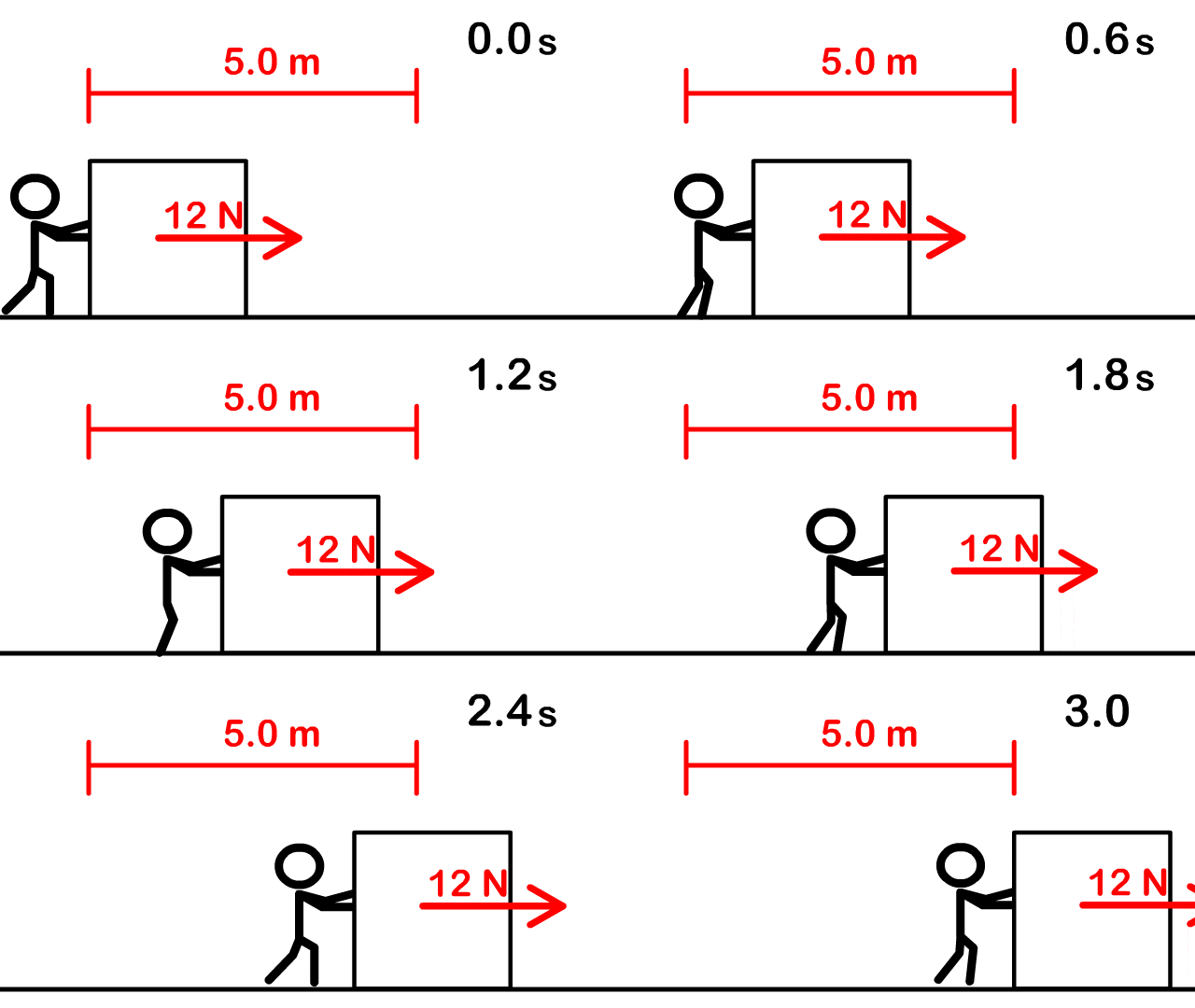
Describe how you know that work was done in this GIF.
Describe how you know that work was done in this GIF.
Describe how you know that work was done in this GIF.
What is the 'theta angle' AND how do you know?
The amount of force (to a point) while pulling the car up the hill at an increasing angle. The work that was done .
Match the 'Example' to the appropriate classifciation:
vertical displacement was 4m, the horizontal force was 20N
the item sits on the shelf with 40J of Potential Energy
there was no force to cause the dispalcement
force directly caused the displacement
there was zero displacement
Work Was Done
No Work Was Done
Calculate the work done by a 40-N force (directed at a 20° angle to the vertical) to move a 5-kilogram box a horizontal distance of 500 cm across a rough floor at a constant speed of 0.7 m/s. (Make sure you show your work for partial credit!)
There is a ball that is 55m above the zero line that has a mass of 55kg. The ball current PEgrav =
If you double the amount of displacement of a spring relative to its equilibrium position, then you the PEspring.
When you quadruple the speed of an object, you its KE by a factor of .
When you reduce the speed of an object by a factor of 3, you its KE by a factor of .
Determine the kinetic energy of a 70-kg roller coaster car that is moving with a speed of 11.1 m/s.
Olver Weightver, the former platform diver for Harrison, had a kinetic energy of 11,000 J just prior to hitting the Pool. If Olver's mass is 100 kg, then what is his speed?
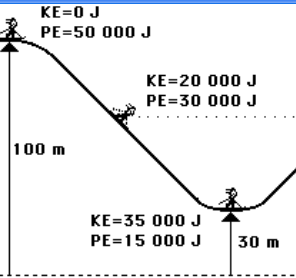
Give one example of mechanical energy, and then justify why your example definitely has mechanical energy.
Describe a way that the skier could increase their height to be above 100m at the next hill?
Classify this example.
A 120-kg car traveling with a speed of 29 m/s skids to a stop. The car experiences a 9000 N force of friction. Determine the stopping distance of the car.