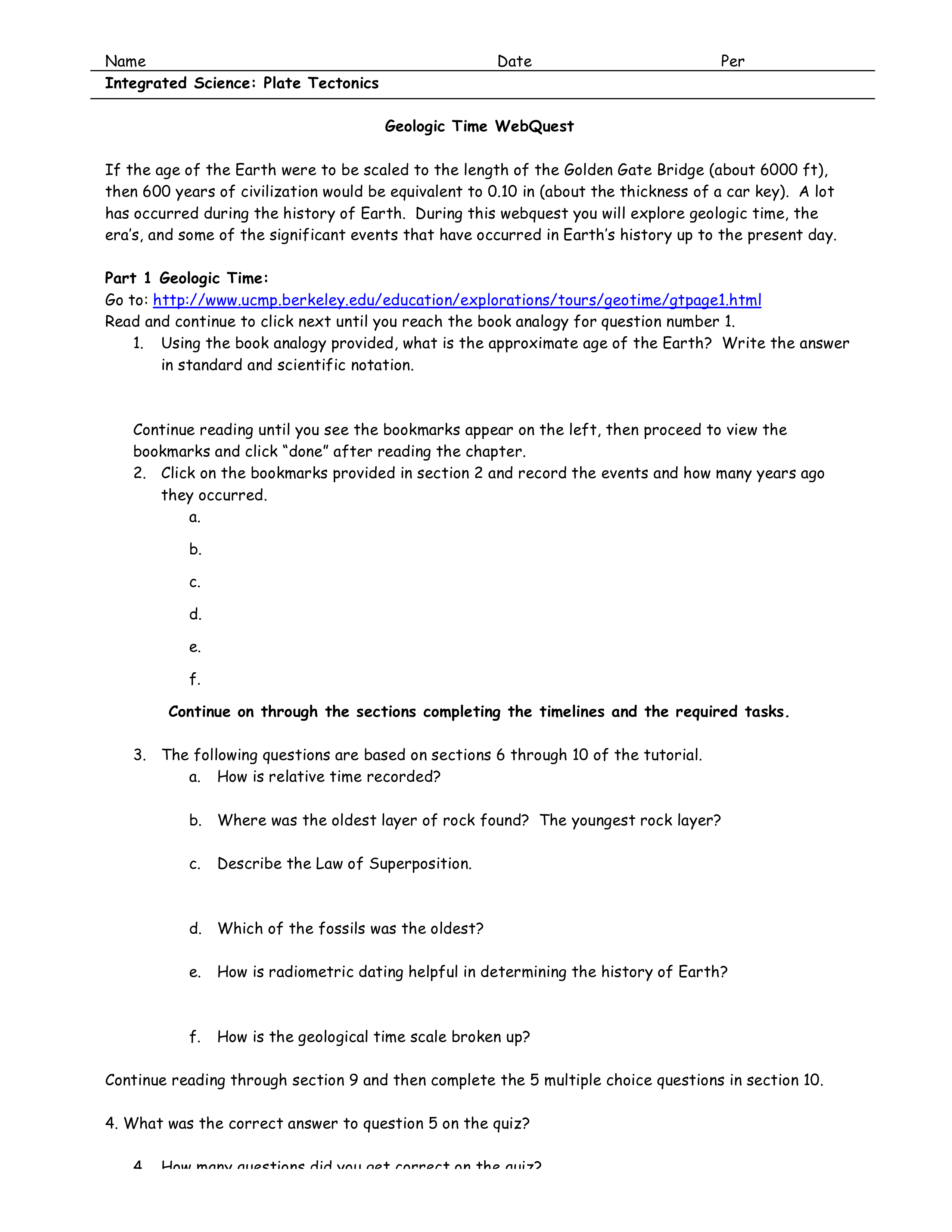
Link for Part 1: https://ucmp.berkeley.edu/education/explorations/tours/geotime/gtpage1.html
1
1
1
1
1
1
1
1
1
Link for Part 2: https://ucmp.berkeley.edu/help/timeform.php
1
1
1
1
1
1
Question 15
15.
1
1
1
Question 18
18.
1
1
1
Question 21
21.
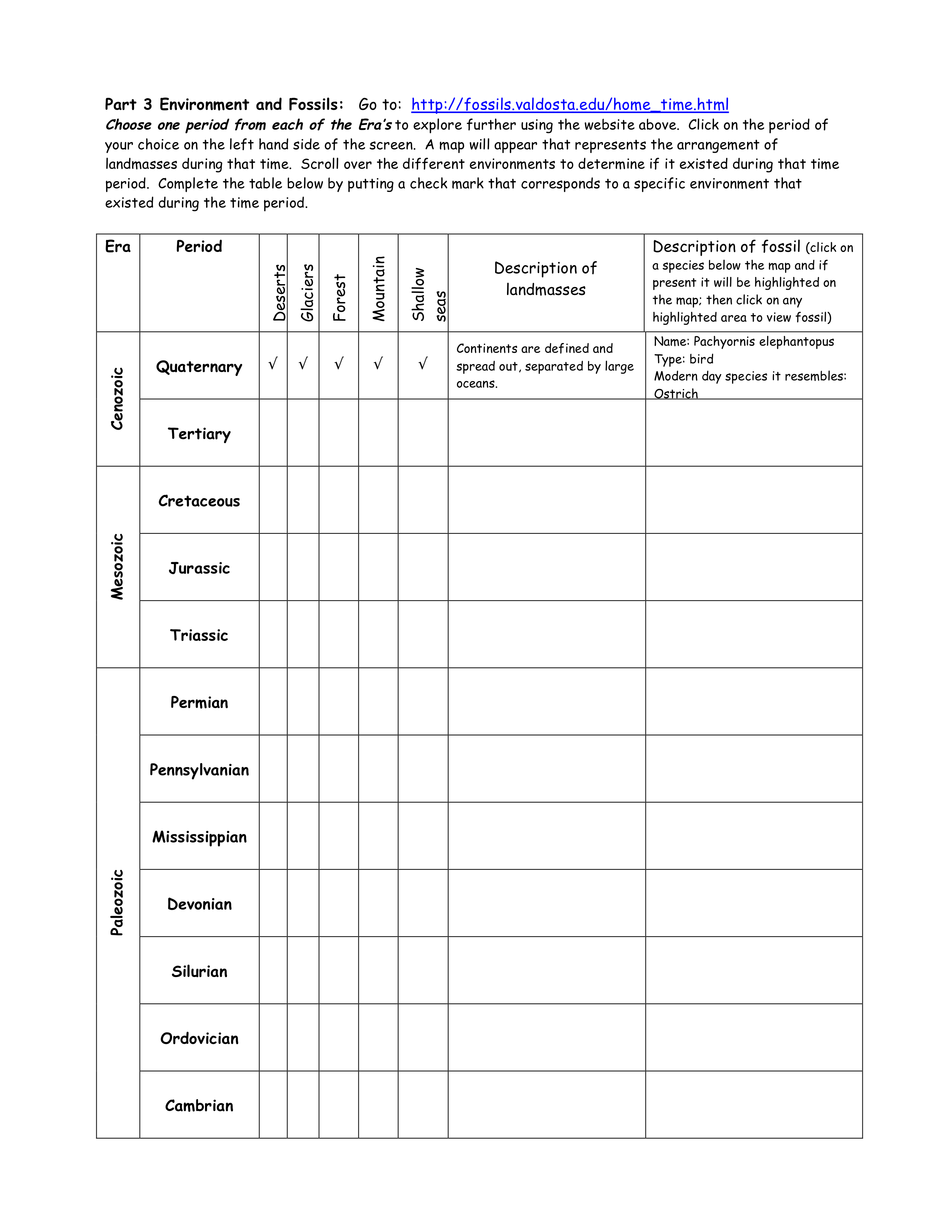
Link for Part 3: https://fossils.valdosta.edu/home_time.html
1
Question 22
22.
List the period you choose from the Cenozoic era. List the type of environments that existed, describe how the continents (landmasses) appeared, and describe the fossil you choose.
1
1
Question 25
25.
List the period you choose from the Precambrian era. List the type of environments that existed, describe how the continents (landmasses) appeared, and describe the fossil you choose.
Question 1
1.
Question 2
2.
Question 3
3.
Question 4
4.
How is relative time recorded?
Question 5
5.
Question 6
6.
What is the law of superposition?
Question 7
7.
Question 8
8.
Question 9
9.
Question 10
10.
Question 11
11.
Question 12
12.
Question 13
13.
Question 14
14.
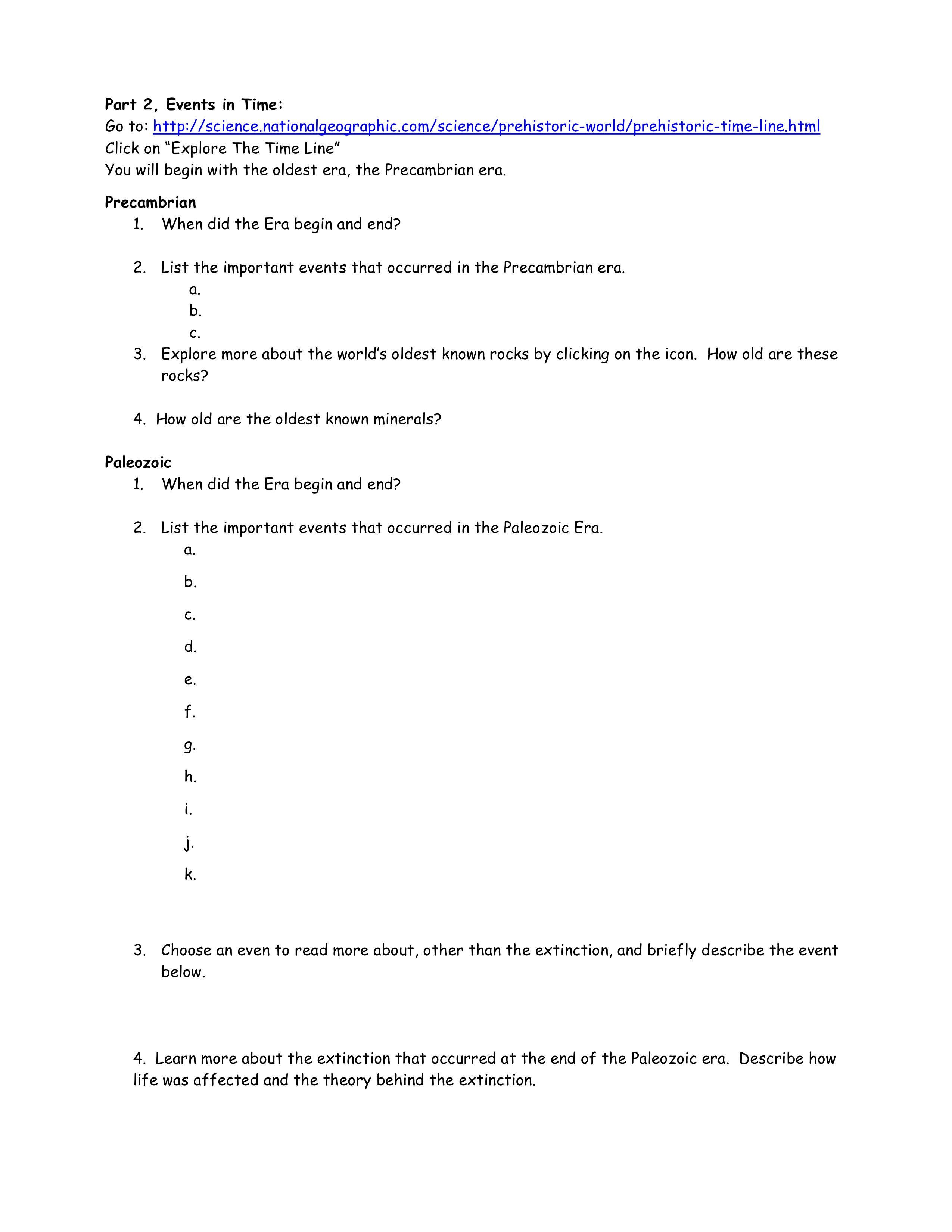
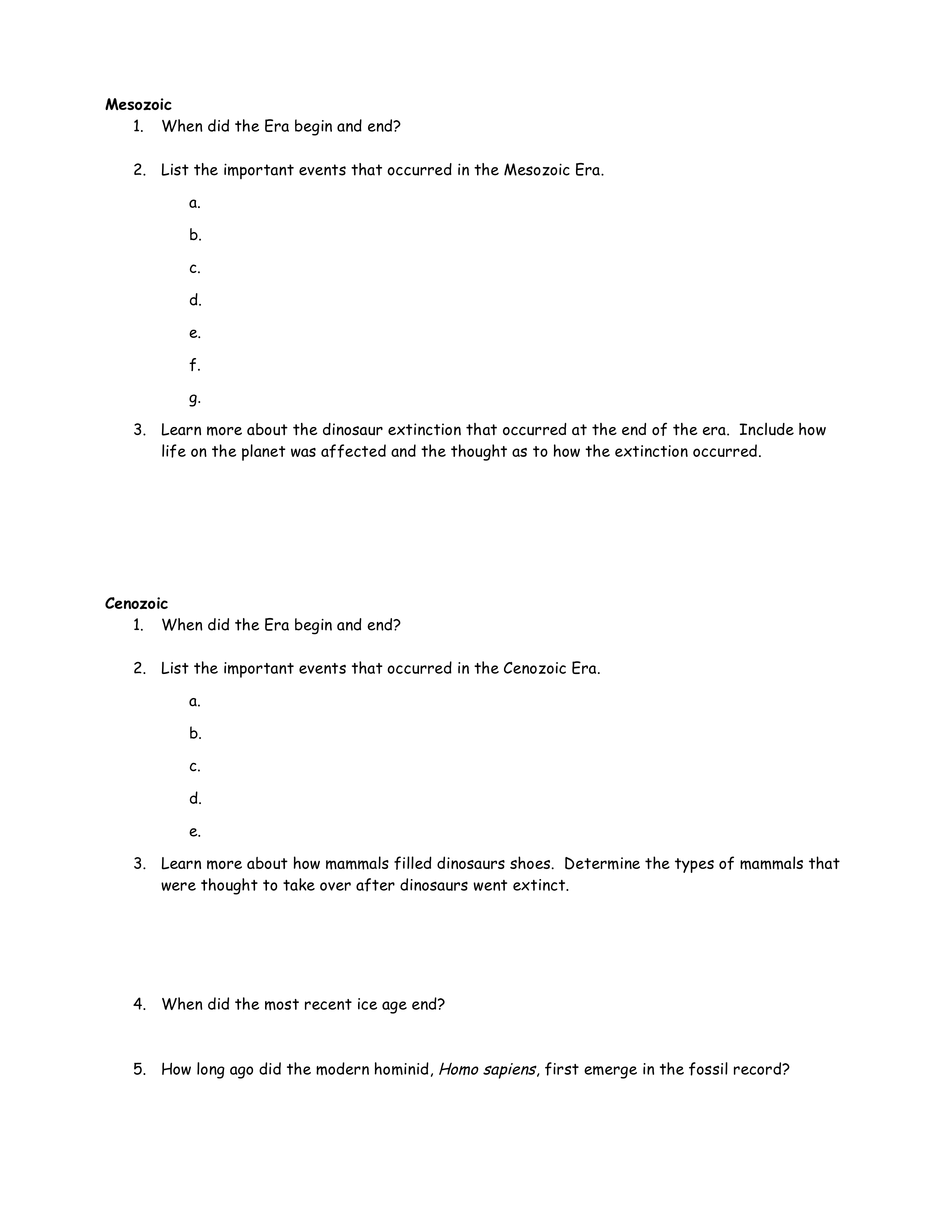
Instead of clicking on "Read More", just choose an event to describe in the Paleozoic era.
Question 16
16.
Question 17
17.
Question 19
19.
Question 20
20.
Question 23
23.
List the period you choose from the Mesozoic era. List the type of environments that existed, describe how the continents (landmasses) appeared, and describe the fossil you choose.

Question 24
24.
List the period you choose from the Paleozoic era. List the type of environments that existed, describe how the continents (landmasses) appeared, and describe the fossil you choose.
Hint: how many thousands of years would it take to read the geologic history of Earth?
A 73
D 1 million
C 145
B 17,503
Choose the correct order of events.
C Formation of the Earth and moon, Earliest life, "Lucy" (earliest hominid), Largest mass extinction, Early land plants, and Dinosaur extinction
A Formation of the Earth and moon, Earliest life, Early land plants, Largest mass extinction, Dinosaur extinction, and "Lucy" (earliest hominid)
B Formation of the Earth and moon, Earliest life, Largest mass extinction, Early land plants, Dinosaur extinction, and "Lucy" (earliest hominid)
Given the events in #2, which fossil would you expect to find at the bottom of the geologic record? At the top?
A Lucy at the bottom layer, fossils of earliest life at the top layer
B Dinosaur extinction at the bottom layer, appearance of plants at the top layer
C fossils of earliest life at the bottom layer, Lucy at the top layer
A The oldest is on top and the youngest is on the bottom.
B The oldest is on the bottom and the youngest is on the top.
C The oldest is on top and the youngest is in the middle.
In section 7, which of the fossils was the oldest?
A Brachiopods
B Trilobites
C Eurypterids
D Ammonites
A Through radiometric dating
B Through relative dating
C There is no dating in the Earth's geologic history.
A 4.6 BYA to 750 MYA
B 4.6 BYA to 542 MYA
C 4.6 BYA to 650 MYA
There are 3 answers.
A Earth formed
B Earliest life appeared
C Humans evolved
D Dinosaurs went extinct
E Jellyfish evolved
A 500 MYA to 300 MYA
B 520 MYA to 250 MYA
C 540 MYA to 252 MYA
There are 6 answers.
A Most of the land was formed into one big supercontinent.
B Forests and swamps developed
C This was the age of the dinosaurs
D The first fish and reptiles evolved
The Cambrian Explosion happened
Plants first evolved
Several mass extinctions happened
Asteroid impact caused the mass extinction that ended the Paleozoic era
C 260 MYA to 25 MYA
A 252 MYA to 65.5 MYA
B 252 MYA to 50 MYA
There are 4 answers.
A Dinosaurs evolved
B Mollusks appeared in the ocean
C Flowering plants evolved on land
The first direct ancestor of the human evolved
The first birds evolved
C 70 MYA to now
A 64 MYA to 10 MYA
B 65 MYA to now
There are 4 answers.
A The ocean cooled significantly and many species went extinct
B Some forms of dinosaurs survived the Mesozoic mass extinction
C Mammals rose up to fill the niche dinosaurs left behind