Ɛhia
1
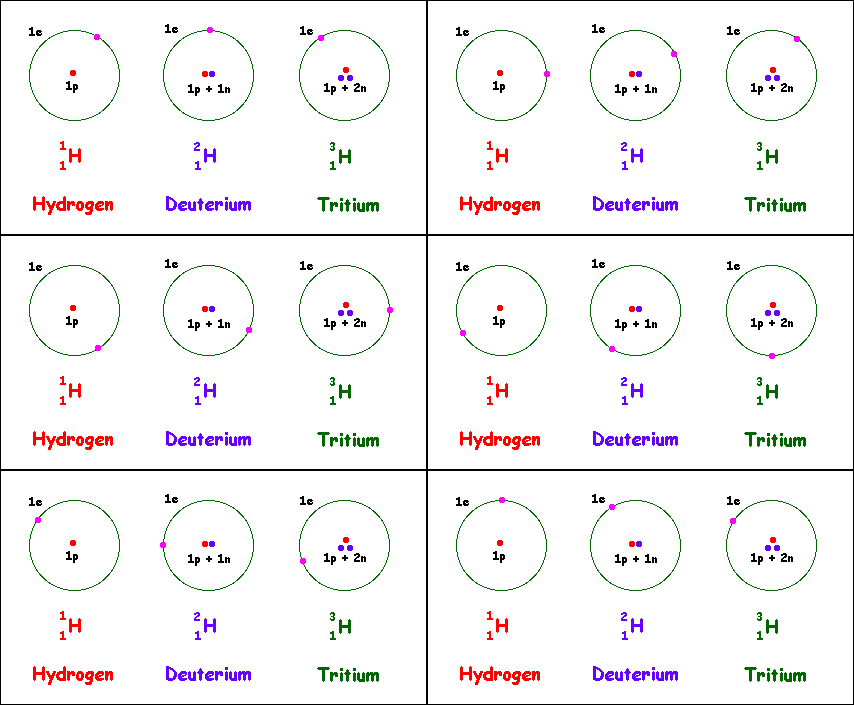
Which statement best describes the image.
Which statement best describes the image.
Ɛhia
1
Explain why you chose your answer for #2.
Explain why you chose your answer for #2.
Where is most of the mass of the atom found?
Which statement best describes the image.
Explain why you chose your answer for #2.
Select the type of subatomic particle that matchs the statement.
Electron | Neutron | Proton | |
|---|---|---|---|
NOT found in the nucleus | |||
Has no charge | |||
Has +1 charge | |||
Has -1 charge | |||
Identifier of the element | |||
Has almost no mass |
If you see something in the classroom or laboratory that is dangerous, tell the teacher
Any spill on the floor can cause an accident. Always clean it up
When you work with laboratory chemicals and bunsen burners, long hair must be
What is the smallest particle into which an element can be divided and still be the same substance?
What part of the atom has a positive charge?
What part of the atom has a negative charge?
What part of the atom has a no charge?
What is found in the center of an atom
What subatomic particles are found in the nucleus? Check all that apply
On a drawing a proton is shown with the symbol____?
On a drawing a electron is shown with the symbol____?
An electron is found...
The main parts of an atom are?
What is the maximum number of electrons that are allowed on the second shell/orbit?
An atom becomes negatively charged by
Potassium has an atomic number of 19 and a mass number of 39. So, it has _________________neutrons.
Which statement is true about the Periodic Table?
In the Periodic Table, the vertical columns that extend down the Periodic Table are called
Hydrogen is located in Group_________of the Periodic Table.
Which scientist is credited with inventing the Periodic Table?
In the Modern Periodic Table, the elements are arranged in order of
Copper
Fluorine
Au
Ge

Select the general properties of metals:


What is an example of an exothermic reaction?
Endothermic reactions release energy stored in chemical bonds.
A balanced equation demonstrates...
State one way that you could speed up the rate of a chemical reaction.
What characteristics do endthermic reactions have? (select all that apply)
What characteristics do exothermic reactions have? (select all that apply)
Select two examples of endothermic reactions.
Select two examples of exothermic reactions.
What group is column 2
What Group is Column 17?
What Group is Column 18?
Why does Tungsten have a chemical symbol W?
What is the bunsen burner used for?
The utility clamp and the iron ring can both be attached to help hold beakers, test tubes, and flasks.
You do not need to wear safety glasses if you have eye glasses or contacts.
It is ok to put your hand on the pan if you want to know how much it mass it has.
This tool is best used to meausre the volume of liquids
This tool is used to hold liquids while heating in the bunsen burner.
This tool is used to move beakers when the beaker is hot.
This a good tool for stirring solutions.
It is ok to use the same pipette in multiple different solutions during the lab.
These are good tools for getting a small amount of chemical out of the stock bottle.