Physics Chapter 6 Assessment

Last updated over 3 years ago
38 questions
2

Accelerations are produced by

2

How does acceleration of an object change in relation to its mass? It is

2

The acceleration produced by a net force on an object is

2

A 10-kg brick and a 1-kg book are dropped in a vacuum. The force of gravity on the 10-kg brick is

2

When a woman stands with two feet on a scale, the scale reads 150 N. When she lifts one foot, the scale reads

2

Suppose the force of friction on a sliding object is 25 N. The force needed to maintain a constant velocity is

2

A bowling ball weighs 20 N. When held at rest in your hands, the net force on the bowling ball is

2

A girl pulls on a 7-kg wagon with a constant force of 14 N. What is the wagon's acceleration?

2

An object has a constant mass. A constant force on the object produces constant

2

A force of 4 N accelerates a mass of 4 kg at the rate of 1 m/s2. The acceleration of a mass of 8 kg acted upon by a force of 8 N is

2

A push on a 4-kilogram brick accelerates the brick. Neglecting friction, to equally accelerate a 16-kilogram brick, one would have to push

2

A toybox is dragged without acceleration in a straight-line path across a level surface by a force of 11 N. What is the frictional force between the toybox and the surface?

2

Suppose a particle is accelerated through space by a constant 10-N force. Suddenly the particle encounters a second force of 10-N in a direction opposite to that of the first force. The particle

2

A tennis ball and a solid steel ball with the same diameter are dropped at the same time. Which ball has the greater force acting on it?

2

A tennis ball and a solid steel ball with the same diameter are dropped at the same time. In the absence of air resistance, which ball has the greater acceleration?

2

The reason a tennis ball and a solid steel ball will accelerate at the same rate, in the absence of air resistance, is that

2

As a care package falls from a high-flying stationary helicopter, its velocity increases and its acceleration

2

If you pull horizontally on a desk with a force of 150 N and the doesn't move, the friction force must be 150 N. Now if you pull with 270 N so the slides at constant velocity, the friction force is

2

When the angle of an incline with a block resting on it increases, the normal support force

2

Consider a ball rolling down the decreasing slope inside a semicircular bowl (the slope is steep at the top rim, gets less steep toward the bottom, and is zero (no slope) at the bottom). As the ball rolls from the rim downward toward the bottom, its rate of gaining speed

2

A block is at rest on an incline. The force of friction necessary to prevent the block from sliding increases when the incline angle is

2

If the force acting on a cart doubles, what happens to the cart's acceleration?

2

Suppose a cart is being moved by a force. If suddenly a load is dumped into the cart so that the cart's mass doubles, what happens to the cart's acceleration?

2

A tow truck exerts a force of 1000 N on a car, accelerating it at 0.5 m/s2. What is the mass of the car?

2

A 8-N falling object encounters 8 N of air resistance. The magnitude of the net force on the object is

2

If you pound a feather with a hammer, which one feels a greater force?

2

An elevator suspended by a vertical cable is moving downward but slowing down. The tension in the cable must be

2

Bill and his daughter Susan are both standing on identical skateboards (with really good frictionless ball bearings), initially at rest. Bill weighs three times as much as Susan. Bill pushes horizontally on Susan's back, causing Susan to start moving away from Bill. Just after Bill stops pushing,

2

A 20-ton truck collides with a 1500-lb car. Which of the following statements must be true?

2

You are standing in a moving bus, facing forward, when you suddenly slide forward as the bus comes to an immediate stop. What force caused you to slide forward?

2

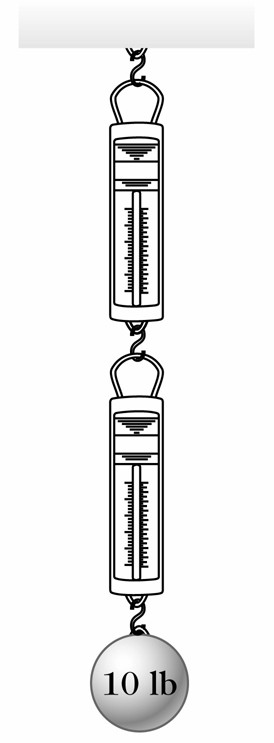
In the figure, a 10-lb weight is suspended from two spring scales, each of which has negligible weight. Which one of the following statements about the readings in the scales is true?

2

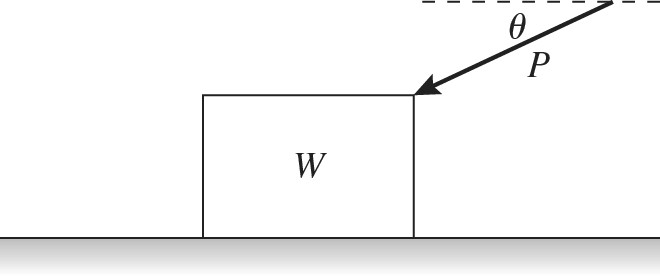
A push of magnitude P acts on a box of weight W as shown in the figure. The push is directed at an angle theta(𝚹) below the horizontal, and the box remains a rest. The box rests on a horizontal surface that has some friction with the box. The normal force on the box due to the floor is equal to

2

A force of 30 N stretches a very light ideal spring from 0.73 m from equilibrium. What is the force constant (spring constant) of the spring?

2

Gunter the weightlifter can lift a 244.2-kg barbell overhead on Earth. The acceleration due to gravity on the sun is 274 m/s2.
a) Would the barbells be heavier on the sun or on Earth?

5

Gunter the weightlifter can lift a 244.2-kg barbell overhead on Earth. The acceleration due to gravity on the sun is 274 m/s2.
b) How much (in newtons) would the barbells weigh on the sun (if it were possible to stand on the sun without melting)?

5

Sarah, whose mass is 39.72 kg, is on her way to school after a winter storm when she accidentally slips on a patch of ice whose coefficient of sliding friction is 0.082. What force of friction will eventually bring Sarah to a stop?

5

A very light ideal spring of spring constant (force constant) 2.5 N/cm is 15 cm long when nothing is attached to it. It is now used to pull horizontally on a 12.5-kg box on a perfectly smooth horizontal floor. You observe that the box starts from rest and moves 96 cm during the first 1.6 s of its motion with constant acceleration of 0.375 m/s2. How long is the spring during this motion?

5

What is the velocity of a 0.500 kg ball that has a momentum of 3.000 kg·m/s?