Understand concept and examples of the Tragedy of the Commons
Know and understand the 3 components of sustainability (solar energy, chemical cycling, biodiversity)
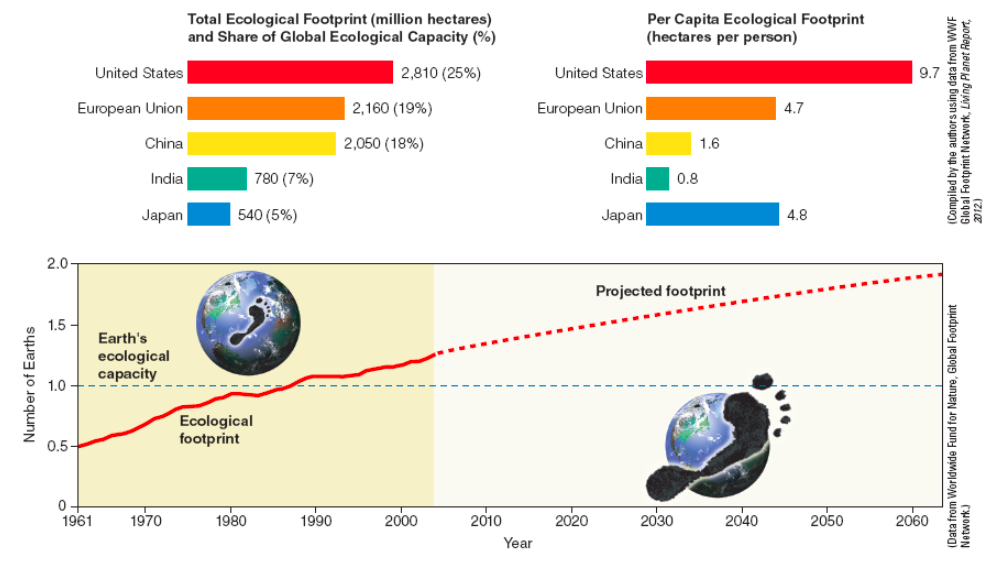
Understand ecological footprints, what they measure, the factors that contribute, etc.
Understand biocapacity
Know developed vs. developing countries (be able to give examples of countries)
Understand affluenza and its advantages/disadvantages
Examples of point vs. nonpoint pollution
Know the 3 major worldviews (environmental wisdom, stewardship, planetary management)
Know and be able to give examples of renewable vs. nonrenewable vs. perpetual resources
Difference between reusing and recycling
Understand the implications of poverty
Chapter 1 Practice Problems
1 point
1
Question 1
1.
Pollution from which of the following is an example of point source pollution?
1 point
1
Question 2
2.
Countries such as China increasingly have populations that are attaining a middle-class status. This has led to all of the following EXCEPT
Use the graphs below to answer the next four questions.
1 point
1
Question 3
3.
India's per capita ecological footprint is approximately
1 point
1
Question 4
4.
In the year 2000, what was the earth's ecological footprint?
1 point
1
Question 5
5.
All of the following ways would help reduce the projected ecological footprint EXCEPT
1 point
1
Question 6
6.
From the bar graph you can infer that Africa's ecological footprint is no greater than
1 point
1
Question 7
7.
Examples of the three principles of sustainability include:
1. Solar energy, which enables plants to photosynthesize and helps humans and helps humans produce electricity
2. Organisms and their ecosystems, the natural services they provide, and the ability of organisms to adapt to changes in their environment
3. Cultural changes such as the agricultural revolution and the industrial revolution, which in many ways enhanced human living conditions but had negative effects on the environment
4. The continuous cycling of chemicals, without which life would not exist
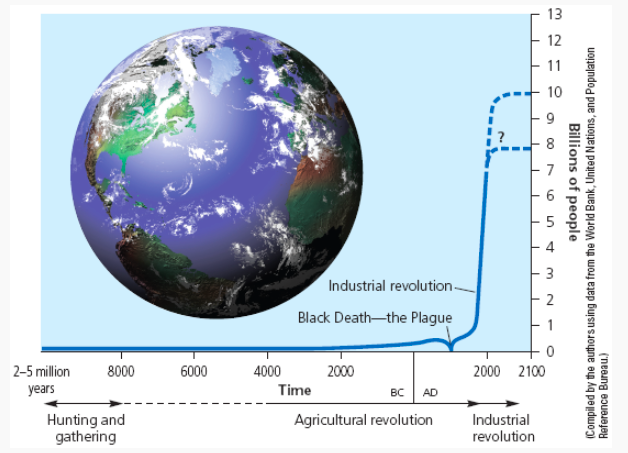
Use the graph at right to answer the next three questions.
1 point
1
Question 8
8.
In what year did the human population reach 6 billion?
1 point
1
Question 9
9.
The dotted line on the graph illustrates which type of growth?
1 point
1
Question 10
10.
Both dotted lines assume that population will
1 point
1
Question 11
11.
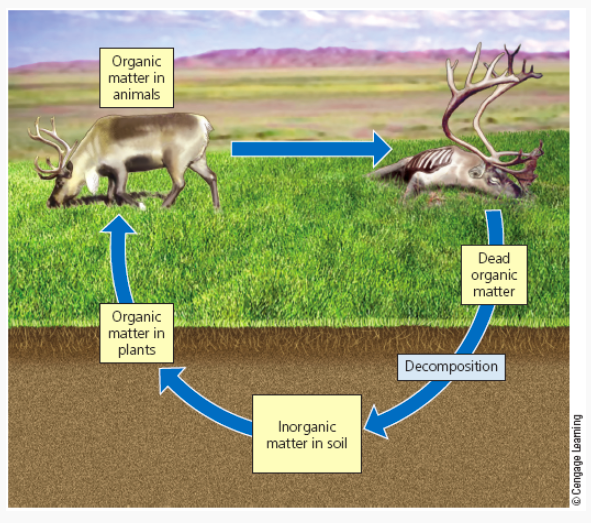
Refer to the figure to answer this question.
The figure illustrates
I. The conservation of energy.
II. A cycle.
III. The conservation of matter.
1 point
1
Question 12
12.
Solutions to environmental problems are not always easy. This is because
1 point
1
Question 13
13.
Which of the below is an example of the tragedy of the commons?
Chapter 25 Practice Questions
1 point
1
Question 14
14.
What one believes about what is right or wrong in our behavior toward the environment is
1 point
1
Question 15
15.
We will probably not run out of resources, but they should not be wasted best fits in which environmental worldview?
1 point
1
Question 16
16.
Which of the following is not a guideline for sustainable living?
1 point
1
Question 17
17.
The idea that science will solve all our problems best describes which mental trap?
1 point
1
Question 18
18.
All of the following are ways to attain a more sustainable world EXCEPT
1 point
1
Question 19
19.
Which of the below is NOT an economic tool that could be used to bring about a sustainable environmental revolution?
1 point
1
Question 20
20.
Which of the environmental worldviews below is incorrectly paired with its focus?
Science, Matter, Energy, and Systems – Chapter 2
Understand the basic chemistry review (matter, atoms, isotopes, pH)
Understand the basic biology review (organic compounds, cells)
Understand matter quality and energy quality including the Law of Conservation and the Laws of Thermodynamics
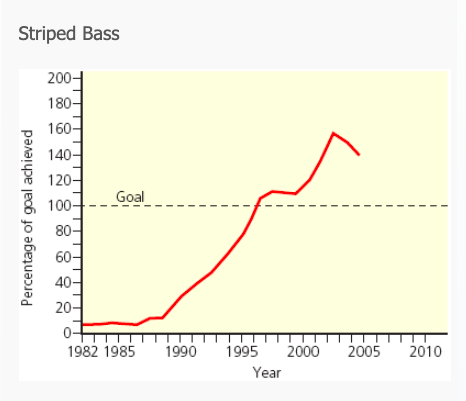
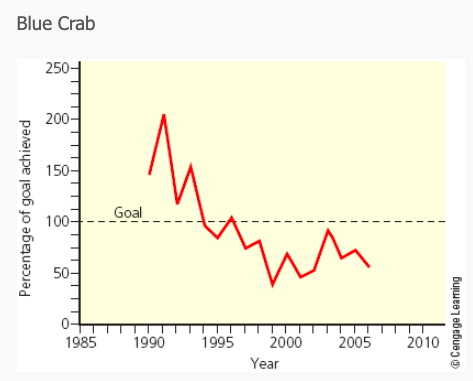
Use the graphs of the Chesapeake Bay, Maryland, striped bass and blue crab population data below to answer the next question.
1 point
1
Question 21
21.
What might be one possible reason for the greater fluctuations in the blue crab population?
1 point
1
Question 22
22.
Which of the below is an example of a high-quality energy source?
1 point
1
Question 23
23.
The energy you use to walk from point A to point B is a result of several energy transformations from one form to another beginning with energy from the sun. The net result of these transformations is
1 point
1
Question 24
24.
The warming of the oceans causing less carbon dioxide to be soluble in them, and at the same time leaving more carbon dioxide in the atmosphere causing an increased warming of the atmosphere, is an example of a
1 point
1
Question 25
25.
A scientist made the following statement in 2008:
“The striped bass Young of the Year (YOY) index for 2008, an annual measurement of the number of juvenile striped bass taken in the Marlyand portion of the Chasapeake Bay, is one of the lowest recorded since data was recorded beginning in 1990. The 2008 YOY index for striped bass was 3.2 while the long-term average is 11.7.” (Kennebec Journal Morning Sentinel; “CHesapeake striped bass population down for ‘08” 10/29/2008; http://morningsentinel.mainetoday.com/sports/stories/227216717.html)
This statement is an example of
1 point
1
Question 26
26.
Which of the below organic molecules is incorrectly paired with its function or role?
1 point
1
Question 27
27.
The installation of ice booms on the Niagara River may well have changed the erosion pattern along the river. The irreversible loss of an island from over 100 acres in size to less than 3 acres is an example of
The next five questions refer to the description of an experiment below.
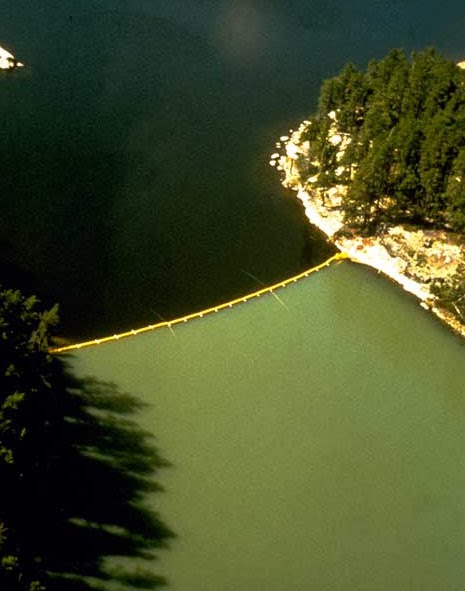
Ecologists designed an experiment to determine whether nitrates or phosphates are more limiting to algae growth. A lake in Canada (Lake 226) was divided into two equal-sized sections by a vinyl curtain. Each sub-basin of the lake was then fertilized, one with nitrates and carbon, and the other with phosphates, nitrates, and carbon. The amount of phytoplankton in the lake was then measured in each side, with the side of the lake with phosphates added showing a greater rate of phytoplankton growth.
1 point
1
Question 28
28.
Frequently, studies in nature are difficult to set up and may lack some aspects of more traditional laboratory based experiments. What element of this experiment could be considered to be lacking?
1 point
1
Question 29
29.
Which of the below is the independent variable in this experiment?
1 point
1
Question 30
30.
Identify the constants in this experiment.
1 point
1
Question 31
31.
Which of the below would be a valid hypothesis for this experiment?
1 point
1
Question 32
32.
What concept below best describes the process being studied in this experiment?
Ecosystems: What are They and How do They Work? – Chapter 3
Know the major components of an ecosystem (organisms, populations, communities, ecosystems, biosphere)
Understand trophic levels and the roles of organisms within trophic levels (producers, autotrophs, consumers, heterotrophs, primary consumers, secondary consumers, tertiary consumers, herbivores, carnivores, omnivores)
Understand the flow of energy through an energy pyramid (i.e. the 10% rule)
Understand food webs
Chapter 3 Practice Questions
1 point
1
Question 33
33.
A tipping point in the disappearance of the tropical rain forests would be
1 point
1
Question 34
34.
Which is NOT an important ecological role of insects?
The next four questions refer to the compounds listed below.
A. Nitrogen gas (N2)
B. Oxygen gas (O2)
C. Water (H2O)
D. Phosphate (PO43-)
E. Methane (CH4)
1 point
1
Question 35
35.
A greenhouse gas produced by raising cattle.
1 point
1
Question 36
36.
Can be stored in marine sediments for long periods of time.
1 point
1
Question 37
37.
A greenhouse gas emitted into the atmosphere through transpiration or evaporation.
1 point
1
Question 38
38.
A limiting factor for most plant growth in lakes and terrestrial systems.
1 point
1
Question 39
39.
Organisms live within a range of tolerance that determines where they live. Which of the below is NOT a range of tolerance?
1 point
1
Question 40
40.
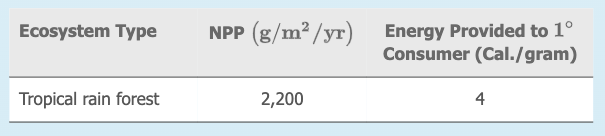
This question refers to the data in the table shown.
Applying the 10% rule, if a shrew living in a tropical rain forest has a daily requirement of 500 Cal., how many square meters of rain forest are needed to support one shrew that feeds only on snails which are primary consumers?
1 point
1
Question 41
41.
The end product(s) of the wood in a log being decomposed by fungi is
1 point
1
Question 42
42.
Which of the below is NOT a human intervention in the nitrogen cycle?
1 point
1
Question 43
43.
The phosphorus cycle includes all of the following EXCEPT it
Climate and Biodiversity/Aquatic Biodiversity - Chapters 7 & 8
Chapter 7:
Understand difference between weather and climate
Understand importance of natural greenhouse effect
Understand what factors influence biomes (temp, precip, latitude, elevation)
Major characteristics of each terrestrial biome
Know examples of human impact on biomes
Chapter 8:
Mutualistic symbiosis that make up coral reefs
Ecological/economic services of coral reefs
Threats to coral reefs & causes of coral bleaching
Ecological/economic services of both marine and freshwater ecosystems
Abiotic factors that influence aquatic ecosystems
Biotic factors and examples (plankton, nekton, benthos, decomposers)
Types of marine zones and their importance (coastal zone, estuaries, wetlands, marshes, seagrass beds, mangrove forests, intertidal zones, open ocean, deep ocean)
Human impact on the areas noted above
Be able to describe and identify on a diagram the zones for open ocean (photic, bathyal, abyssal)
Be able to describe/identify on a diagram the zones for freshwater ecosystems (littoral, limnetic, benthic)
Oligotrophic vs. eutrophic lakes
Be able to describe/identify zones of rivers and streams (source, transition, flood zones)
Chapter 7 Practice Questions
1 point
1
Question 44
44.
Long-term differences in which two variables are the primary determinants of climate?
1 point
1
Question 45
45.
Which of the below is an example of a change in weather?
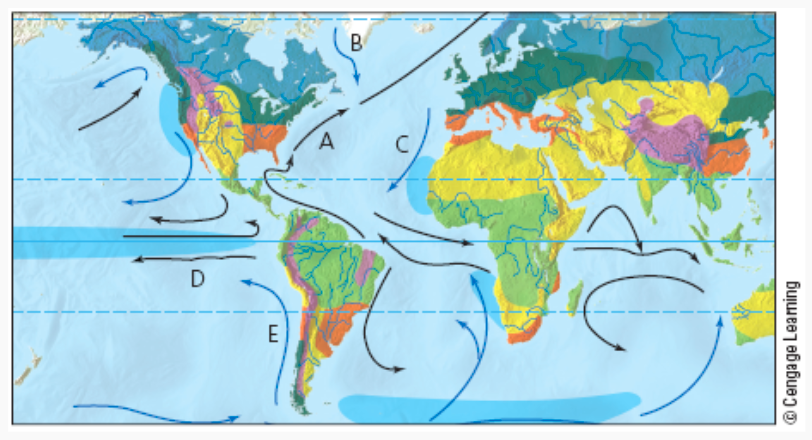
The next group of questions refer to this diagram of surface currents in the oceans. Indicate answer with the corresponding letter from the map.
1 point
1
Question 46
46.
A current responsible for moving heat away from the equator.
1 point
1
Question 47
47.
The reversal of this current is associated with ENSO events.
1 point
1
Question 48
48.
Cape Cod juts out from the Eastern coast of North America. This current keeps the waters off Cape Cod very cool.
1 point
1
Question 49
49.
This current causes offshore upwellings of nutrient rich water that is responsible for plankton rich waters sustaining a large anchovy fishery.
1 point
1
Question 50
50.
As one climbs a mountain, the elevation change causes a change in biomes. Which of the below is a change caused by elevation?
1 point
1
Question 51
51.
Which of the below is a true statement about biomes?
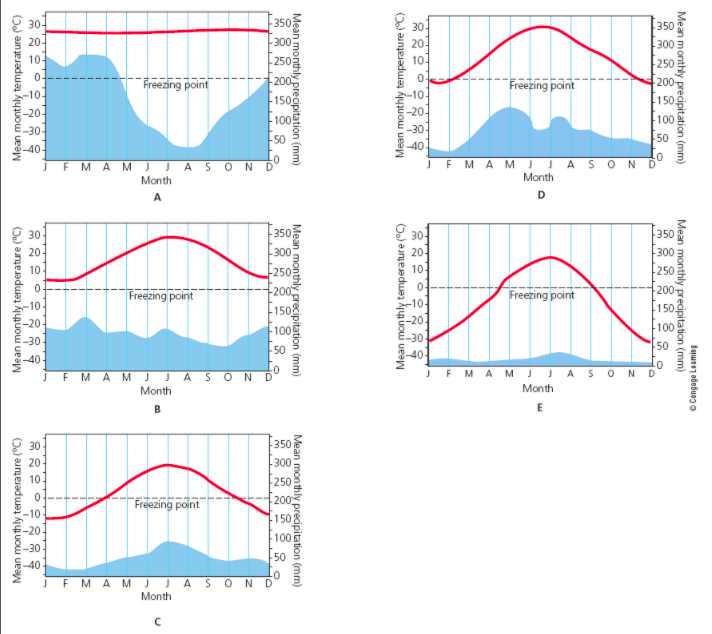
The next three questions refer to the climate graphs below. The red line represents temperature and the blue represents precipitation.
1 point
1
Question 52
52.
This biome is characterized by subfreezing temperatures much of the year, low precipitation rates, and the formation of permafrost.
1 point
1
Question 53
53.
This biome found in equatorial regions has large amounts of precipitation but has low levels of nutrients in the soil.
1 point
1
Question 54
54.
This biome often has snow, yet the average monthly temperature is always greater than the freezing point. Trees in this biome lose their leaves every fall, producing colorful displays.
1 point
1
Question 55
55.
Which of the below is NOT an adaptation found in plants living in the desert?
Chapter 8 Practice Questions
1 point
1
Question 56
56.
Which element below will be most helpful for reducing erosion from wave action to the coastline of an island in the ocean?
1 point
1
Question 57
57.
Zooplankton are animal larvae that
I. are primary consumers that feed on phytoplankton.
II. are secondary consumers that feed on other zooplankton.
III. are photosynthetic bacteria responsible for most of the ocean surface's primary productivity.
1 point
1
Question 58
58.
Which of the below factors is NOT a primary determining factor for whether an organism is found on the surface or in the middle of the water column in the ocean?
1 point
1
Question 59
59.
Which area below will have the lowest net primary productivity/km2?
1 point
1
Question 60
60.
The primary force responsible for tidal action is the
1 point
1
Question 61
61.
Which of the below is the correct path that a grain of sand would take as it is eroded from a mountain, carried downstream, and deposited on the ocean floor?
1 point
1
Question 62
62.
Where are photosynthetic organisms least likely to be found?
1 point
1
Question 63
63.
Which area of the oceans is most used by people for recreation?
The next four questions refer to the human impacts on ecosystems listed below. (Indicate with appropriate letter)
A. Coral reef damage
B. Overfishing
C. Coastal development
D. Cultural eutrophication from release of excess nutrients
E. Population growth and burning of fossil fuels
1 point
1
Question 64
64.
Causes large areas of little to no oxygen in the Chesapeake Bay and the Gulf of Mexico.
1 point
1
Question 65
65.
Causes large areas of beach loss or erosion or migration of beaches to new locations.
1 point
1
Question 66
66.
Caused by boats improperly anchoring.
1 point
1
Question 67
67.
Causes ocean warming and pH reduction, leading to coral bleaching.
UNIT 2: BIODIVERSITY
Biodiversity and Evolution - Chapter 4
And Sustaining Biodiversity - Chapter 9
Understand the components of biodiversity
Functional diversity
Genetic diversity
Ecological diversity
Species diversity
Understand & be able to interpret the indices use to measure biodiversity
species richness
species evenness
Understand the Theory of Evolution by natural selection (mutations, adaptations, fitness in environment)
Understand how species evolve (speciation, geographic isolation, reproductive isolation)
Convergent vs. divergent evolution
Understand difference between background extinction and mass extinction
Understand how evolution & extinction affects biodiversity
Generalist vs specialist species
Roles that species play (native, nonnative, indicator, keystone, foundation)
Understand GPP and NPP and be able to do associated calculations
Chapter 9:
Economic/Ecological Role of honeybees, pollination
Difference between different kinds of extinction: Biological, mass extinction, background extinction.
Difference between endangered/threatened; extirpation
Benefits of species diversity and ecosystem services
HIPPCO and what each letter means
Invasive species: causes, dangers, prevention
Island Biogeography
National/International treaties to protect species
Roles and limitations of refuges/zoos and other conservation strategies
What is the precautionary principle?
Principles of sustainability applied to protecting biodiversity
Chapter 4 Practice Questions
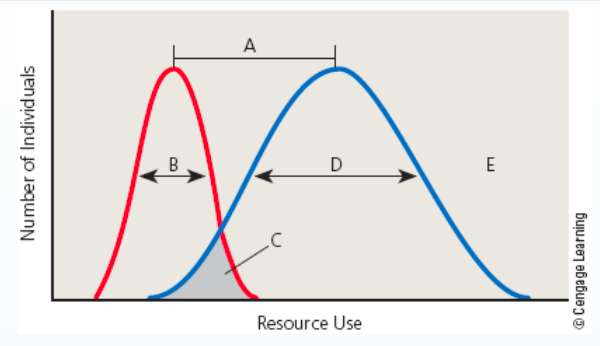
The next three questions refer to this diagram.
1 point
1
Question 68
68.
Which part of the diagram depicts the resource use that would be in competition if a new species moves into an area and is in direct competition with another species?
1 point
1
Question 69
69.
The niche of the black bear which is an omnivore would be best represented as which letter?
1 point
1
Question 70
70.
The area under the curve depicted by letter B would be best described as
1 point
1
Question 71
71.
Which of the choices below is the best summary of evolution?
1 point
1
Question 72
72.
Keystone species such as alligators in the Southeast U.S. have an important role and effect on their environment through
The next four questions refer to the terms below.
A. indicator species
B. keystone species
C. foundation species
D. native species
E. specialist species
1 point
1
Question 73
73.
As pollution levels in streams rise, many aquatic insects such as the mayfly quickly disappear. For this reason, many aquatic insects are studied intensively.
1 point
1
Question 74
74.
The beaver transforms its environment from streams to ponds and swamps, allowing a diverse collection of organisms to thrive that would not normally be able to survive.
1 point
1
Question 75
75.
Kelp (a brown algae) forms large beds, creating a habitat for many fishes and shellfishes.
1 point
1
Question 76
76.
The Chitymomma is an Agave that regionally helps or is used to define the Chihuahuan Desert of Northern Mexico and the Southwestern United States.
1 point
1
Question 77
77.
Protists are best described as
1 point
1
Question 78
78.
Which of the below are mechanisms of speciation?
I. Reproductive isolation
II. Mutation
III. Natural selection
1 point
1
Question 79
79.
The best example of an endemic species is
Chapter 9 Practice Questions
1 point
1
Question 80
80.
Introduced species often become pests because they
1 point
1
Question 81
81.
The biggest threat to biodiversity is
1 point
1
Question 82
82.
The sale of a large forest to a developer causing the building of roads, logging, and urban development would most likely lead to
1 point
1
Question 83
83.
Which of the following would prevent invasive species from being introduced and becoming established?
I. Inspect foreign goods before they enter the country.
II. Allow ships to discharge their ballast water as they enter the port.
III. Establish international treaties banning the transfer of species across borders.
1 point
1
Question 84
84.
Match the legislative actions below with what they established legally.
Draggable item
arrow_right_alt
Corresponding Item
The National Environmental Policy Act (NEPA) - 1970; requires federal agencies to assess the environmental effects of their proposed actions prior to making decisions.
arrow_right_alt
Endangered Species Act (ESA)
Bans the hunting, capturing, and selling of threatened or endangered species in 178 countries
arrow_right_alt
The Convention on International Trade in Endangered Species (CITES)
National policy to prevent marine mammal species and population stocks from declining beyond the point where they ceased to be significant functioning elements of their ecosystems.
arrow_right_alt
The National Marine Fisheries Act
Legally commits participating governments to reducing global rate of biodiversity loss and equitably share benefits from use of world's genetic resources, ratified/accepted by 193 countries
arrow_right_alt
National Environmental Policy Act (NEPA)
Protect and recover imperiled species and the ecosystems upon which they depend; National Act passed in 1973 in US.
arrow_right_alt
The Marine Mammal Protection Act
Magnuson-Stevens Fishery Conservation and Management Act (MSA), 1976 to establish federal management of the nation’s fisheries and restrict fishing activities in U.S. waters.
arrow_right_alt
Endangered Species Act
1 point
1
Question 85
85.
Biological extinction occurs when
1 point
1
Question 86
86.
Most extinction experts believe that the extent of biodiversity loss will increase over the next 50 to 100 years because of
1 point
1
Question 87
87.
The giant panda is prone to ecological and biological extinction because of all of the following reasons EXCEPT
1 point
1
Question 88
88.
The best example of biomagnification is
The next three questions refer to the following choices:
a. Habitat destruction, degradation, and fragmentation
b. Invasive (nonnative) species
c. Population and resource use growth
d. Greenhouse effect
e. Overexploitation
1 point
1
Question 89
89.
Sale of exotic pets and decorative plants
1 point
1
Question 90
90.
Logging, mining, building of roads, and urban
development
1 point
1
Question 91
91.
No natural predators, generalist, and high reproductive rate
UNIT 3: POPULATIONS
Biodiversity, Species Interactions, and Population Control - Chapter 5
Know and understand examples of species interactions (competition, predation, parasitism, mutualism, commensalism)
Understand how species avoid competition (niches, resource partitioning)
Understand difference between fundamental and realized niche
Understand predator-prey relationships including adaptations and coevolution
Understand and differentiate between primary ecological succession and secondary ecological succession
Population Dynamics - Chapter 5 (cont from previous unit)
Understand what limits population size
Density dependent limiting factors vs. density independent limiting factors
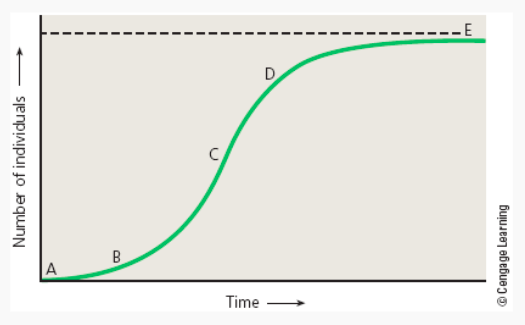
Understand J-shaped and s-shaped curves and carrying capacity
r-selected vs. K-selected species
Understand cycles of population booms and crashes (think of your hare/lynx lab)
Understand survivorship curves
Chapter 5 Practice Questions
The next group of questions refer to the species interactions below.
a. Interspecific competition
b. Predation
c. Parasitism
d. Mutualism
e. Commensalism
1 point
1
Question 92
92.
Three species of grasses compete for sunlight in a grassy lawn.
1 point
1
Question 93
93.
A species of ant living in the thorns of the Acacia tree protects the tree from herbivores and feed off of lipid rich food-bodies on the tree.
1 point
1
Question 94
94.
Barnacles adhering to the skin of a whale. The barnacle benefits by being transported to new sources of food and the presence of barnacles does not appear to hamper or enhance the survival of the animals carrying them.
1 point
1
Question 95
95.
Chipmunks, squirrels, and other animals eat the pine nuts that pine trees produce.
1 point
1
Question 96
96.
A species of pseudoscorpion disperses by concealing itself under the wings of large beetles. The pseudoscorpions gain the advantage of being dispersed over wide
areas while being protected from predators. The beetle is unaffected by the presence of the hitchhikers.
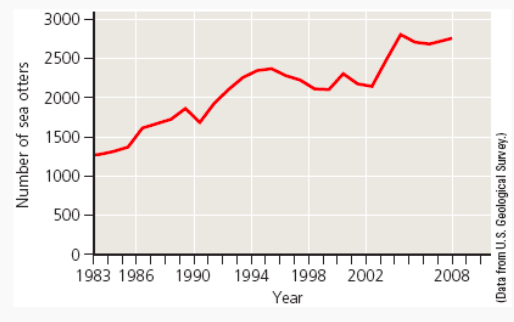
The next two questions refer to the graph below of an otter population off the coast of California.
1 point
1
Question 97
97.
What generalized trend can be made from 1983 to
2007 from this graph?
1 point
1
Question 98
98.
What is the percent change in the otter population
from 1995 to 2000?
1 point
1
Question 99
99.
Which of the following is a good example of coevolution?
1 point
1
Question 100
100.
Which of the following has NOT contributed to the explosion of the white-tailed deer population?
1 point
1
Question 101
101.
Which point on the curve above reflects the selection most like that of an elephant, a K-selected species that has reached its carrying capacity?
1 point
1
Question 102
102.
Which of the below is undergoing secondary succession?
1 point
1
Question 103
103.
Which of the below is an example of density dependent population control?
1 point
1
Question 104
104.
When does a tipping point occur?
Human Population and Its Impact – Chapter 6
U.S. population size (330 million)
World population size (7.9 billion as of Nov. 2021)
Carrying capacity vs. cultural carrying capacity
Population Growth Rate (PGR) - % PGR = (birth rate – death rate)/10
Population Change = (births + immigration) – (deaths + emigration)
Understand the Rule of 70 and how to use it
Crude birth and death rates are based per 1,000 people in a population
Understand/be able to interpret population age structures
General population dynamics in developing vs. developed countries
Concerns with aging populations
Demographic transition stages and be able to interpret demographic transition chart
Solutions to population size (family planning, women’s rights/education, reducing poverty)
Chapter 6 Practice Questions
1 point
1
Question 105
105.
A medium population growth projection calls for a population of 9.3 billion people in 2050 up from the current population of 7.5 billion. What percent increase is this?
1 point
1
Question 106
106.
In 1798 Thomas Malthus hypothesized the collapse of the human population. What factor proved Malthus wrong and led to the continued increases in the human population?
1 point
1
Question 107
107.
The infant mortality rate is NOT
1 point
1
Question 108
108.
Why is replacement-level fertility slightly higher than two children per couple?
1 point
1
Question 109
109.
One of the most important factors in helping to stabilize a developing country's population and reducing environmental degradation is to
1 point
1
Question 110
110.
Which of the below is an example of a positive use of nature's natural capital?
1 point
1
Question 111
111.
Which of the below is the correct order of demographic transition states that a country experiences when industrializing?
1 point
1
Question 112
112.
Which of the below has been utilized in both India and China to attempt to reduce population growth rates?
1 point
1
Question 113
113.
UNIT 5: LAND AND WATER USE
Food Production and the Environment - Chapter 12
Undernutrition vs. malnutrition vs. overnutrition and effects
Environmental effects of industrialized agriculture
Pros/cons of GMOs, organic agriculture, Animal feedlots, Chemical pesticides
1st Green revolution & 2nd Green revolution
Gene revolution (GMOs)
Integrated Pest Management (IPM)
Regenerative farming
What is it?, Examples of practices, Climate benefit
Soil
Identify and know the properties of different soil horizons
Identify and know the properties of soil components
Clay, Silt, Sand
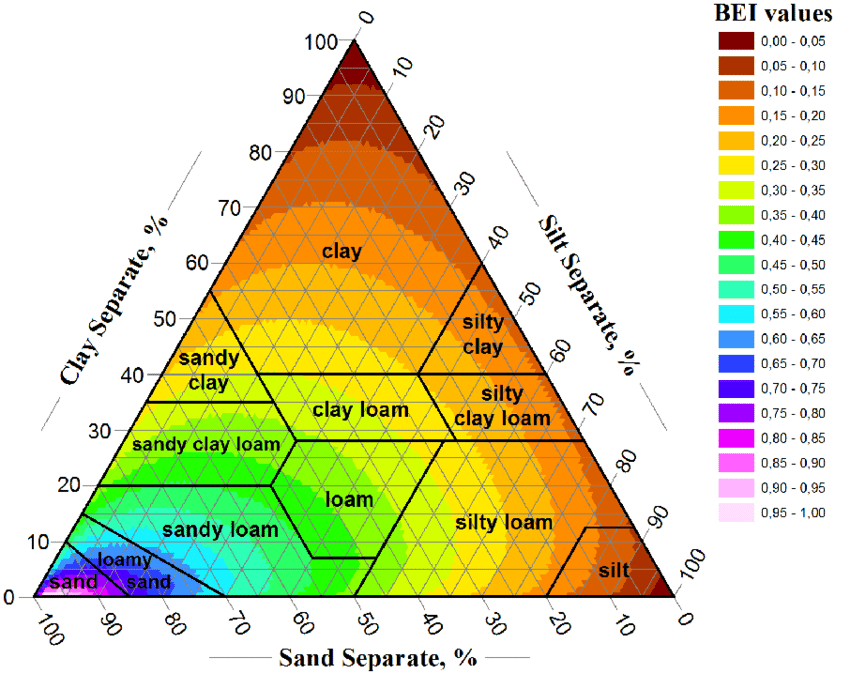
Be able to use the Soil Texture Triangle
Chapter 12 Practice Questions
1 point
1
Question 114
114.
Industrialized meat production has harmful environmental consequences. These include all of the following EXCEPT
1 point
1
Question 115
115.
Which of the following techniques helps to limit soil erosion?
1 point
1
Question 116
116.
Which best describes genetically modified crops (GMOs)?
1 point
1
Question 117
117.
One way that farmers can help to reduce soil erosion is by using soil conservation methods. Which of the following is an example of a soil conservation method?
Use this soil triangle to determine the following soil types based on %'s of clay, sand and silt.
1 point
1
Question 118
118.
Sample #1:
clay: 45%, silt: 45%, sand: 10%?
1 point
1
Question 119
119.
Sample #2:
clay: 20%, silt: 45%, sand: 35%?
1 point
1
Question 120
120.
Sample #3:
clay: 15%, silt: 80%, sand: 5%?
1 point
1
Question 121
121.
Which of the following would be a disadvantage to using pesticides?
1 point
1
Question 122
122.
Which is the best example of persistence?
1 point
1
Question 123
123.
The following practices are used to grow organic crops EXCEPT
1 point
1
Question 124
124.
A method of using biological control to control pests is to
1 point
1
Question 125
125.
The goal of integrated pest management is to
1 point
1
Question 126
126.
One way to successfully incorporate genetic engineering is to
1 point
1
Question 127
127.
All of the following are true about aquaculture EXCEPT
1 point
1
Question 128
128.
A more sustainable form of meat production is to
Water Resources - Chapter 13
Distribution of Earth’s water and freshwater availability - largest to smallest sources
Groundwater - zone of saturation, water table, aquifers (natural recharge vs. lateral recharge)
Surface water - watershed delineation, surface runoff, reliable runoff
Human water usage - domestic, agricultural, virtual water
Freshwater shortages
Causes
Locations - uneven global distribution of water resources
Problems with using groundwater - over pumping aquifers, etc.
Expanding surface water resources -
Dams/reservoirs, advantages vs disadvantages
Water Transfer - Aral Sea Case Study
Desalination
How can we use freshwater more sustainably? - agriculture, industry, homes
Threat of flooding - can we reduce the risks?
Chapter 13 Practice Questions
1 point
1
Question 129
129.
Approximately what percentage of the water on the earth is saltwater?
1 point
1
Question 130
130.
A drought in the 1930s transformed large parts of the Midwest into a "Dustbowl." This is an example of
1 point
1
Question 131
131.
One way to conserve water in agriculture is to
1 point
1
Question 132
132.
The Ogallala Aquifer is a one-time deposit of water and has such a slow recharge rate it is
1 point
1
Question 133
133.
The Colorado River project is
The next four questions refer to the following terms. Indicate choice with the appropriate letter.
A. Aquifer
B. Surface water
C. Confined aquifer
D. Water table
E. Transpiration
1 point
1
Question 134
134.
The freshwater from precipitation and snowmelt
1 point
1
Question 135
135.
Evaporation from the leaves of plants into the atmosphere
1 point
1
Question 136
136.
Underground caverns and porous layers of sand, gravel, or bedrock through which groundwater flows
1 point
1
Question 137
137.
Upper surface of the zone of saturation
1 point
1
Question 138
138.
A forested hillside will help eliminate
1 point
1
Question 139
139.
One method of desalination is
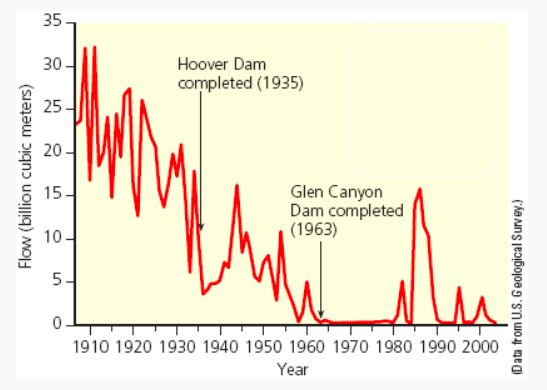
Use the graph to answer the next three questions.
1 point
1
Question 140
140.
According to the graph, the flow of the Colorado River has
1 point
1
Question 141
141.
What is a possible explanation about the flow of the Colorado from 1960 to 1980?
1 point
1
Question 142
142.
Which of the following best explains the general downward trend in Colorado River flow from 1910 until 1970?