1
1
1
How many teaspoons of drink mix should be used with 3 cups of water?
How many teaspoons of drink mix should be used with 3 cups of water?
1
1
1
1
1
Find the value of each product mentally.
How many teaspoons of drink mix should be used with 3 cups of water?
How can we tell that 4:1 and 12:3 are equivalent ratios?
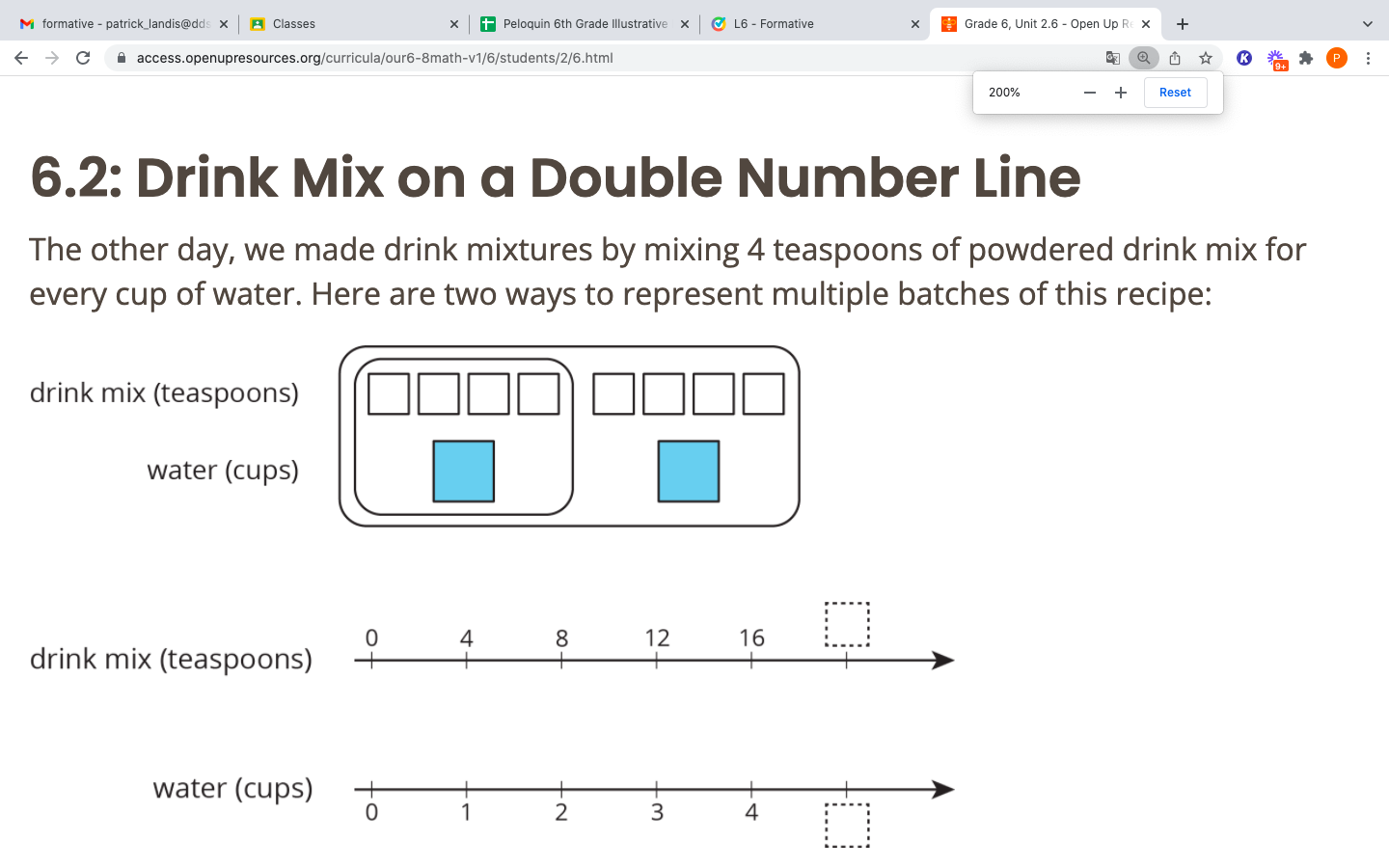
How are these representations the same?
How are these representations different?
How many cups of water should be used with 16 teaspoons of drink mix?
What numbers should go in the empty boxes on the double number line diagram?
___ and ___
What do these numbers mean?
Recall that a perfect square is a number of objects that can be arranged into a square. For example, 9 is a perfect square because 9 objects can be arranged into 3 rows of 3. 16 is also a perfect square, because 16 objects can be arranged into 4 rows of 4. In contrast, 12 is not a perfect square because you can’t arrange 12 objects into a square.
How many whole numbers starting with 1 and ending with 100 are perfect squares?
What about whole numbers starting with 1 and ending with 1,000?
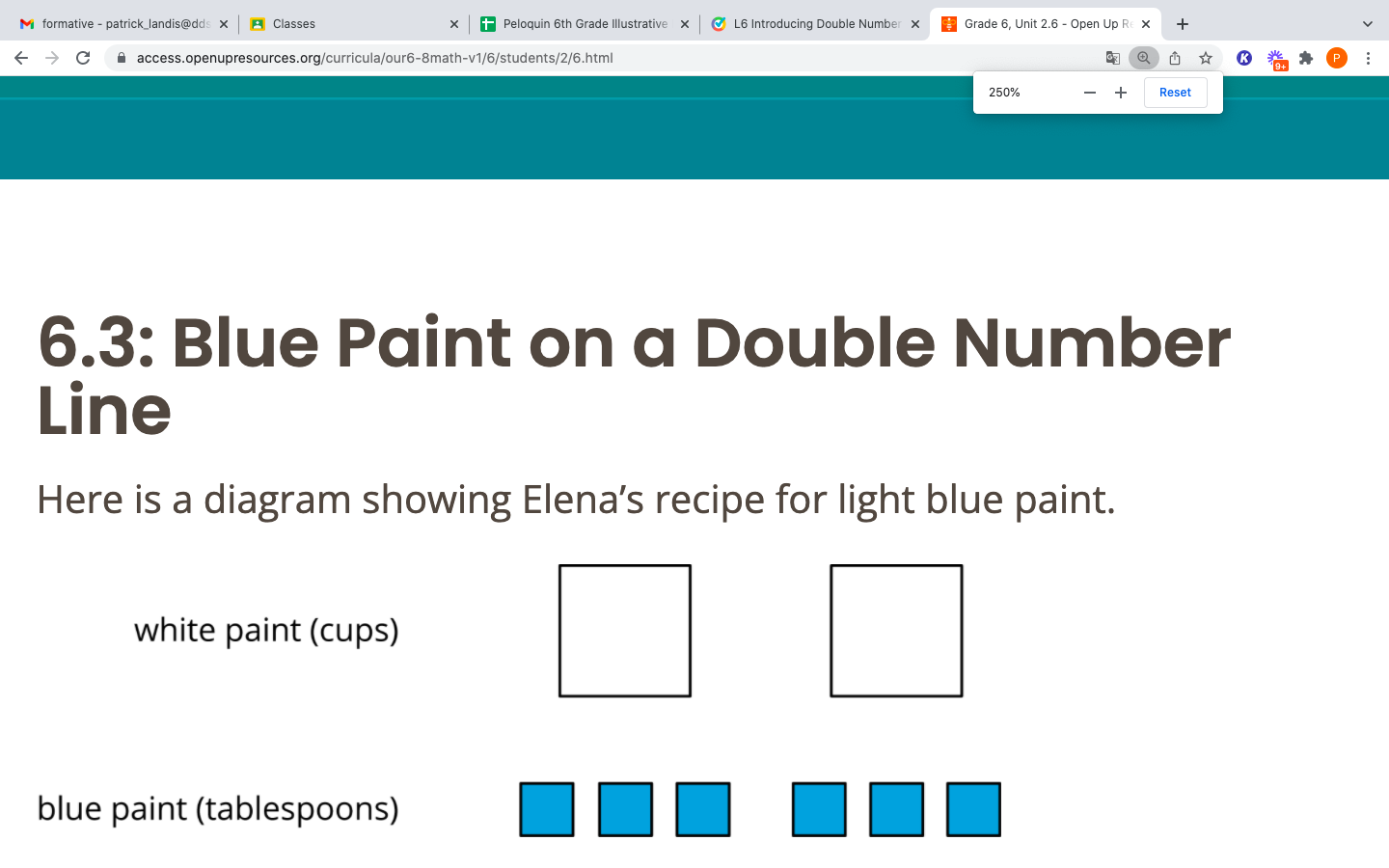
Complete the double number line diagram to show the amounts of white paint and blue paint in different-sized batches of light blue paint.
Compare your double number line diagram with your partner. Discuss your thinking. If needed, revise your diagram.
How many cups of white paint should Elena mix with 12 tablespoons of blue paint?
How many batches would this make?
How many tablespoons of blue paint should Elena mix with 6 cups of white paint?
How many batches would this make?
Use your double number line diagram to find another amount of white paint and blue paint that would make the same shade of light blue paint.
___ white to ___ blue
How do you know that these mixtures would make the same shade of light blue paint?
Complete the double number line to show the amount of flour and vanilla for 1, 2, 3, 4 and 5 batches of cookies
If you use 20 cups of flour, how many teaspoons of vanilla should you use?
If you use 6 teaspoons of vanilla, how many cups of flour should you use?