Log in
Sign up for FREE
arrow_back
Library

ECC 1.4

star
star
star
star
star
Last updated about 3 years ago
23 questions
Objective and Slides
Part 1
Part 2
Part 3
1
1
1
1
1
1
1
1
0
1
Part 4
Part 5
2
Finished Early?
Testing Changes to the Atmosphere

Objective: KWBAT test changes to the atmosphere in order to observe how they change the amount of energy absorbed by Earth’s surface.
Welcome back climatologists! Yesterday you explored the SIM for evidence as to what is causing ice to melt on Earth’s surface. You discovered that when more ice is melting on Earth’s surface, the amount of energy absorbed by Earth’s surface increases. Today we will investigate ideas about what kinds of changes to the atmosphere can affect how much energy is absorbed by Earth’s surface. Now that we know energy is involved in the rising global temperatures and melting ice, we can finally answer the question of: Why is the ice on Earth’s surface melting? To do this we must learn more about our atmosphere and what is in it!

Part 1: Do Now

0
0

Part 2: How do Greenhouse gasses actually work?

Question 3
00:01
keyboard_arrow_down
0
Questions 4 & 5
00:46
keyboard_arrow_down
1
1

Part 3: Investigation of Changing Gases in Atmosphere

Goal: Use the SIM to investigate the claim about changing gases in our atmosphere.

Carbon Dioxide

Question 6
6.
When I INCREASED (+) Carbon Dioxide….
  • energy absorbed by the surface: __________
  • temperature: __________
  • the amount of ice: __________
Question 7
7.
When I DECREASED (-) Carbon Dioxide….
  • energy absorbed by the surface: __________
  • temperature: __________
  • the amount of ice: __________

Methane

Question 8
8.
When I INCREASED (+) Methane….
  • energy absorbed by the surface: __________
  • temperature: __________
  • the amount of ice: __________
Question 9
9.
When I DECREASED (-) Methane….
  • energy absorbed by the surface: __________
  • temperature: __________
  • the amount of ice: __________

Sulfur Dioxide

Question 10
10.
When I INCREASED (+) Sulfur Dioxide….
  • energy absorbed by the surface: __________
  • temperature: __________
  • the amount of ice: __________
Question 11
11.
When I DECREASED (-) Sulfur Dioxide….
  • energy absorbed by the surface: __________
  • temperature: __________
  • the amount of ice: __________

Nitrogen Dioxide

Question 12
12.
When I INCREASED (+) Nitrogen Dioxide….
  • energy absorbed by the surface: __________
  • temperature: __________
  • the amount of ice: __________
Question 13
13.
When I DECREASED (-) Nitrogen Dioxide….
  • energy absorbed by the surface: __________
  • temperature: __________
  • the amount of ice: __________
Question 14
14.

Synthesize: Based on your data, do all gases have the same effect on the amount of energy absorbed by earth’s surface?

Question 15
15.
Investigation Claim: A change to any gas in the atmosphere affects energy absorbed by the surface in the same way.

I __________ with the investigation claim. After completing the 4 gas trials in the SIM, I found that all gases __________affect the amount of energy absorbed by Earth’s surface in the same ways. Therefore, this claim is __________ by my data.

Part 4: Reading "A Hole in the Ozone"

1
0
Question 17
17.

Find a quote that answers this question:

What purpose does ozone serve to humans?

0
0
Question 19
19.

Find a quote that answers this question:

What causes Global Climate Change?

1
0

Part 5: Exit Ticket

Question 22
22.
When the amount of carbon dioxide or methane in the atmosphere changes, the amount of energy absorbed by the surface also changes.

When the amount of carbon dioxide or methane _______ , energy absorbed by the surface increases.
When the amount of carbon dioxide or methane _______ , energy absorbed by the surface decreases.
0
Question 23
23.


Question 1
1.

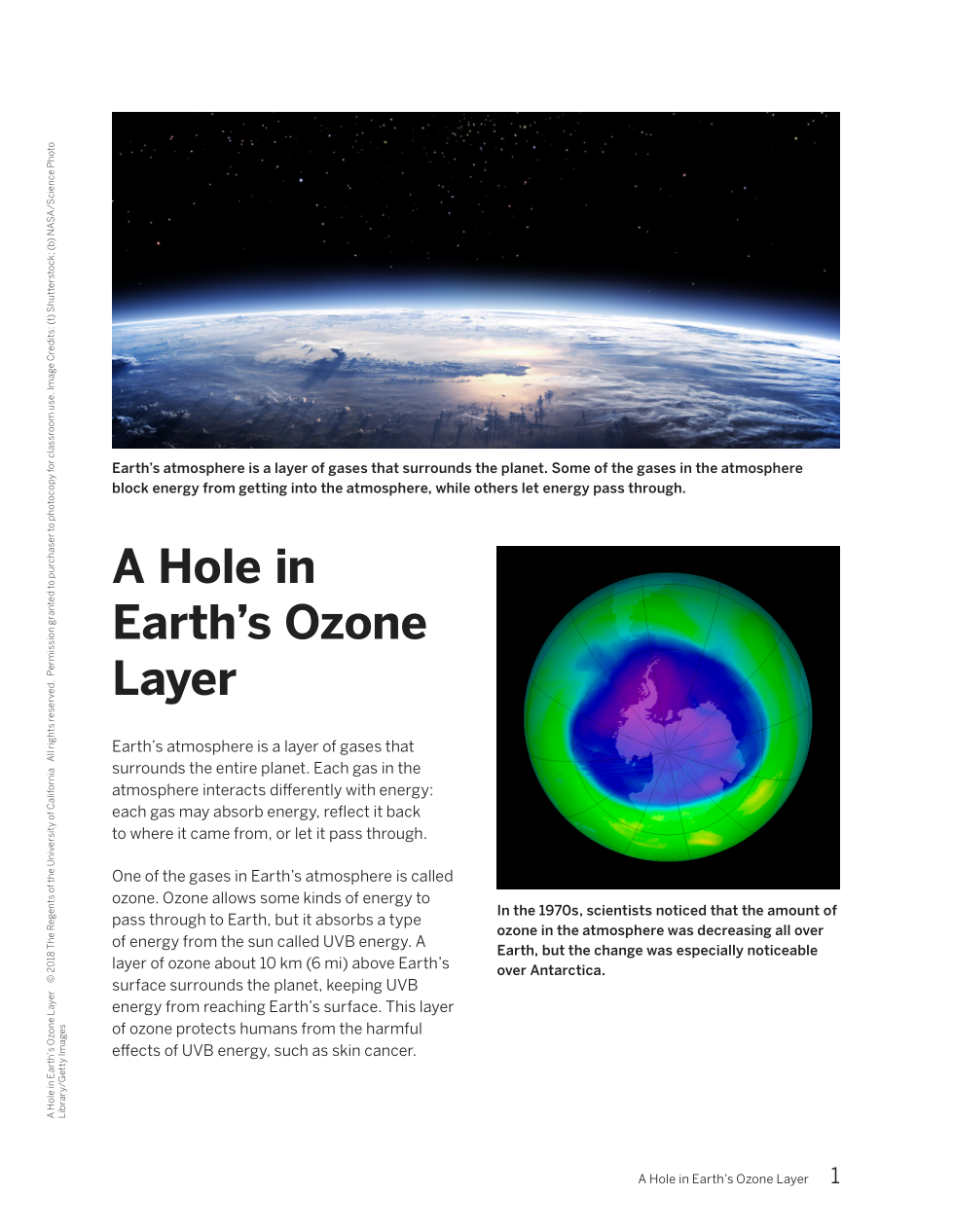
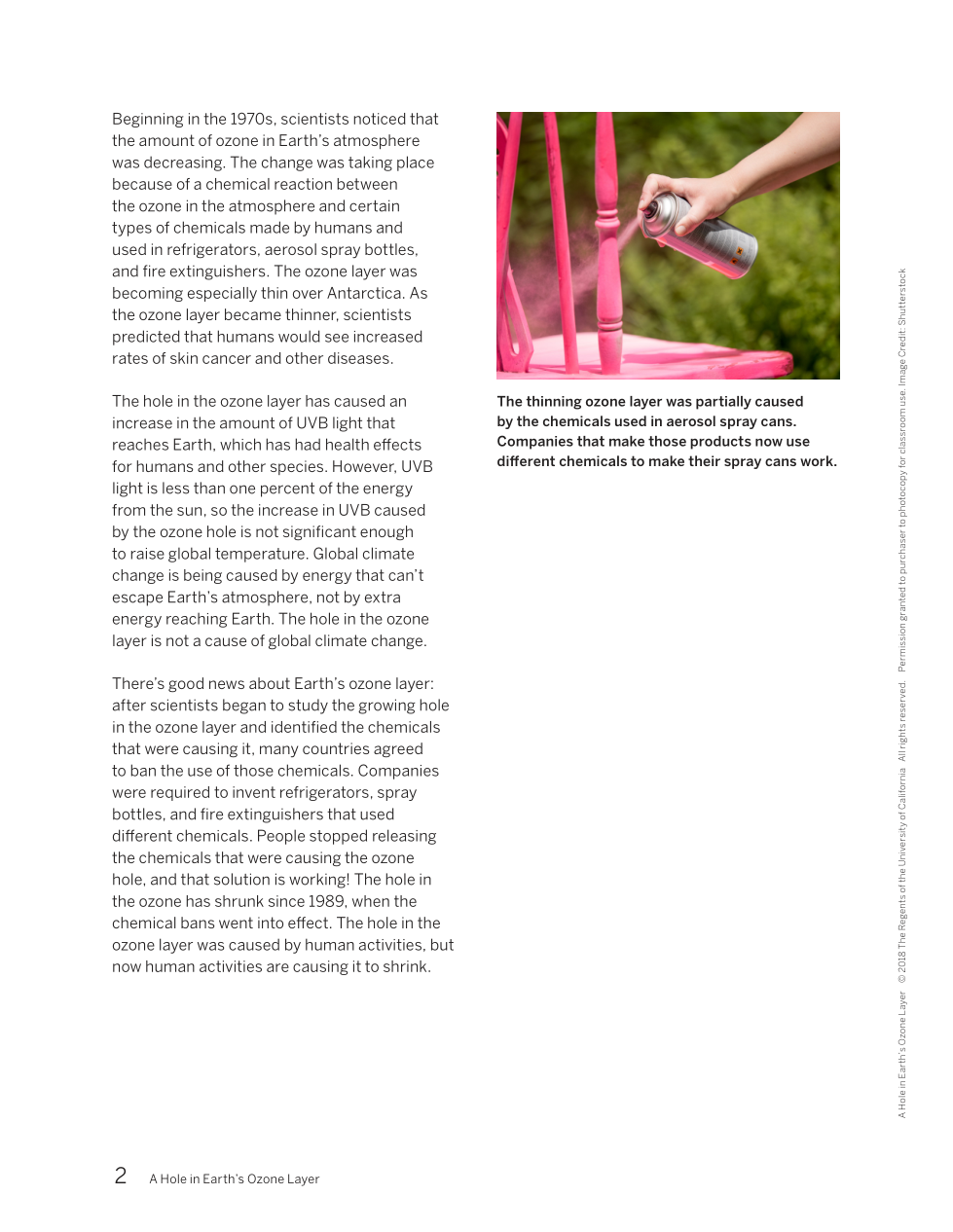
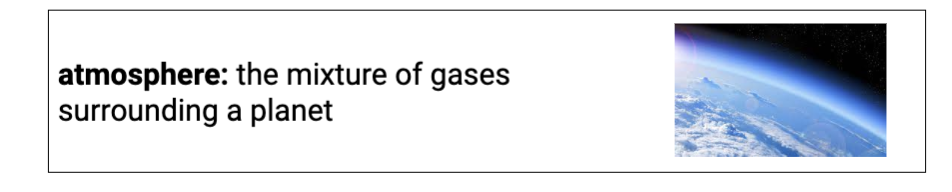
The Earth’s atmosphere is about 480 km (300 miles) thick and surrounds Earth.

What is Earth’s atmosphere made of? If you’re unsure, take your best guess!

Question 2
2.

Why do you think our atmosphere is so important to life on planet Earth?
Question 3
3.

What do you already know about greenhouse gasses?

Question 4
4.

Question 5
5.

SIM DIRECTIONS
  1. Open the ECC Simulation and press play, to run it for 20 seconds.
  2. Increase (+) the Carbon Dioxide to 500.
  3. Run the test until the timer reaches 40 seconds.
  4. Observe the temperature, amount of ice, and yellow glow of absorbed energy.
  5. Record your results in the tables below highlighting your answers. Either increase/decrease/no change.
  6. Reset the SIM.
  7. Repeat steps 1-7 but now decrease the Carbon dioxide down to 0.
Record your results, then REPEAT this entire process again for the 3 other remaining gases!
Question 16
16.

Question 18
18.

Why do you think that the amount of ozone in the atmopshere was decreasing?

Question 20
20.

Question 21
21.

What caused the hole in the ozone layer?

After science class one day, your friend texts you saying, “We will always need carbon dioxide in our atmosphere because that is one part of how plants produce their own food, through photosynthesis. And besides, animals including us breathe it out --so it can’t be all that bad!”


Criteria For Success
  • 2-3 complete sentences using appropriate science vocabulary
  • Answer explains what changes happen to global temperature and surface ice
  • Answer explains what changes happen to the amount of energy absorbed by Earth’s surface
Word Bank
  • absorb
  • atmosphere
  • carbon dioxide
  • decrease
  • energy
  • ice
  • increase
  • methane
  • surface
  • temperature
Using what you know and discovered today in the SIM, write a short reply to your friend telling them about what happens to the amount of energy absorbed by Earth, global temperature, and surface ice when there is a large increase of carbon dioxide in our atmosphere.

You may instead draw a visual representation of this answer as long as you label each part.
Infrared radiation is...
heat
energy
temperature
light
Most molecules in the atmosphere are made up of fast-moving liquid molecules.
True
False
What are the ways each gas can interact with energy? Select all that apply.
combine the energy
let it pass through
destroy the energy
may absorb energy
may reflect energy
The hole in the ozone layer is not a cause of global climate change.
True
False