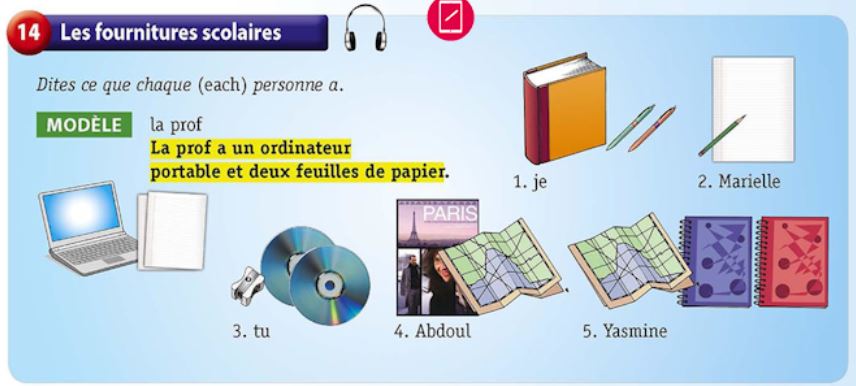
1
1. je ...
1. je ...
1
2. Marielle ...
2. Marielle ...
1
tu ...
tu ...
1
Abdoul ... (poster and map)
Abdoul ... (poster and map)
1
Use your notes to complete the following exercises. Most will automatically count you wrong or right. I can override "wrong" answers that are actually right, but many answers here have limited options.
Use your notes to complete the following exercises. Most will automatically count you wrong or right. I can override "wrong" answers that are actually right, but many answers here have limited options.
What does "AVOIR" mean?
What does "Qu'est-ce que tu as?" mean?
I have an eraser.
You (inf.) have a pen.
He has a flash drive.
We have some binders.
You (formal) have some cell phones.
They (fem) have some pencils and some erasers.
1. je ...
2. Marielle ...
tu ...
Abdoul ... (poster and map)
To talk about needing something (rather than having something), we use the avoir expression "avoir besoin de" (to have need of). The word "de" (of) reacts to different words near it (like "a" versus "an" in English). Here is how it works with un/une/des:
de + un = d'un
de + une = d'une
de + des = des
For example, j'ai besoin d'une gomme. (I have need of an eraser. / I need an eraser.)
Refer to your notes to help translate these sentences.
I need a pencil.
You (inf.) need a pencil pouch.
She needs a piece of paper.
We need some books.
You (for.) need (some) calculators.
They (m.) need a back pack.
Yasmine ... (map and notebooks)